

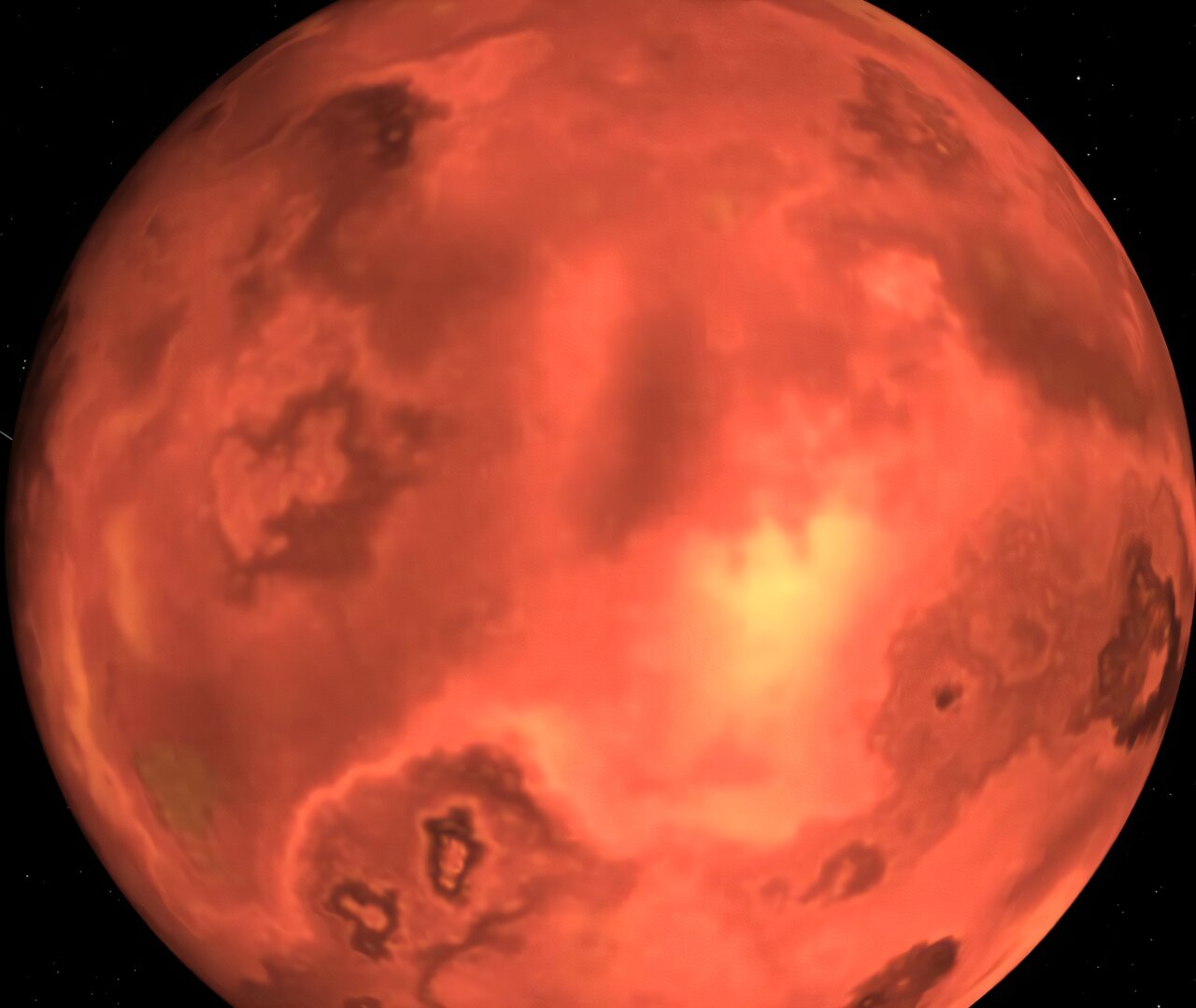
Scientists used the James Webb Space Telescope to study the exoplanet GJ 3929b. It was discovered in 2022. It was assumed that this world could be suitable for life, but now it is known that it is completely devoid of atmosphere.
Planets with no atmosphere
The James Webb Space Telescope is not only one of the most powerful, but also one of the most versatile instruments in modern astronomy. However, there is one area of application that it was originally intended for, and it was there that an important, but not very optimistic, discovery was recently made.
This involves spectroscopic research into the atmospheres of exoplanets in search of signs of life or at least an environment suitable for its existence. It was expected that James Webb would perform this work in tandem with the TESS satellite. According to the plan, the second was supposed to find a bunch of potentially habitable planets, and the first was supposed to check their gas envelopes.
This was the case with the planet GJ 3929 b. TESS discovered it in 2022, and at the same time, its parameters were estimated: 0.43 times the mass of Earth and 1.15 times its radius. This indicated that it could be Earth-like, with an atmosphere in which signs of life could be detected. However, James Webb’s data indicates that there is simply nothing to explore there. No gas envelope with a pressure greater than 10 millibars has been detected.
Shoreline
The result obtained is very important given the nature of the star GJ 3929. It is a red dwarf located 52 light years from Earth. Such stars make up 75% of all stars in the Galaxy, they remain on the main sequence for a very long time and have narrow habitable zones where it is easy to find a planet.
Red dwarfs would be the best candidates for finding Earth’s twin. However, these stars exhibit increased explosive activity, raising concerns that over billions of years, the planet in the potentially habitable zone will simply lose its atmosphere and hydrosphere.
Other researchers disagreed with this, and as a result of scientific disputes, a modern compromise emerged — the so-called shoreline theory. It describes the boundary on the diagram combining the required gas loss rate and the level of insolation. On one side of this line are barren, rocky worlds, and on the other are Earth-like planets.
The only question is that this line can be drawn in three different ways. But no matter how you look at it, GJ 3929 b will still end up on the side where no atmosphere can exist. Therefore, this new discovery leads to a rather complicated situation.
On the one hand, the discovery refutes the most optimistic theories to a certain extent. On the other hand, it does not say anything about which “shoreline” is correct. Moreover, there are still many possibilities for life to exist in red dwarf systems.
According to phys.org

