

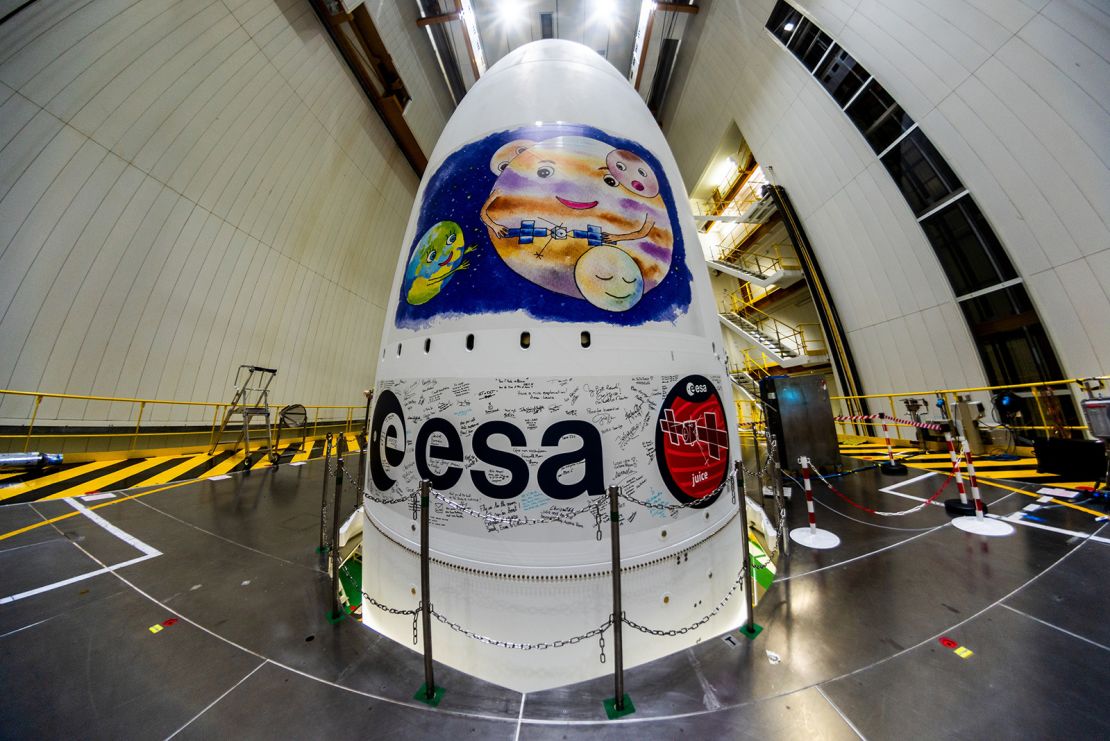
On April 14, 2023, an Ariane 5 rocket was launched from the Kourou spaceport in French Guiana. Its main fairing was decorated with a drawing by 8-year-old Yaryna Zakaliuzhna from Zhytomyr.
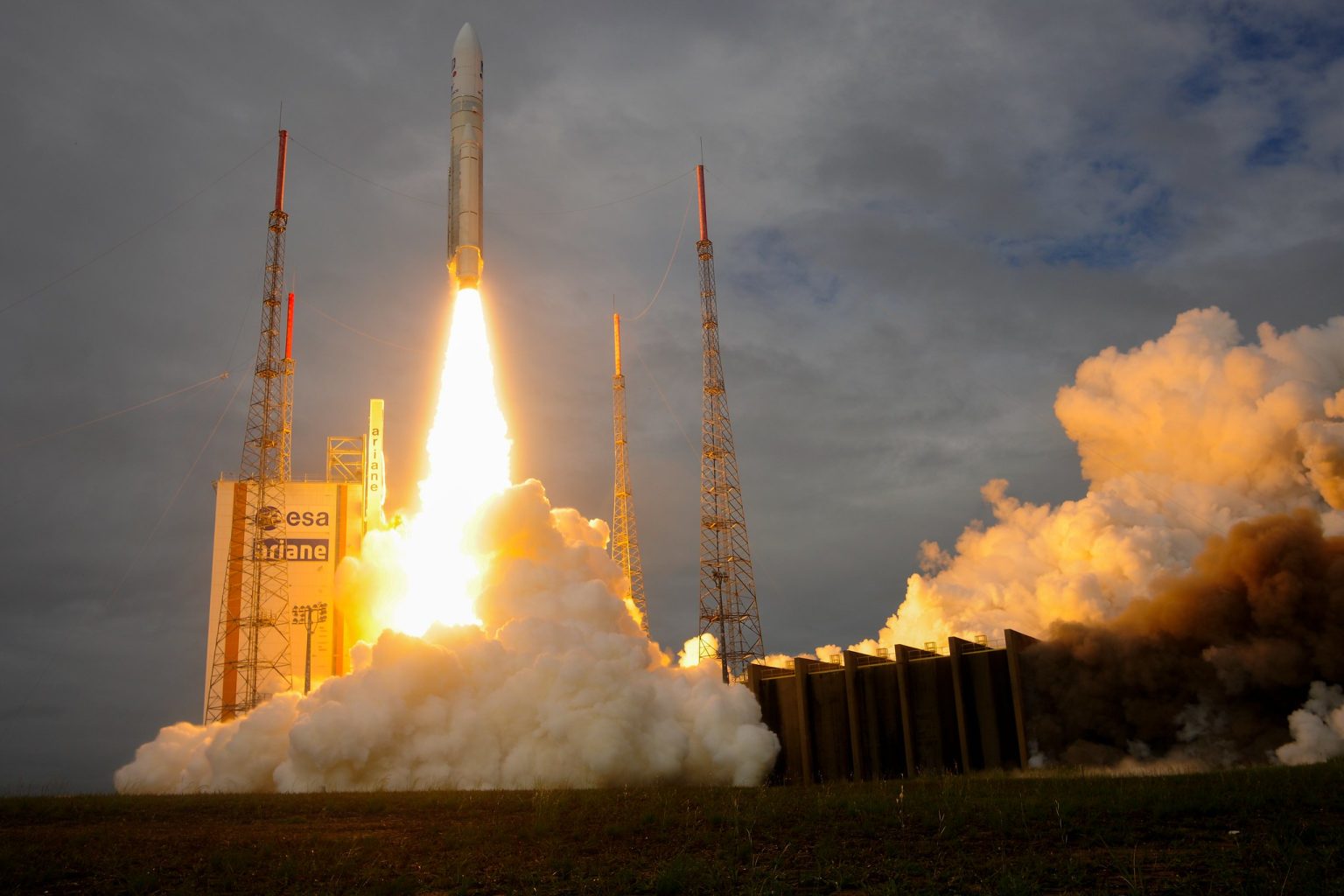
Hidden under the main fairing is JUICE, the most ambitious and complex interplanetary spacecraft in the history of the European Space Agency (ESA). Below, you will learn about the technical equipment and main objectives of this mission, as well as why a drawing by a Ukrainian girl adorned the rocket that launched it.
Project history
The origins of the JUICE project date back to the late 2000s. At that time, ESA launched its first independent missions to the Moon, Mars, and Venus. However, it did not intend to stop there and decided to set its sights on the outer planets of the Solar System, which had previously only been explored by NASA probes.
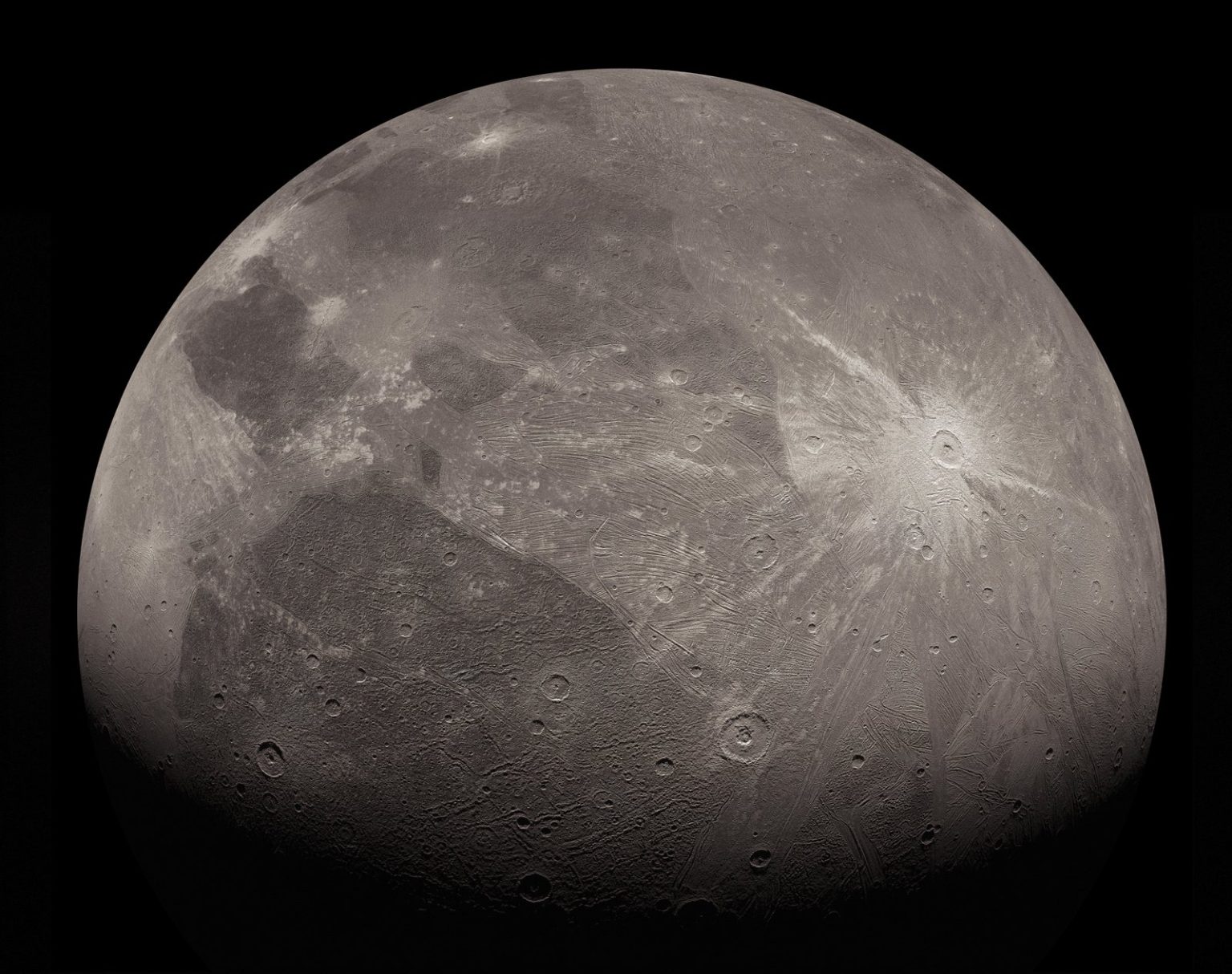
This is how the idea for the JGO (Jupiter Ganymede Orbiter) mission came about. Its target was Ganymede, the largest moon in the Solar System, which is even larger than Mercury. The 950-kilogram spacecraft was to enter a permanent orbit around this celestial body and study it for several years.
But the thing is that JGO was conceived as part of the international EJSM-Laplace project, under which NASA was supposed to send its own probe to Europa, another of Jupiter’s moons. Unfortunately, due to financial difficulties after the 2008 crisis, the US aerospace administration had to withdraw from the program (incidentally, a similar situation arose with the infamous ExoMars mission).
As for ESA, its management decided not to abandon the idea of launching a mission to Jupiter. However, its concept was completely redesigned. The agency intended to significantly expand it and make it its flagship project for the 2020s. And since the scope of the mission’s scientific objectives had grown considerably, this, in turn, required the creation of a completely different, much more powerful and, as a result, more expensive spacecraft. It was named JUICE (Jupiter Icy Moons Explorer).
The JUICE mission received approval from ESA in 2012. Construction of the spacecraft started in 2015. Airbus served as the main contractor, with over 80 European companies involved in the project. Assembly was finished in May 2022, costing €870 million in total.
After completion of assembly operations, JUICE underwent a series of tests that confirmed its ability to withstand interplanetary flight. The spacecraft was then transported to the Kourou spaceport in French Guiana, where it is being prepared for launch.
Main objectives of JUICE
While JGO was conceived as a spacecraft designed exclusively for studying Ganymede, JUICE has been assigned a much more ambitious task. The probe will study Ganymede, Callisto, and Europa. These are Jupiter’s three largest icy moons. What they have in common is that there is a high probability of liquid water oceans hidden beneath their surfaces. And where there is water, as we know, there may also be life.
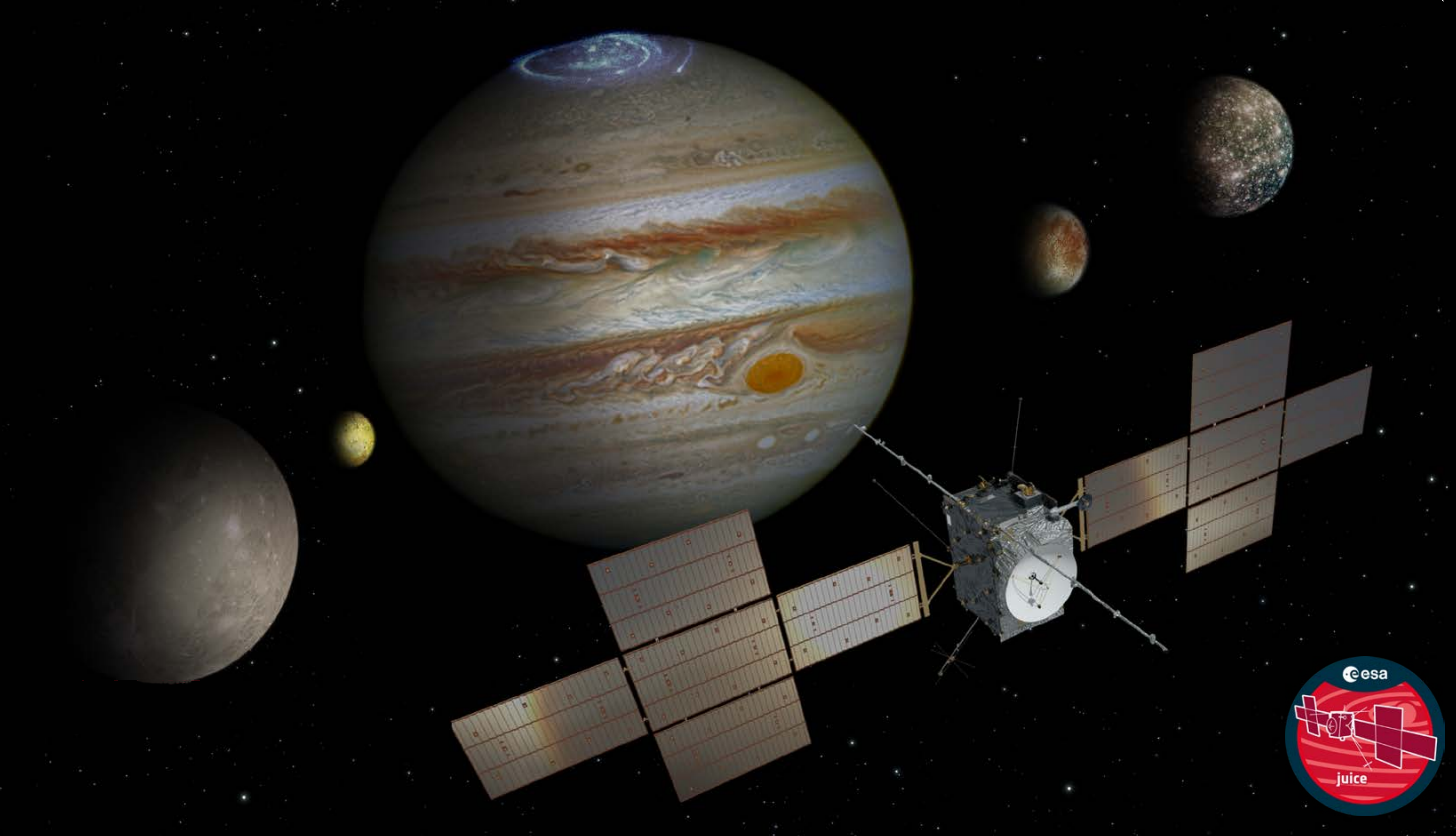
Of course, JUICE is not designed to land directly on Jupiter’s moons to drill into their surface and search for living creatures. Such tasks will be performed by subsequent missions. But before launching them, scientists need confirmation that oceans are indeed hidden beneath the icy surface of these moons, as well as to determine their basic properties. This is one of the key tasks of the spacecraft. It must determine the characteristics of the oceans of Ganymede, Europa, and Callisto, which will ultimately make it possible to assess their habitability.
JUICE will perform detailed scans of the moons, compile detailed topographic maps, and determine the chemical composition of their surfaces. Another important task of the mission is to study Ganymede’s magnetosphere. It is the only natural satellite in the Solar System that has its own magnetic field. Scientists are very interested in the mechanism of its generation and how it interacts with Jupiter’s magnetosphere.
JUICE design
The mass of JUICE (including fuel) is 6,042 kg. It is the heaviest interplanetary spacecraft ever built by ESA. Several factors contribute to its considerable mass.
Firstly, the spacecraft is equipped with powerful scientific instruments that require a lot of energy to operate. Unlike NASA, ESA does not use radioisotope generators in deep space missions, so solar panels are the only option for powering JUICE. The problem is that in the vicinity of Jupiter, it will receive 27 times less light than near Earth. Because of this, engineers had to equip it with very large photovoltaic panels. When deployed, they cover an area of almost 100 m². These are the largest solar panels ever produced in Europe for a spacecraft. It is expected that when the probe reaches Jupiter, it will be able to generate approximately 820 W of energy.
Another reason for the spacecraft’s high mass is Jupiter itself. The largest planet in the Solar System has powerful radiation belts. Even though JUICE’s orbit will mostly be at a considerable distance from them, the probe will still be exposed to significant radiation. Therefore, the designers had to equip their electronic components with enhanced protection.
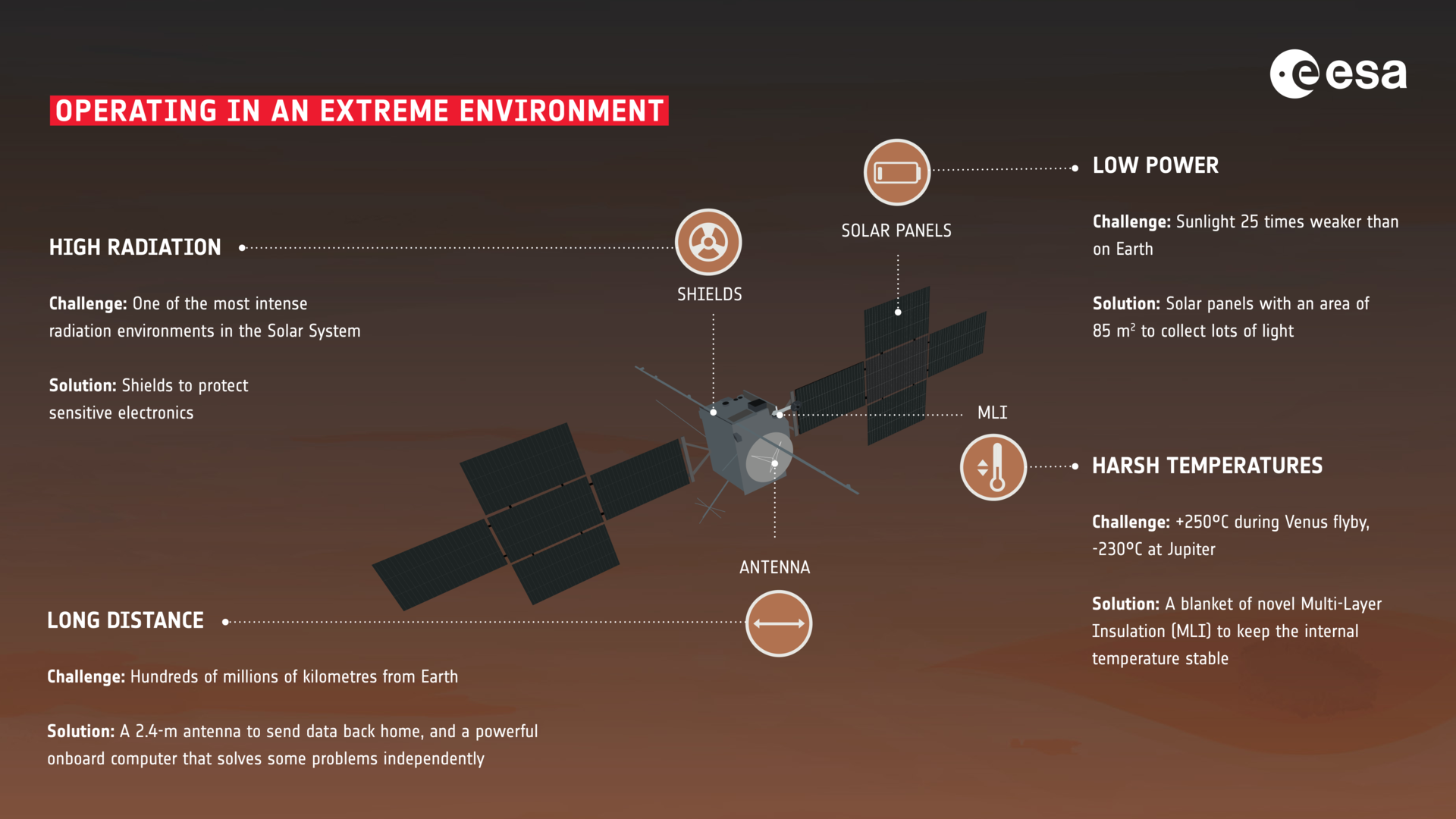
Due to JUICE’s significant mass, Europe’s most powerful launch vehicle, Ariane 5, is unable to send it directly to Jupiter. This means that in order to reach its destination, the spacecraft will have to perform a series of gravitational maneuvers for additional acceleration. One of them will take place near Venus. While in its vicinity, the spacecraft’s body will heat up to a temperature of about 200°C. In view of this circumstance, the designers equipped it with additional heat protection, which also significantly increased its mass.
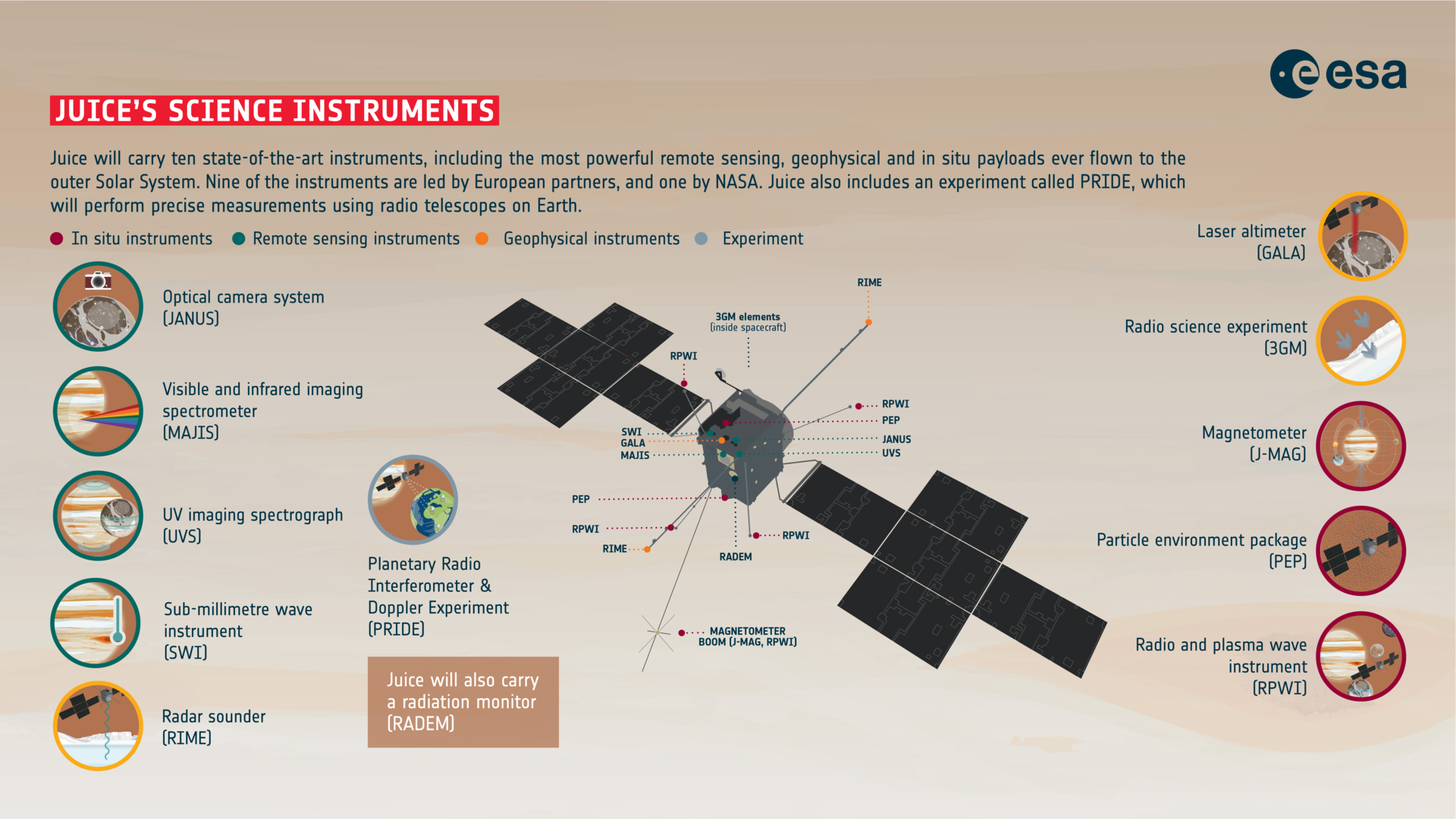
As for the scientific equipment of the mission, it consists of ten instruments created by various European scientific institutions with the support of NASA and JAXA. These include high-resolution cameras, spectrometers, a magnetometer, radar, a laser altimeter, and instruments for measuring the characteristics of charged particles and gravitational fields.
JUICE will use a 3.2-meter antenna to communicate with Earth. It is expected to transmit approximately 1.4 GB of collected data per day.
Painting by Yaryna Zakaliuzhna
In recent years, space agencies have been paying increasing attention to promoting their missions, especially among young people. NASA has the most experience in this area. The US aerospace administration regularly holds various public competitions (such as finding the best name for Mars rovers) or offers anyone interested the chance to send their name into space aboard a new interplanetary spacecraft.
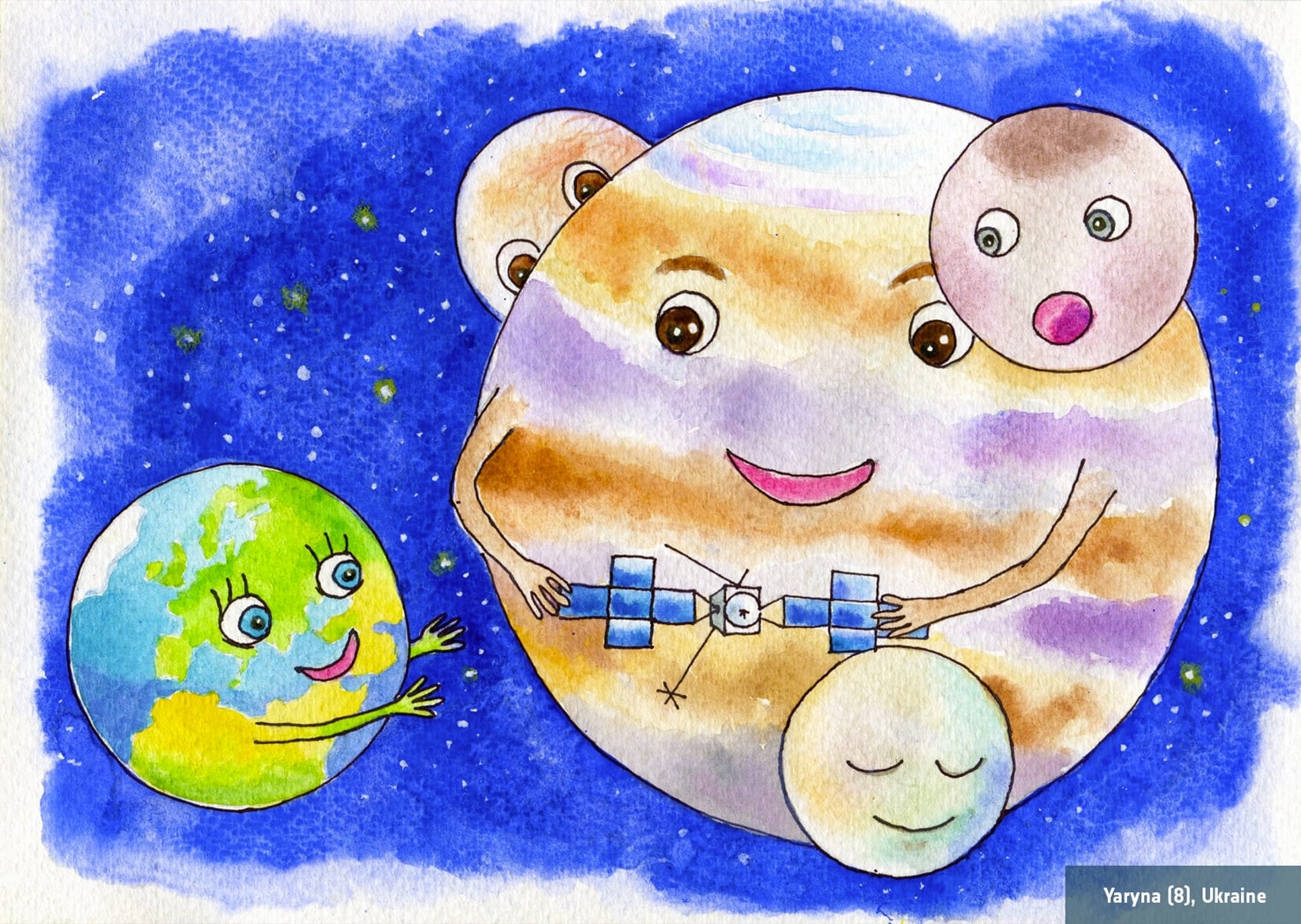
ESA decided not to lag behind its overseas colleagues. In 2021, the space agency organized a children’s drawing competition called Juice up your rocket! A total of 2,600 entries dedicated to the anticipated launch of JUICE were submitted by children from 63 countries around the world.
In the end, the jury chose the drawing by Yaryna Zakaliuzhna, a young girl from Zhytomyr, who was only eight years old at the time of the competition. The image depicts Earth handing over the JUICE spacecraft to Jupiter. It also shows three of the planet’s moons, each displaying different emotions about the encounter: one is frightened, another is surprised, and the third has fallen asleep. As a reward, Yaryna’s drawing was printed on the nose cone of the Ariane 5 rocket that sent JUICE to Jupiter. In addition, the girl was allowed to attend the launch.
A commemorative plaque was also affixed to the JUICE spacecraft shortly before launch. It features images of several pages from the 1610 treatise Sidereus Nuncius, in which Galileo Galilei first told the world about the discovery of Jupiter’s four largest moons.
Four weeks of nightmare
JUICE was launched on April 14. Ariane 5 successfully delivered the European spacecraft to its designated trajectory. Unfortunately, an unforeseen situation arose that caused considerable concern among space enthusiasts.
So, after launch, JUICE successfully deployed its solar panels and established contact with the Control Center. Engineers began activating and calibrating its scientific instruments — and that’s when the problem arose. The source of the problem was the RIME (Radar for Icy Moons Exploration) radar. This is one of the probe’s key scientific instruments, which will enable it to peer inside Jupiter’s icy moons. Thanks to its 16-meter antenna, this device will be able to scan its surface to a depth of 9 km with a vertical resolution of 30 m.
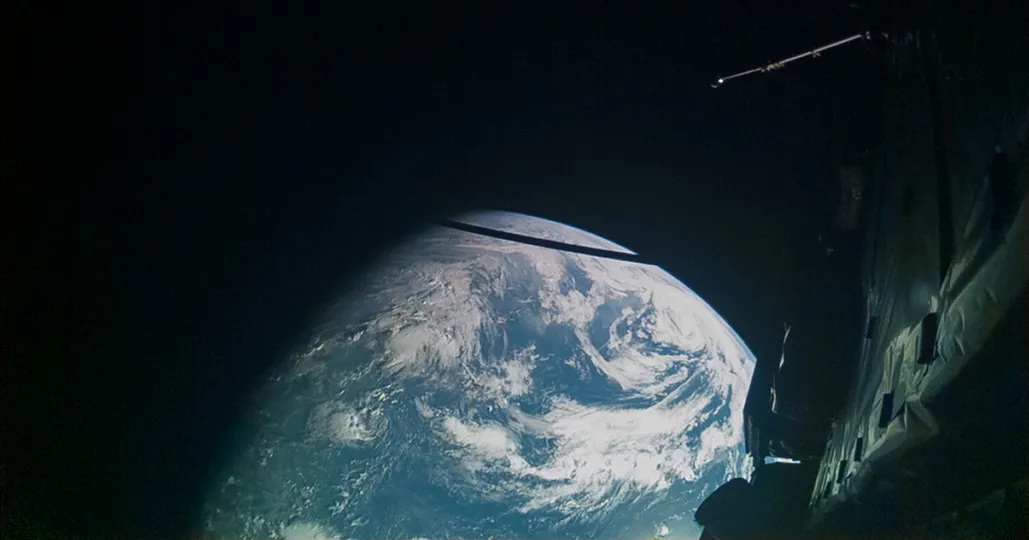
ESA specialists were dismayed to discover that JUICE had failed to deploy its RIME antenna. Images taken by the selfie camera mounted on the spacecraft’s body showed that it had only opened one-third of the way. The situation brought back unpleasant memories of the Galileo mission. At the time, that spacecraft was unable to deploy its main communications antenna, which had a significant impact on its scientific program.
After analyzing the situation, engineers concluded that the antenna most likely failed to deploy due to a stuck pin and developed a strategy to help it unfold. It involved firing the engine to “shake” the spacecraft and a series of rotations.
However, all these operations did not produce the desired effect. Therefore, as a last resort, on May 12, engineers activated a mechanical device called a “non-explosive actuator” (NEA) located in the jammed bracket. This caused an impact that moved the pin a few millimeters, allowing the antenna to unfold. However, the last part of RIME remained folded. The team then activated another actuator in the bracket, which completely freed the antenna. Thus, JUICE successfully survived its “four weeks of nightmare”. As for the rest of the scientific instruments, they passed the test successfully. This means that the spacecraft is ready to meet Jupiter.
Eight years to fly to Jupiter
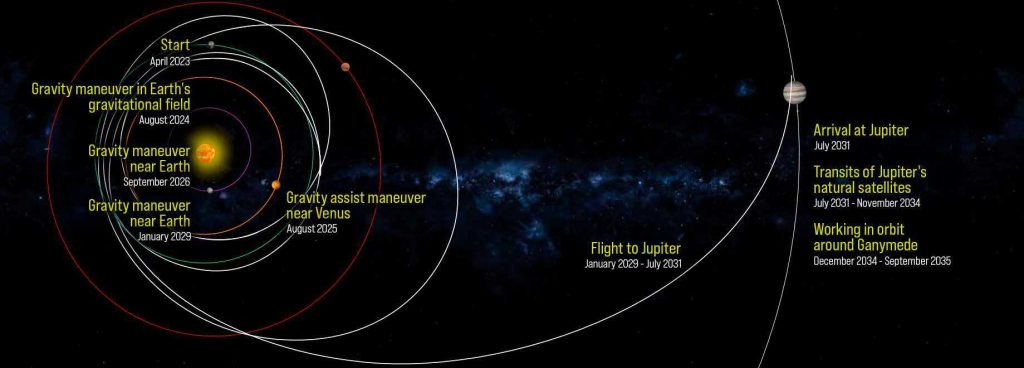
However, the actual encounter with the gas giant will only take place in eight years. The fact is that even the power of Ariane 5 is not enough to send JUICE directly to Jupiter. To gain the speed necessary to reach the fifth planet of the Solar System, the probe will have to perform four gravitational maneuvers to accelerate. The first took place in August 2024, when it performed a “double” flyby. First, JUICE visited the Moon, and a day and a half later, Earth. A year later, the spacecraft found itself in the vicinity of Venus. In September 2026, JUICE will approach Earth for the second time, then pass through the asteroid belt, and later return to our planet again. The final gravitational maneuver near Earth is scheduled for January 2029. It will allow the probe to finally set course for Jupiter.
In October 2029, a European spacecraft will fly close to the 80-kilometer asteroid 223 Rosa. Most likely, ESA will use this opportunity to turn the small body into a kind of “training ground” for mission specialists. During the flyby, they will be able to practice organizing observations and calibrate the automatic reconnaissance instruments at the same time.
JUICE will begin regular observations of Jupiter in early 2031. In July of that year, it will reach the planet’s vicinity, after which it will fly by Ganymede. This maneuver will allow it to enter its initial orbit around the gas giant.
In July 2032, JUICE will perform the first of two planned flybys of Europa. The main focus will be on studying its active zones. Observations suggest that there may be geysers on Europa that feed small subsurface reservoirs, possibly connected to the ocean. If it is lucky enough to fly through one of the geyser emissions, the spacecraft will be able to perform a detailed chemical analysis of the water.
It should be noted that by the time it reaches Europe, JUICE will not be the only earthly emissary in this region. It will be accompanied by NASA’s Europa Clipper probe, which, as the name suggests, is designed to study this particular celestial body. Undoubtedly, space agencies will take advantage of this unique opportunity to conduct joint observations of the icy natural satellite, which will complement each other’s results.
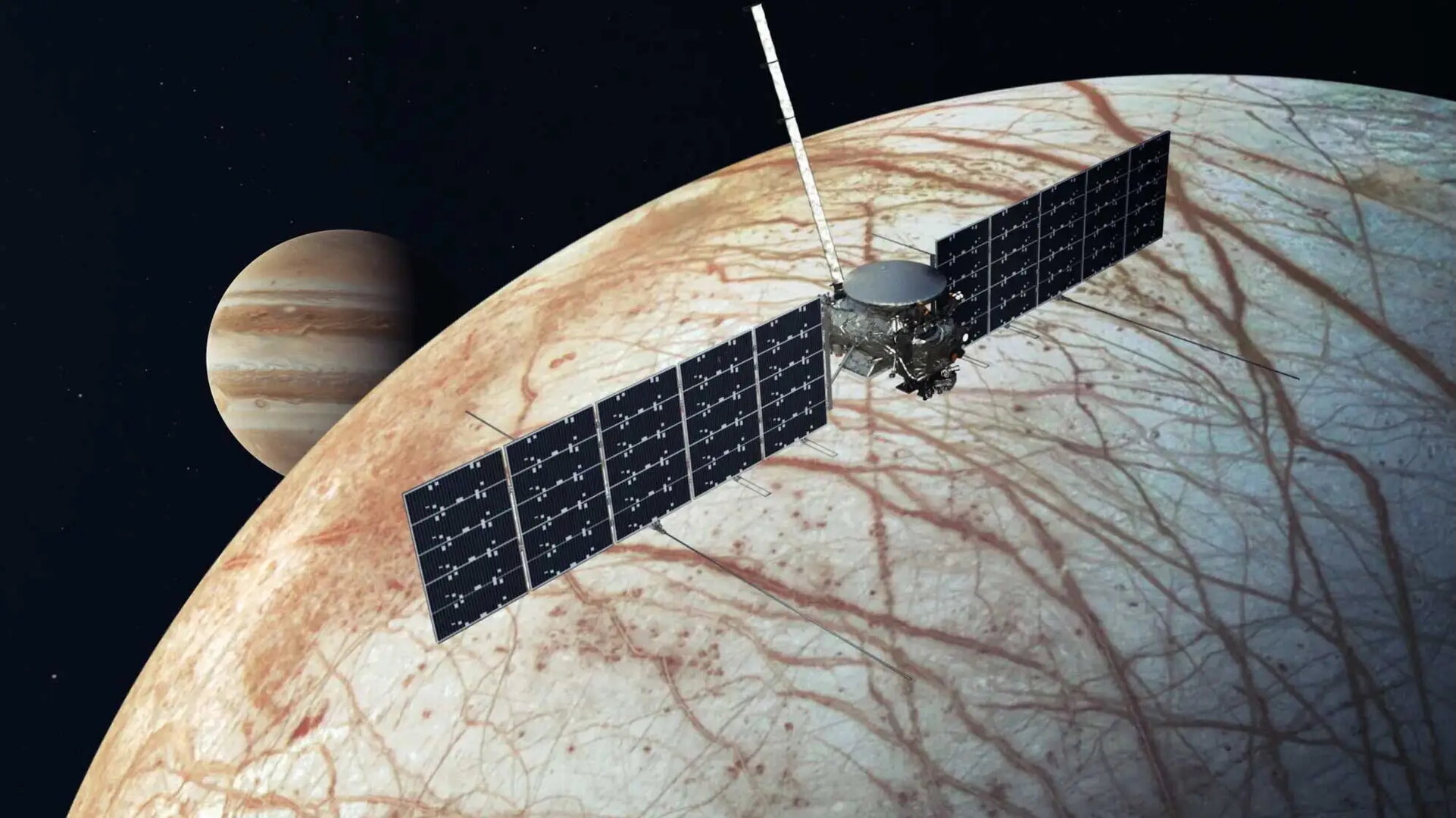
In July 2032, JUICE will also begin a series of flybys of Callisto. In total, the probe will make 21 flybys during its mission. These maneuvers will have a dual purpose. First, they will allow for a thorough investigation of this moon. Second, with the help of Callisto’s gravity, the spacecraft will increase the inclination of its orbit relative to Jupiter’s equator, which will give scientists the opportunity to comprehensively study the polar regions of the gas giant.
In December 2034, JUICE will begin the next phase of its mission. It will perform a maneuver that will bring it into orbit around Ganymede, becoming the first Earth messenger in history to enter a permanent orbit around another planet’s moon.
Initially, JUICE will be in an elongated orbit around Ganymede. During subsequent maneuvers, it will first move to a 5,000-kilometer circular orbit and then reduce its altitude to 500 km. These events will mark the culmination of the mission. The probe is expected to collect a huge amount of data about this natural satellite, its internal structure, exosphere, and magnetosphere.
Despite the fact that Ganymede has no significant atmosphere, JUICE’s orbit will gradually decrease. This will occur due to a combination of factors, including the heterogeneity of the natural satellite’s gravitational field and the influence of Jupiter and its other moons. To counteract this, the probe will have to use its engines. Over time, the Earth’s messenger will completely exhaust its fuel reserves and lose the ability to maintain its orbit, after which it will crash into the icy surface of Ganymede. According to preliminary estimates, this will happen sometime in late 2035.
However, we cannot rule out the possibility that European experts will find some clever way to extend the mission, as there are plenty of similar examples in the history of space exploration. The data collected will certainly significantly change scientific ideas about the icy moons of the largest planet in the Solar System. And if there really is some kind of life in their depths, then… Who knows, perhaps it will be a European researcher who will discover traces indicating its existence.
This article was published in issue No.1 (189) of Universe Space Tech magazine in 2023. You can purchase this issue in electronic format from our store.

