

The James Webb Space Telescope (JWST) has captured unique images of an object that astronomers have dubbed the “Space Skull” (Exposed Cranium). In fact, it is the planetary nebula PMR 1 — a giant cloud of gas and dust created by a star at the end of its life. Thanks to the telescope’s two different infrared “eyes,” scientists were able to see incredible details of this structure, resembling a brain hidden in a transparent skull, for the first time.
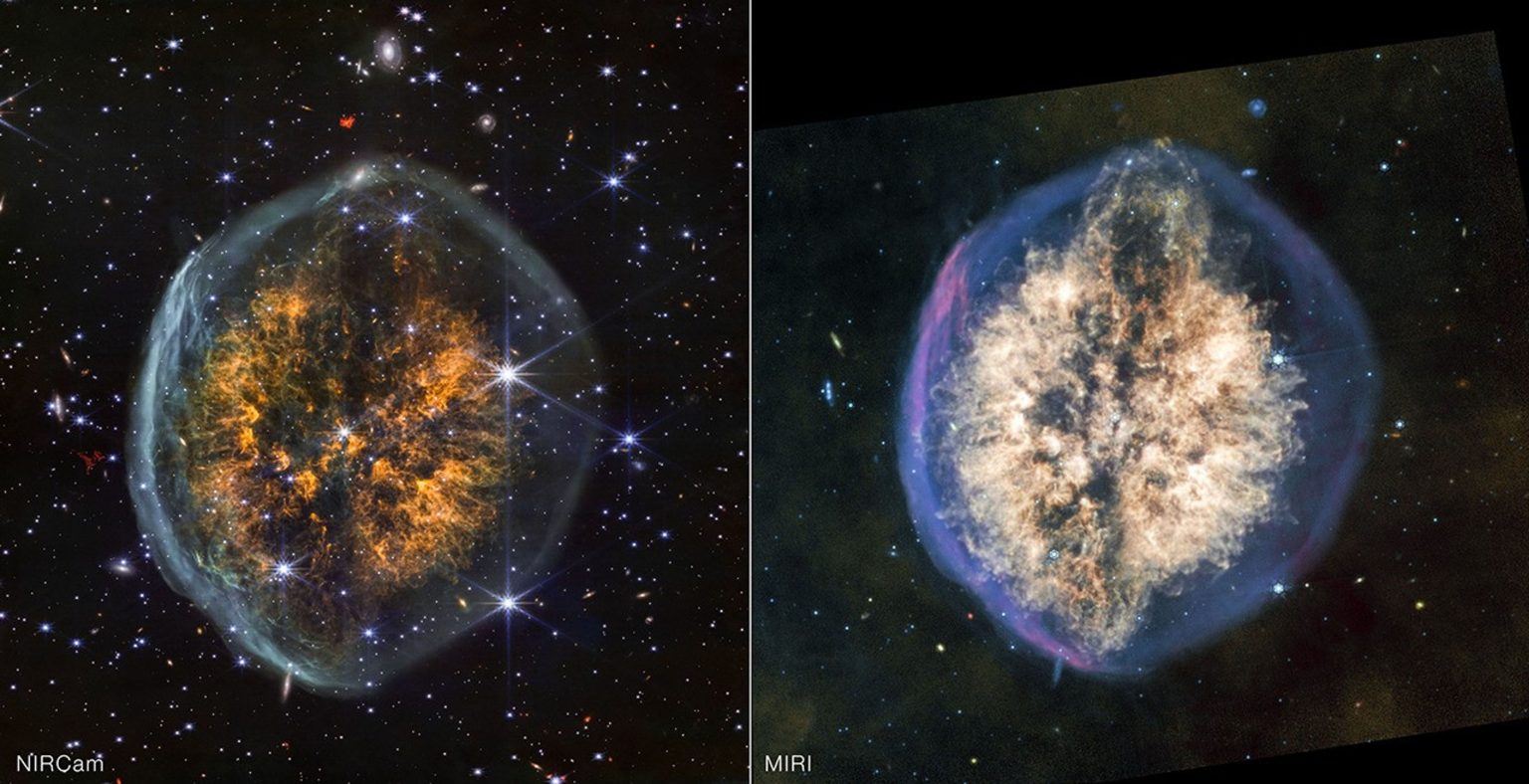
The PMR 1 nebula was first captured on camera back in 2014 by the Spitzer telescope, the predecessor to JWST. But only now, thanks to the incredible sensitivity of James Webb, we can see it in the finest detail. Planetary nebulae are the final chord in the life of stars similar to our Sun. When the nuclear fuel in their cores is depleted, they shed their outer layers, creating bizarre, shimmering formations that scatter throughout space.
Two perspectives on PMR 1
The new images combine data from two instruments: the Near Infrared Camera (NIRCam) and the Mid-Infrared Instrument (MIRI). It is precisely the ability to see space at different wavelengths that makes JWST so powerful.
- NIRCam image. Here, the outer shell of the nebula appears as a bright white bubble, while the inner clouds glow orange. The most interesting detail is the dark vertical lane that divides the nebula into two hemispheres, creating the illusion of a human brain. Through the transparent shell in this image, distant galaxies and stars can be seen.
- MIRI image. In the mid-infrared range, the picture changes dramatically. The outer bubble takes on a violet-blue hue, while the inner clouds appear much denser and more complex. The mysterious dark lane is almost disappearing — it is hidden by dust and gas, which become opaque in this range.
The mystery of the dark lane
Why are these differences so important to astronomers? The fact is that the dark lane, which is clearly visible in the NIRCam image, is actually closely related to powerful gas emissions from the upper and lower parts of the nebula. What we see as a “partition” between the hemispheres may be the result of the work of a double star in the center or complex magnetic processes. By comparing the two images, scientists obtain a three-dimensional picture of what is happening inside this cosmic “skull”: where dust accumulates and where ionized gas accumulates.
What fate awaits the star?
These images are not just beautiful pictures. They are like geological layers that allow us to glimpse into the past of the star. The outer shell of the nebula consists of hydrogen ejected during the early stages of the star’s death. Internal clouds are a mixture of heavier elements and dust that the star ejected relatively recently.
What will happen to the bright spot in the center of PMR 1? It all depends on its mass. If it turns out to be massive enough, it will explode as a bright supernova. But most likely, it will have a more peaceful fate: it will continue to slowly shed its layers, leaving behind a tiny, incredibly dense object — a white dwarf that will slowly fade away over billions of years, hidden in a majestic sarcophagus of gas that we call a planetary nebula.
Earlier, we reported on how a dark energy camera captured an image of a cosmic steering wheel.
According to Live Science

