

Exoplanets may also have atmospheres, and therefore climates. And recently, scientists have discovered a new way to predict them. They tested the accuracy of their new model on the planets in the TRAPPIST-1 system.
Types of climate models
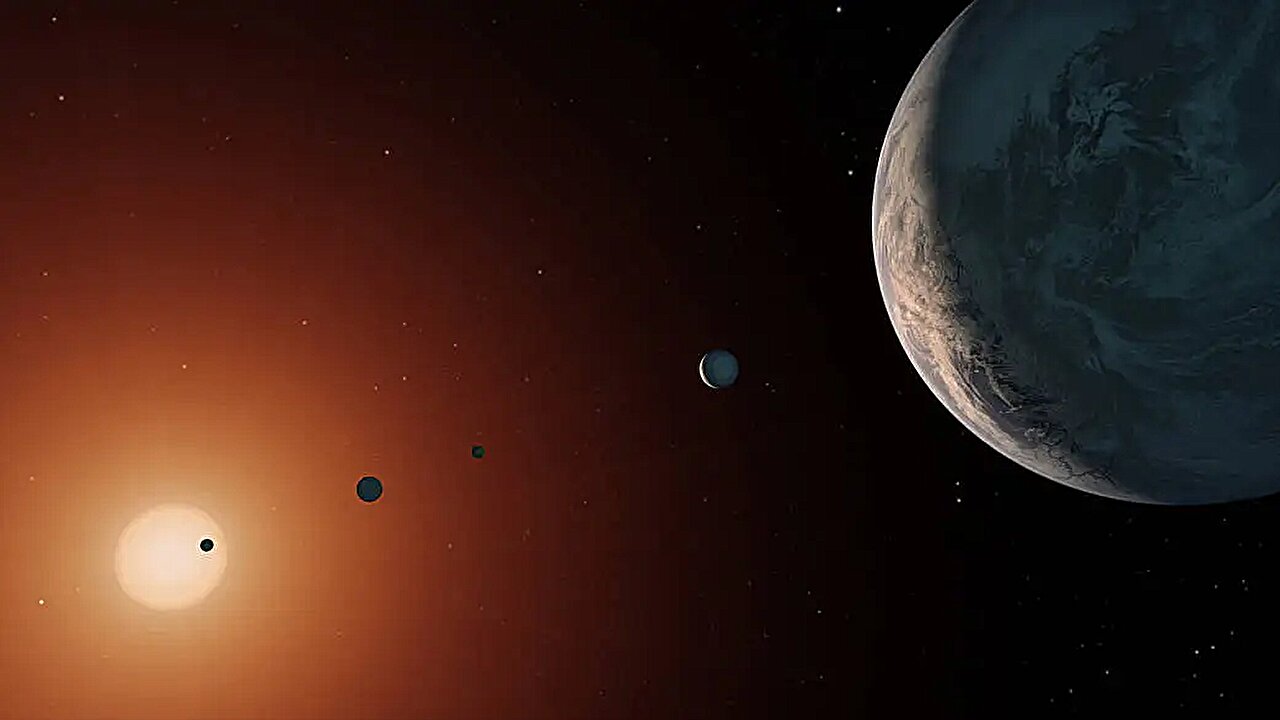
The TRAPPIST-1 system, located approximately 41 light-years from Earth, has become the focus of numerous discussions about exoplanets—primarily because it contains seven confirmed planets orbiting a dim M-class dwarf star. Two of these planets—TRAPPIST-1e and -1f—are believed to be within the habitable zone. However, the habitable zone of M-class dwarf stars is so close to the star that the planets are likely tidally locked to it, meaning they have a permanent day and night side with a “twilight terminator” between them.
Building on this knowledge, scientists are attempting to model the climate on these two exoplanets, and in a new article by Jacob Haqq-Misra of Blue Marble Space, a new type of climate model is used that allows them to do so accurately while consuming far fewer computational resources.
When modeling the climates of exoplanets, scientists typically use three-dimensional general circulation models. These extremely complex models accurately calculate characteristics such as radiative transfer, atmospheric dynamics, and other physical processes. But all these calculations mean that they are very computationally intensive, which makes it difficult to use them when studying a large number of potential variables, such as the amount of carbon dioxide or the amount of stellar energy a planet might receive.
However, there are alternative options. Scientists also use simpler models, known as energy-balance models (EBMs). These much simpler models, which typically operate in only one dimension (as opposed to the three dimensions of GCMs), do not attempt to simulate every raindrop or every gust of wind. Instead, they analyze the energy reaching the planet in the form of radiation from its parent star and the energy leaving the planet in the form of radiation returning to space. Balancing these two values provides a general idea of how much the planet will heat up or cool down, and this requires much less computing power.
Haqq-Misra’s new modified model
Dr. Haqq-Misra chose a specific EBM-based model for his work—the HEXTOR model (Habitable Exoplanet Energy Balance Model)—for observing exoplanets. However, he had to modify it for a tidally locked planet, changing the coordinate axis from latitude to longitude to simulate the continuous transfer of energy from the planet’s “day” side to its “night” side, unlike the traditional energy transfer from the equator to the poles on a non-tide-locked planet. It should be noted that the model does not predict real weather. It estimates the average thermal regime of the planet and possible climatic states. This is more of a quick climate assessment than a weather forecast in the earthly sense.
To improve the accuracy of his model, Dr. Haqq-Misra calibrated it using a reference table of surface temperatures generated by more computationally intensive global climate models (GCMs) as part of the “TRAPPIST-1 Habitable Atmospheres Comparison” (THAI) project—a collaborative effort that created a standard set of exoplanet simulations, helping to reconcile certain properties of this intriguing planetary system. Using this calibration dataset and its longitude-dependent modification, HEXTOR was able to successfully reproduce an average global temperature of 240.8 K for TRAPPIST-1e, which is virtually identical to the result obtained using the more complex THAI GCM models.
Reconstructing the climate on the planets TRAPPIST-1e and TRAPPIST-1f
Based on this preliminary assessment, Dr. Haqq-Misra took full advantage of the simplified model’s capabilities by running 6,300 simulations that varied the intensity of solar radiation (the amount of light coming from the star) and the carbon dioxide pressure in the planet’s atmosphere. He found that the most likely scenario for TRAPPIST-1e is a “cool” day side, which would transition to a “warm day side” or an ice-free state only if the partial pressure of CO2 were approximately 0.1 bar or higher. TRAPPIST-1f, on the other hand, is likely a “snowball,” where even the day side is completely covered in ice. For the day side to be completely ice-free, the CO2 pressure would have to exceed 1 bar—effectively turning the planet into a giant greenhouse.
But in reality, the HEXTOR model was never intended to produce a final result. Its true purpose is to identify which of the 6,300 simulations it has run will be the most interesting for further study using more powerful global climate models (GCMs). This combination of “reconnaissance” and the subsequent use of powerful models could serve as a model for instruments such as the James Webb Space Telescope, which continues to explore this fascinating solar system and may discover an atmosphere capable of supporting life as we know it.
According to phys.org

