

Two spacecraft—the American MAVEN and the Chinese Tianwen-1—have jointly detected signs of magnetic reconnection in Mars’ magnetotail for the first time. Researchers believe that this is the process that causes the tail to “wiggle”—just as it does on Earth. The findings have been published in the journal AGU Advances.
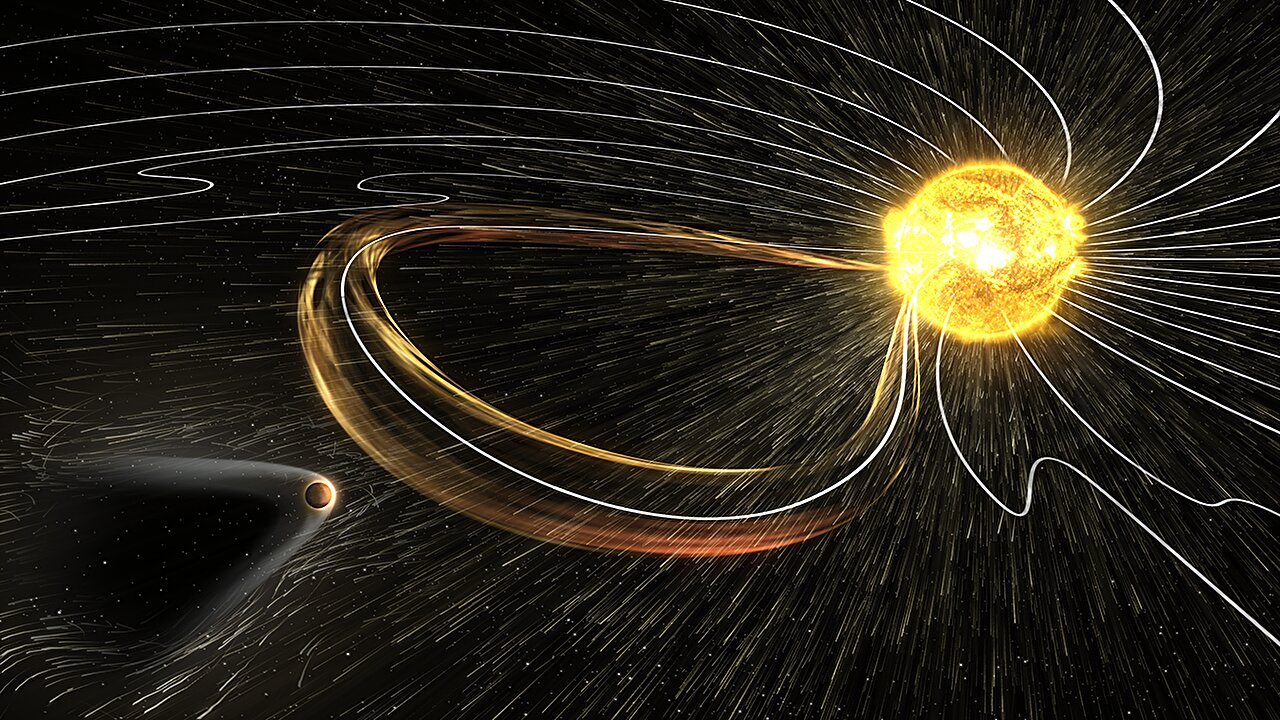
What is a magnetotail, and why does it move?
The solar wind—a continuous stream of charged particles accompanied by a magnetic field—interacts with the atmospheres and magnetospheres of planets, forming long plasma tails behind them. These magnetotails contain thin layers of plasma that sometimes begin to oscillate up and down—to “flutter.”
On Earth, this phenomenon is associated with magnetic reconnection: the magnetic field lines break apart and instantly reconnect in a new configuration, releasing the stored energy. Whether the same mechanism operates on Mars had previously remained unknown.
Billions of years ago, Mars lost its global magnetic field. Despite this, it does have a magnetosphere—due to the interaction of the solar wind with charged particles in the upper atmosphere, as well as powerful local magnetic fields in certain regions of the Martian crust—remnants of the planet’s former magnetic field. This tail is dynamic: it twists, shifts, and oscillates, and particles from it can escape into outer space.
What the two devices captured at the same time
Until recently, Mars’s magnetic tail had been studied only by NASA’s MAVEN mission (Mars Atmosphere and Volatile Evolution). The problem is that a single probe can only monitor one section of the tail, so it has not been possible to determine the causes of the fluctuations.
Thanks to the Chinese Tianwen-1 orbiter, scientists were able to observe the tail from two different vantage points simultaneously for the first time. Analysis of synchronous data revealed that signs of magnetic reconnection in the upper part of the tail coincided in time with fluctuations recorded downstream.
Twisted plasma structures as a connecting link
Before and during the oscillations, both spacecraft also detected temporary twisted plasma structures. A similar phenomenon has previously been observed on Earth. Scientists believe that these structures, generated by magnetic reconnection in the upper part of the tail, propagate outward and destabilize the plasma layer, triggering oscillations.
Further research is needed to confirm this mechanism—but even now, these observations are shedding new light on how energy moves and is released in the space around Mars, and possibly around other bodies in the Solar System.
According to phys.org

