

Astronomers have managed to see an incredibly distant and bright supernova located 10 billion light-years away thanks to a unique cosmic phenomenon. The discovery, published in The Astrophysical Journal Letters, was only possible because two galaxies acted as a natural telescope, amplifying the light from the explosion dozens of times.
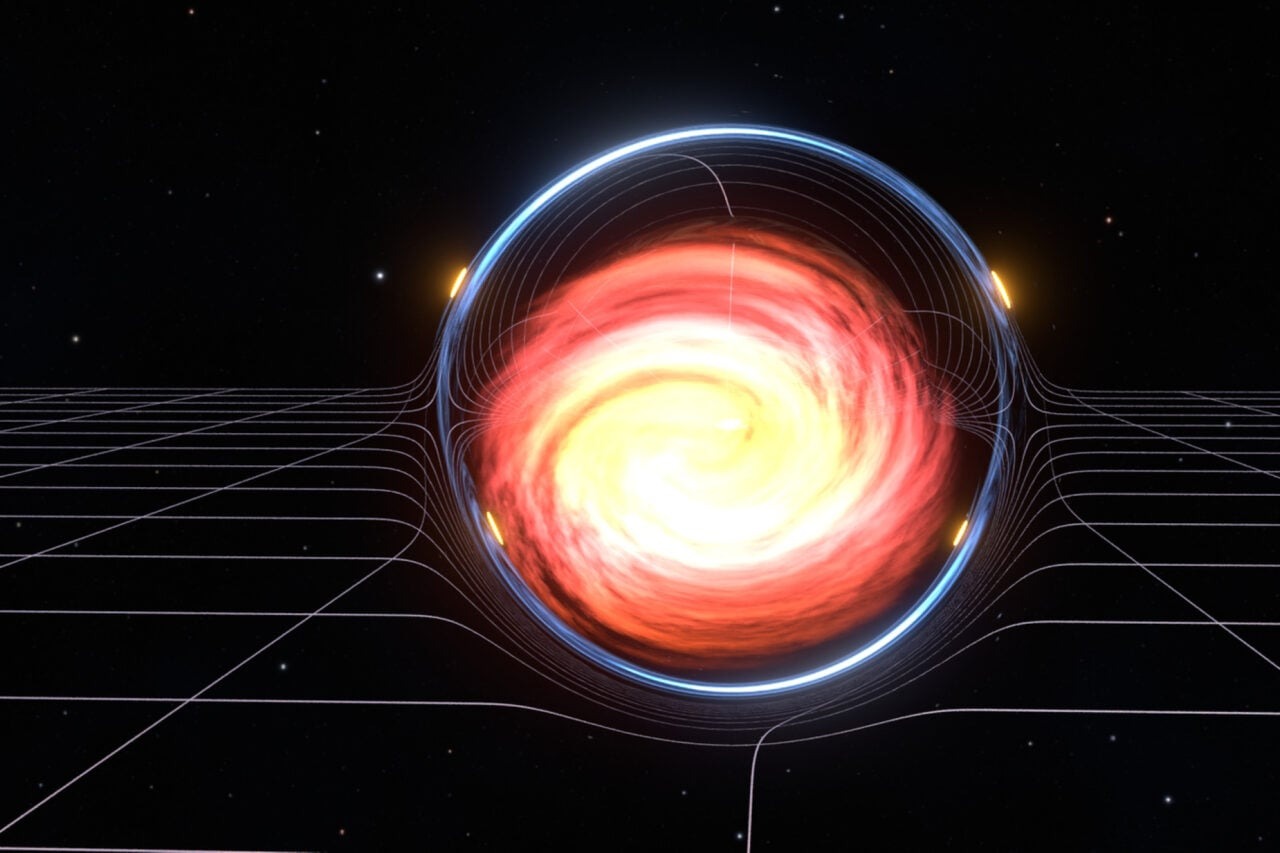
An international team led by astrophysicist Joel Johansson from Stockholm University observed a supernova designated SN 2025wny. Usually, such objects at the edge of the Universe cannot be studied in detail. However, two galaxies located on the line between Earth and the supernova curved space-time with their gravity and focused its light, increasing its brightness by 50 times.
How does the “space magnifying glass” work?
Gravitational lensing is an effect whereby a massive body—a galaxy or star cluster—acts as a lens, distorting and amplifying light from an object behind it. In this case, the light from the supernova was not only amplified, but also split into several images that reached Earth at different times. At first, scientists found it difficult to believe the discovery.
“At first, I thought it was a camera artifact,” admitted graduate student Jacob Wise.
Multimessenger astronomy
SN 2025wny is the first super-bright supernova discovered using gravitational lensing. This opens up new possibilities for cosmology. In particular, the time difference between the appearance of the lensed images will help to more accurately measure the expansion rate of the Universe and resolve a current scientific debate — the so-called “Hubble tension.”
The discovery is a striking example of the new era of multi-messenger astronomy. The Hubble and James Webb Space Telescopes have already been enlisted to further study SN 2025wny. Scientists believe that such observations are not only a milestone in themselves, but also a glimpse into the future of rapidly developing astronomy.
Earlier, we reported on how the explosion of a star in 1604 changed our understanding of the Universe.
According to Gizmodo

