

When astronauts next set foot on the Moon’s surface, they and their equipment will be threatened by dust that is extremely treacherous in its properties. Engineers believe that electrodynamic dust shields, which can be made flexible and compact, may be an effective way to combat this.
Dust on the Moon
The journal Acta Astronautica has published an article by two scientists from the Georgia Institute of Technology on methods of protection against dust on the Moon. To achieve this, they propose using real force fields, very similar to those described in science fiction.
Dust on the Moon is indeed a huge problem, because it is completely different from the dust we deal with on Earth. Each particle has a huge static charge, which arises under conditions of friction in the absence of atmosphere, and very sharp edges. And all of this can rise up and form a cloud that will remain above the surface for some time.
This means that this dust will stick to all surfaces, scrape them, and get inside any mechanism. This means that they could be seriously damaged. That is why engineers are looking for ways to protect any structure or astronaut’s spacesuit from it.
Electrodynamic dust shields
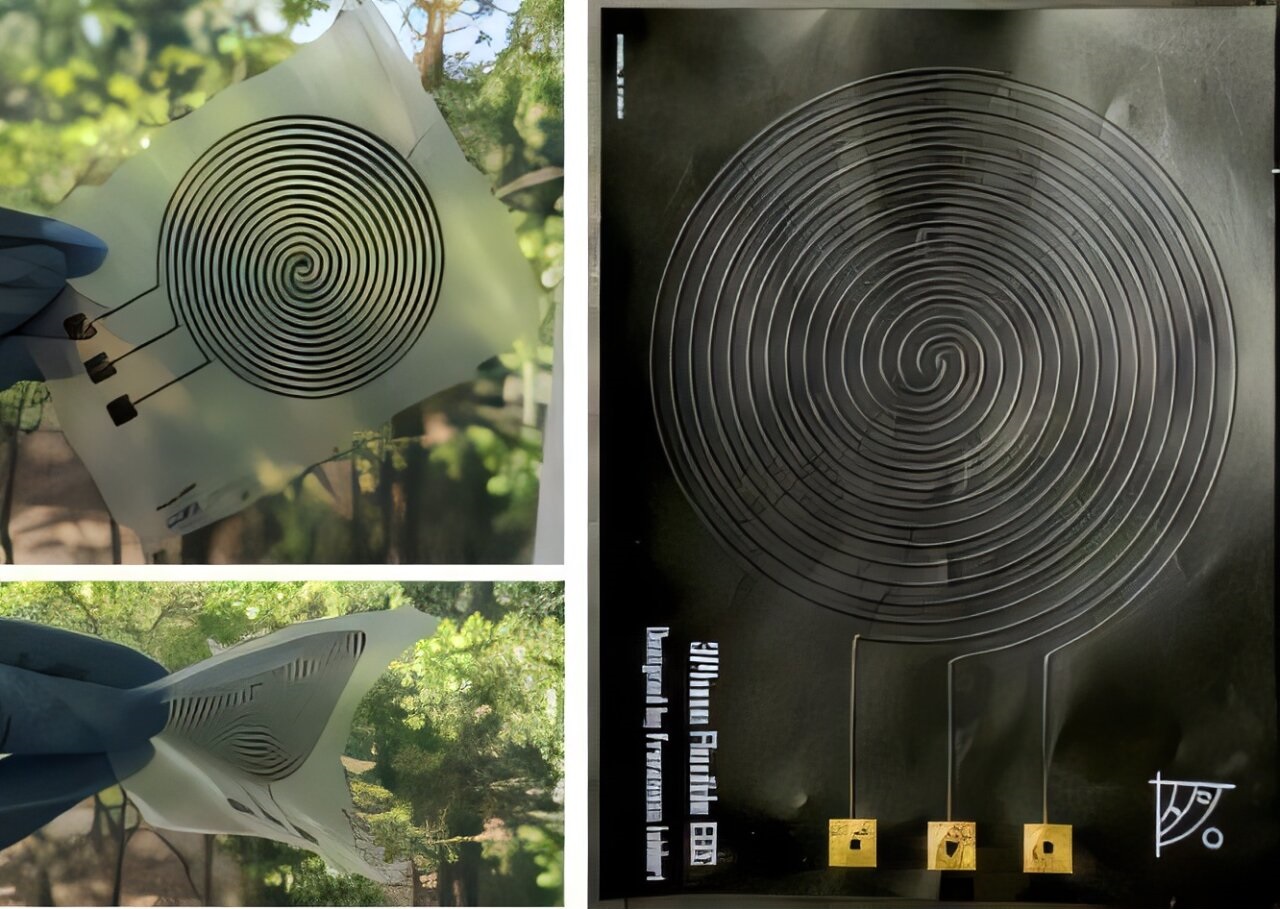
In principle, there is a way to protect against dust: a magnetic field. In order to repel a charged particle in a vacuum, it does not need to be too powerful. And devices based on it have long been known – Electrodynamic Dust Shields (EDSs) And theoretically, they can even be made compact and flexible so that, if necessary, they can be wrapped around a structure of any shape to create something similar to the force field that envelops spaceships in science fiction.
The only problem is that EDSs are made from copper wires, which react very negatively to repeated bending and unbending. Simply put, they break. And this is precisely the problem that the new study addresses.
Scientists have created an EDS based on modified graphene oxide. This material is very similar to copper in terms of electrical conductivity, but it withstands both dynamic and static bending much better. In addition, its creators point out that, in addition to mechanical deformations, there will also be significant thermal deformations over the course of several months.
Test results
To ensure that the new flexible shields were effective, engineers conducted tests in the Exolith Lab vacuum chamber. It contained two types of EDS: one based on copper polyamide and the other based on hafnium oxide. Conditions were created there similar to those on the Moon — sharp dust settled in a vacuum under intense ultraviolet radiation, which charged it.
Under these conditions, both types of EDSs demonstrated their ability to combat dust. Copper removed 90% even when deposited on the surface. The result for hafnium oxide is slightly worse – 60%. However, this is still very good.
However, the researchers’ optimism is tempered by the fact that it has not been possible to achieve absolute conformity between the experiment and lunar conditions. Thermal loads were not modeled at all, and the dust simulation was incomplete. Therefore, the effectiveness of the system can only be definitively proven during an actual flight.
According to hys.org

