

A fragment found in the Sahara probably is a remnant of a long-vanished protoplanet that may have been as large as the Moon or even Mars. This is the most compelling evidence yet that a large planetary body existed in the early Solar System and subsequently disappeared. Fragment found in Sahara likely a fragment of a long-lost protoplanet

A rare rock
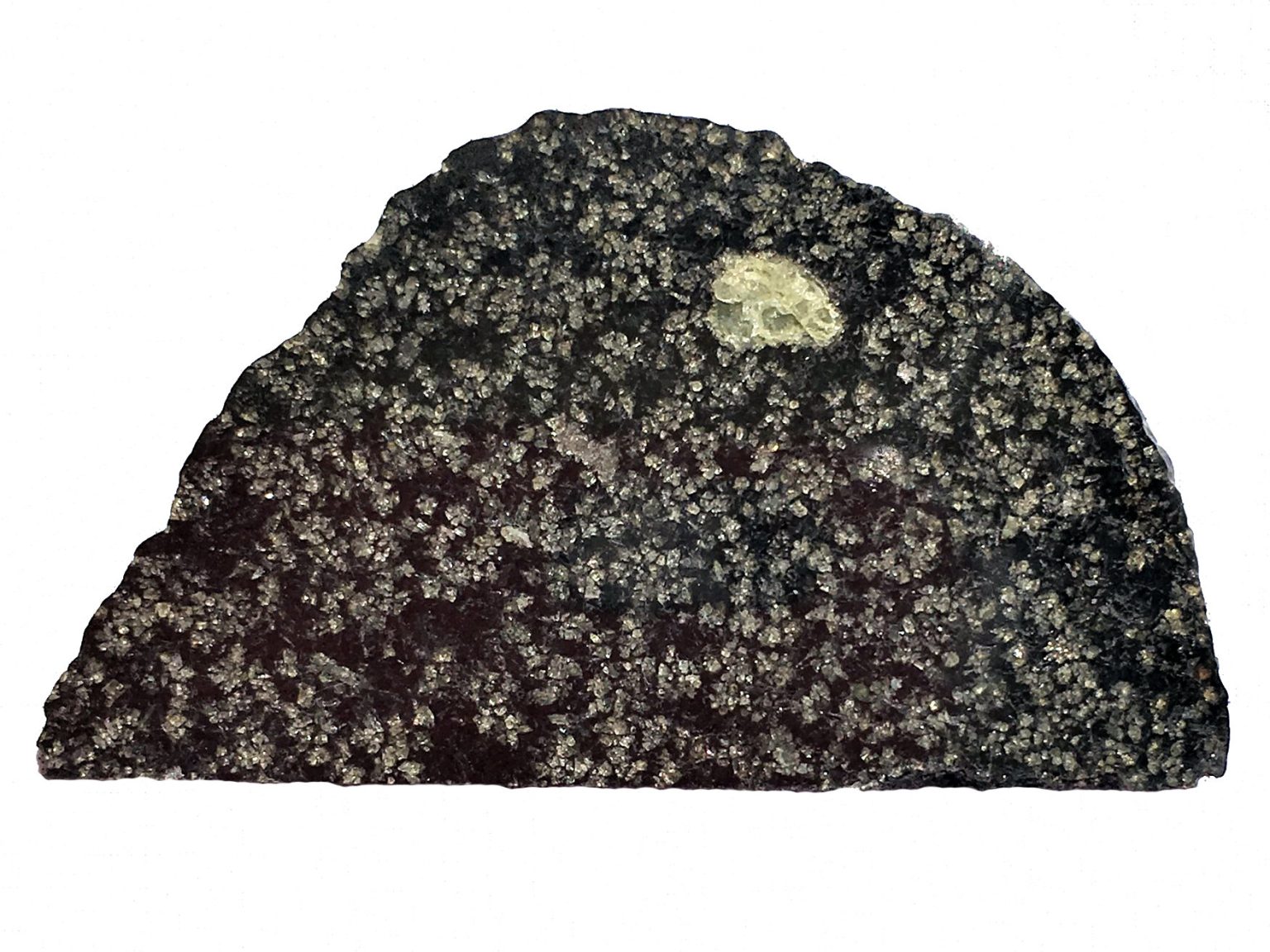
Scientists at the University of Colorado Boulder have studied a sample of the NWA 12774 meteorite, which was most likely found in Mauritania. It belongs to the Angrites, one of the oldest volcanic rocks in the Solar System, formed just a few million years after the Solar System’s formation about 4.56 billion years ago.
Of the more than 80,000 known meteorites on Earth, only 68 are angrites. Chemically, this rock stands out from the rest. Unlike Earth, Mars, and other rocky planets, it contains very little silicon dioxide, or silica, which is the main component of nearly all known Earth-like planets. Because of this, it was previously believed that angrites originated exclusively from asteroids with a radius of less than 200 kilometers.
Pressure from the depths
In the sample, researchers identified clinopyroxene, a mineral commonly found in the Earth’s crust and mantle. The crystals of this mineral were exceptionally rich in aluminum, which is indicative of formation under high pressure deep below the surface.
Calculations have shown that a pressure of at least 17.5 kilobars is required for such clinopyroxene to form. By comparison, at the bottom of the Mariana Trench, the deepest point on Earth, the pressure is only about 1 kilobar. Such conditions could not have existed inside a small asteroid.
Dimensions of the missing protoplanet
Calculations indicate that the body from which the angrites originated had a radius of at least 1,000 kilometers. Other features of the meteorite suggest an even larger scale.
The crystals inside NWA 12774 have retained sharp edges and fine chemical structures that would have been lost if the rock had formed at great depth. This means they formed at a relatively shallow depth, and therefore the body itself was significantly larger. Under this scenario, the protoplanet’s radius could have exceeded 1,800 kilometers, comparable to the Moon, and according to some estimates, the body could have approached the size of Mars, with a radius of just over 3,300 kilometers.
Mystery of the disappearance
It is still unknown exactly how this protoplanet disappeared. According to one theory, a catastrophic collision in the early Solar System shattered the protoplanet, and its fragments later became part of other planets, including Earth.
The composition of the material from which this body formed differs radically from that of Earth and Mars. This points to a distinct evolutionary path in planetary formation. According to researcher Aaron Bell, many meteorites still lie unexamined in storage facilities, and traces of other vanished protoplanets may be hidden among them. The study was published in the journal Earth and Planetary Science Letters.
According to sci.news

