

What happens when tiny black holes collide or the crust of a magnetar cracks — events that last for thousandths of a second and remain outside the LIGO range? A new study proposes an original solution: to convert cryogenic superconducting magnets used in experiments related to the study of dark matter, DMRadio and ADMX-EFR, into high-frequency gravitational wave antennas. If the idea is implemented, we will hear the Universe for the first time in the range from several kilohertz to tens of megahertz — and this without building expensive laser interferometers.

Superconducting magnets will learn to listen to gravitational waves
On June 29, an international group of physicists demonstrated that the energy stored in such magnets was sufficient to detect microscopic changes in their own field caused by the passage of a gravitational wave. In principle, this resembles classic Weber resonators, but instead of mechanical deformations, an electromagnetic signal is measured directly, which SQUID sensors record with less noise.
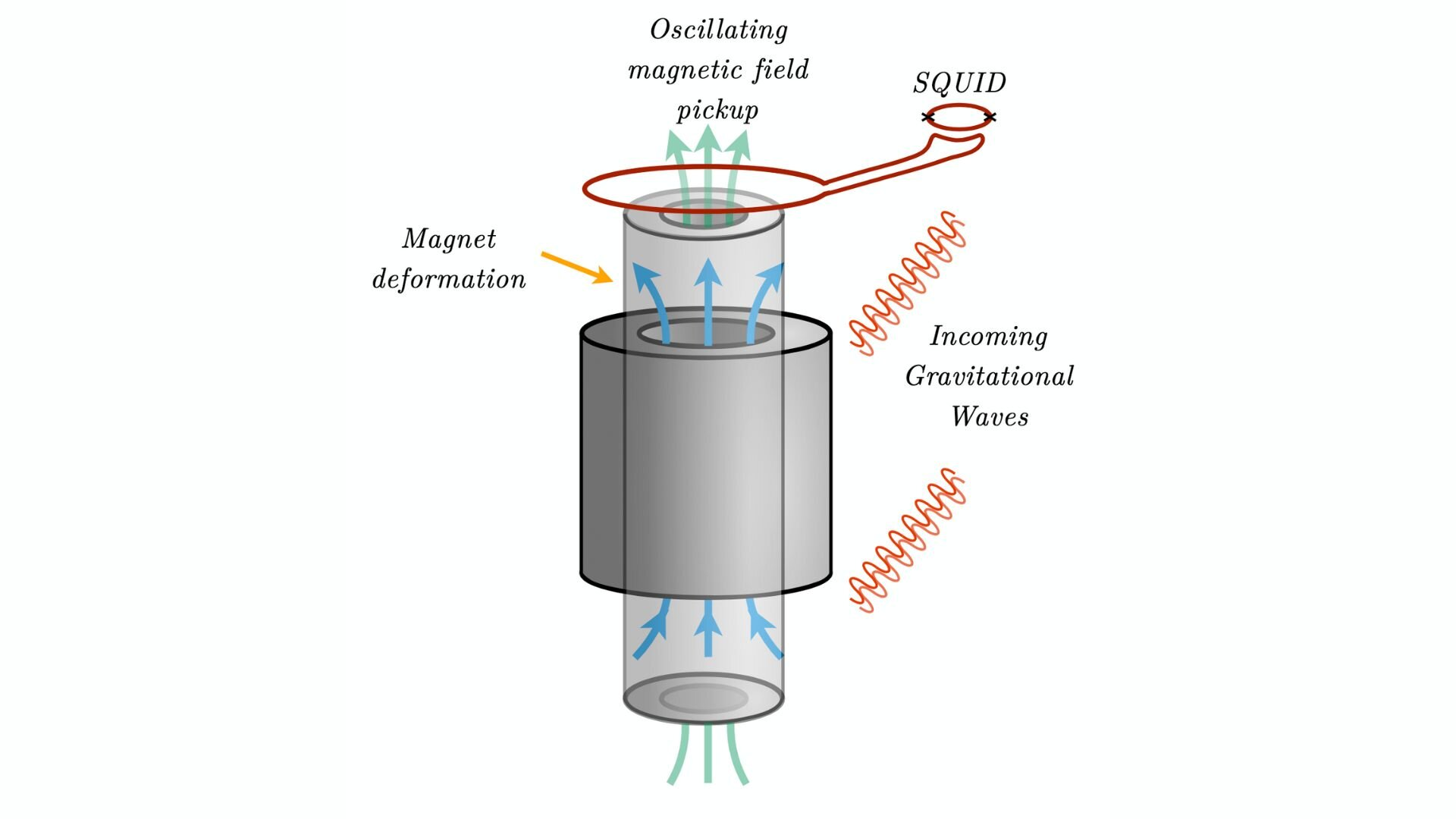
The advantage of this approach is that it is “two in one”: existing axion search facilities can simultaneously detect new cosmic events without increasing the budget for the experiments. The main challenge remains isolation from ground vibrations, but the authors note that laser observatories such as LIGO have already tested these techniques, so the prospects are optimistic. The article was published in Physical Review Letters.
The opening of the high-frequency “window” will allow researchers to directly observe ultra-short processes for the first time: the merger of small black holes, destructive “flares” of magnetars, and, possibly, signals from primordial objects in the early Universe. Combined with optical and X-ray data, such measurements will provide a complete multifaceted picture of extreme phenomena, improve models of compact body evolution, and help calibrate future interplanetary navigation detectors, which is critical for deep space missions.
Are you interested in understanding how the “music” of gravitational waves relates to the main mystery of cosmology — the speed of the expansion of the Universe? New detectors reveal previously unseen frequencies, but to understand the pace set by the mysterious “cosmic symphony”, it is worth looking deeper. Read the article “How fast is the Universe exploding? The biggest problem in cosmology” to find out!

