

Scientists continue to use data from the third release of the Gaia space telescope to make new discoveries. This time, they focused on protoplanetary disks around young stars.
Planet formation in protoplanetary disks
Have you ever wondered how planetary systems like our Solar System form? Thanks to the European Space Agency’s Gaia space telescope, we have a unique opportunity to peek behind the cosmic curtain into these dusty environments.
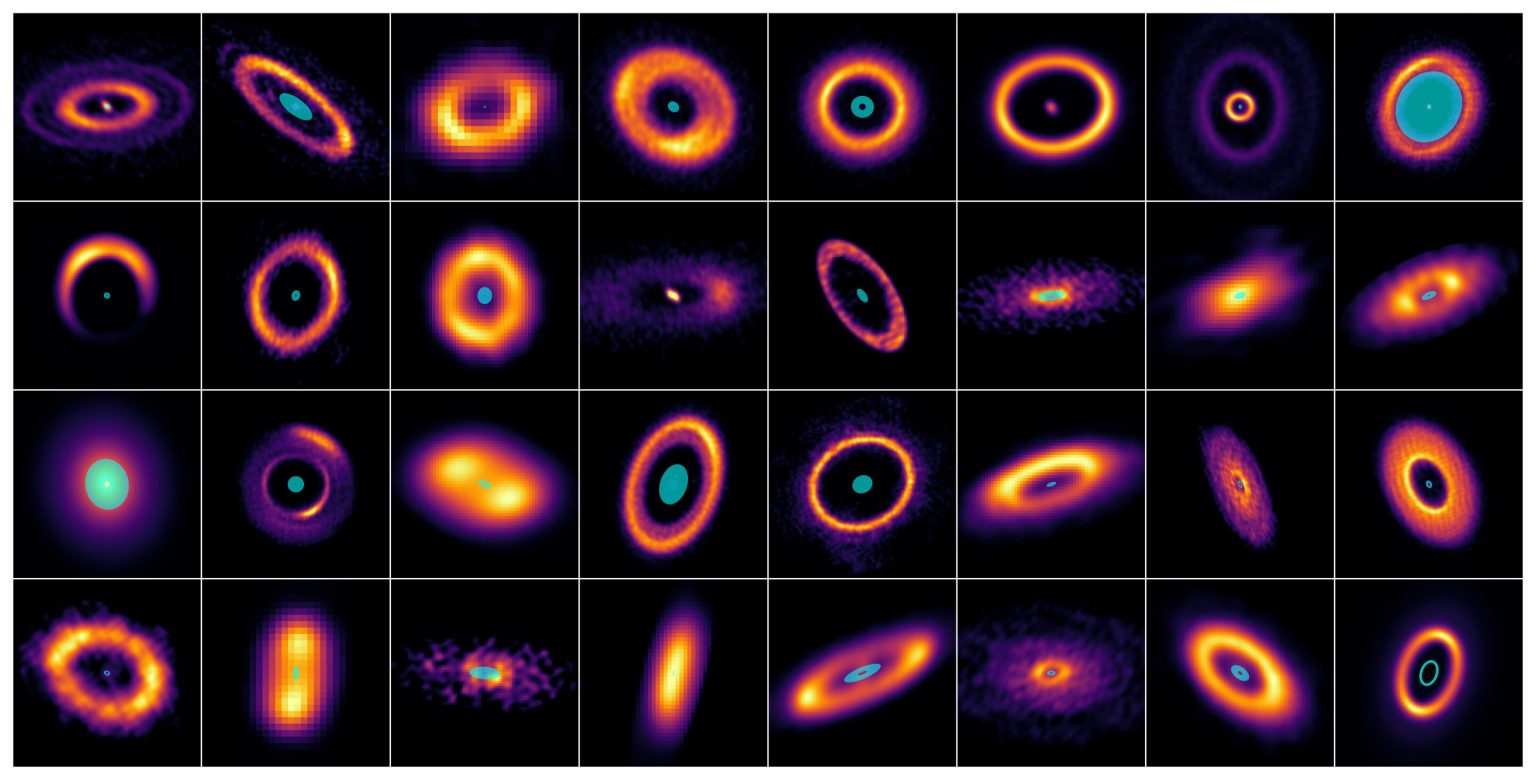
In this collage, we see images of 32 young star systems. The collage also shows our own Solar System for comparison at the bottom right, as it is thought to have looked at the age of 1 million years, with the Sun at the center (not visible).
All systems are centered around very young stars that have recently formed from huge clouds of gas and dust.
After the clouds collapsed under their own gravity, they began to rotate faster and flattened into disks with hot, dense centers. These centers became stars, and sometimes multiple stars formed. The disks around them are called protoplanetary disks.
32 young star systems are shown here in orange and purple, as seen by the Atacama Large Millimeter/submillimeter Array (ALMA) ground-based telescope.
Astronomers expect that the remaining material in protoplanetary disks will clump together to form planets, but until now it has been very difficult to detect them due to the dust and gas present in the disks. To date, very few planets have been discovered around forming stars.
Invisible companions of stars discovered by Gaia
In 31 of the 98 young star systems, Gaia detected subtle movements indicating the presence of invisible companions. In seven of these systems, the observed movements correspond to objects of planetary mass. In eight systems, the data best corresponds to the presence of brown dwarfs — objects larger than planets but smaller than stars. The remaining 16 systems probably have additional stars around them.
Gaia’s estimated locations of these companions in the systems are shown in blue. In the reference image of our young Solar System, Jupiter’s orbit is also shown in blue.
Gaia has discovered companions in young star systems thanks to its unique ability to detect the gravitational pull, or “wobble,” that a planet or companion causes on a star. This technique has already been used to search for companions around older stars. But now, for the first time, a team of astronomers led by Miguel Vioque from the European Southern Observatory in Germany has used Gaia’s technique to search for planets and companions around stars that are still forming.
Importance of research in the field of planetary formation
The large-scale nature of the Gaia survey, covering the entire sky, has allowed the team to study hundreds of forming stars for the first time and discover companions in large samples. This contrasts with expensive ground-based searches, which can only cover a few stars at a time.
This capability of Gaia is revolutionizing the field of star and planet formation research. Companions already detected by the telescope can now be studied with telescopes such as the NASA/ESA/CSA James Webb Space Telescope, which can examine the inner disks of young systems in greater detail.
With the upcoming fourth release of Gaia data, even more hidden planets are expected to be discovered.
According to phys.org

