

Deep space hides incredible shapes. But they are rarely so expressive. Astrophotographer Greg Meyer has presented an impressive image of a dark nebula, whose silhouette resembles a giraffe racing across the starry sea of the Milky Way.
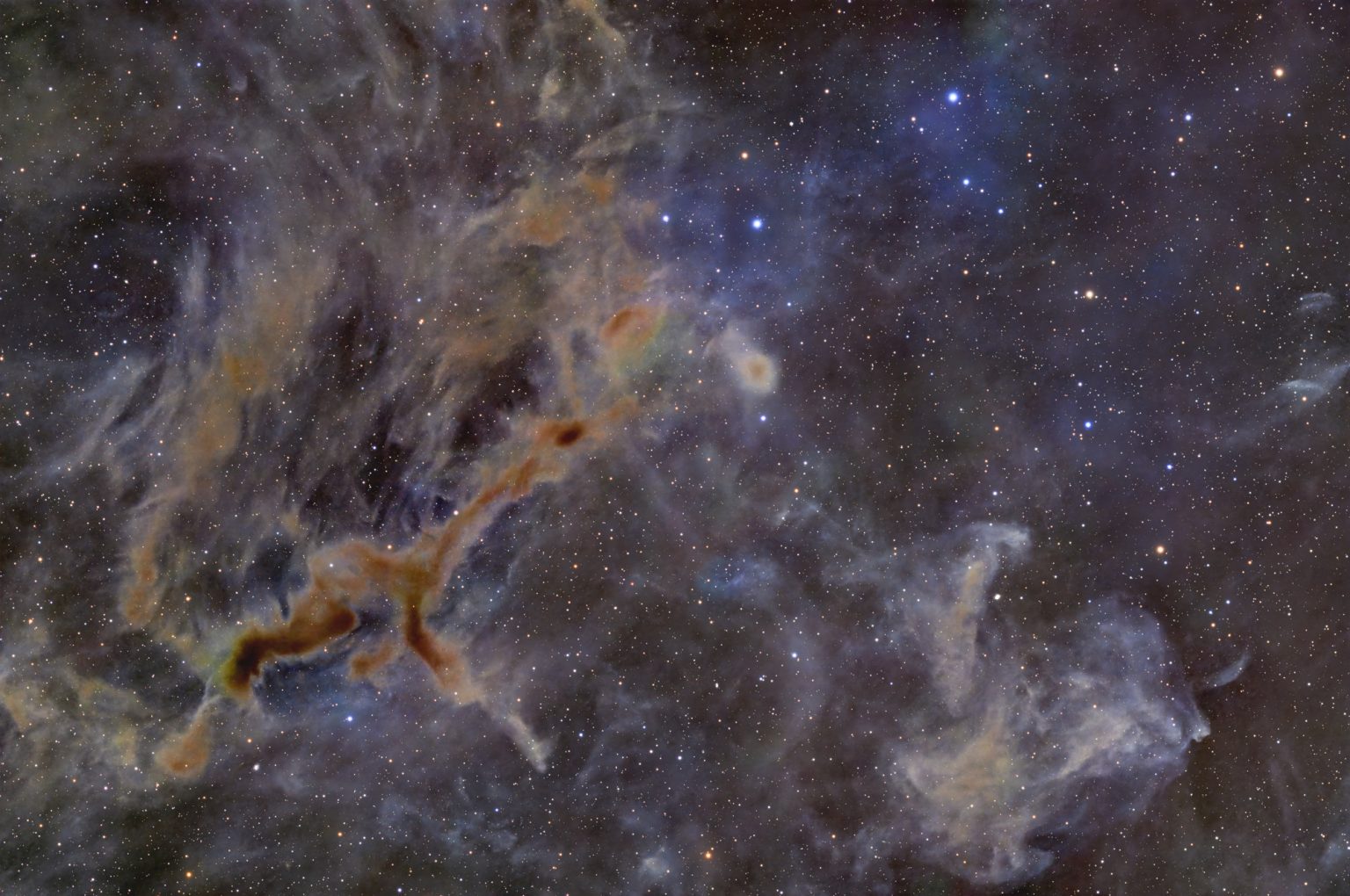
Space silhouette in the constellation Cassiopeia
The object known as LDN 1245 is a large, cold cloud of interstellar dust located in the constellation Cassiopeia. Its dense regions completely absorb the light of distant stars, creating black silhouettes against the bright background of our galaxy. It is this feature that has allowed us to see an entire image in abstract form: the nebula’s long “antennae” look like the neck and legs of a giraffe running at full speed, with its “head” stretched out toward a cluster of blue stars nearby.
25 hours for the perfect shot
Photographing a dark nebula is an extremely difficult task, as it emits virtually no light of its own. Greg Meyer spent more than three months working on this project, from October 2025 to January 2026. The total exposure time was 25 hours.
The photo was taken in Texas using a specialized 120-millimeter telescope and an astronomical camera with a set of color filters. The final image was compiled and processed using professional software.
Why do the edges of the nebula glow?
As the author explains, a faint blue glow can be seen at the edges of the “Cosmic Giraffe.” This is a different type of object — a reflection nebula. Here, dust particles do not absorb but scatter the powerful light from neighboring bright stars, acquiring a characteristic blue tint. Thus, two different cosmic phenomena are combined in one image.
This photograph is a striking example of how technical skill and creative vision can reveal poetic images hidden deep within the Universe. It reminds us that even in the seemingly empty and dark cosmos, incredible beauty lies in wait for artists with telescopes and cameras.
Earlier, we reported on how astronomers found the Dark Wolf in the sky.
According to Space

