

The European Space Agency has published an image taken by the Euclid telescope. It shows the galaxy NGC 646, which has a very unusual shape, somewhat resembling a garland.
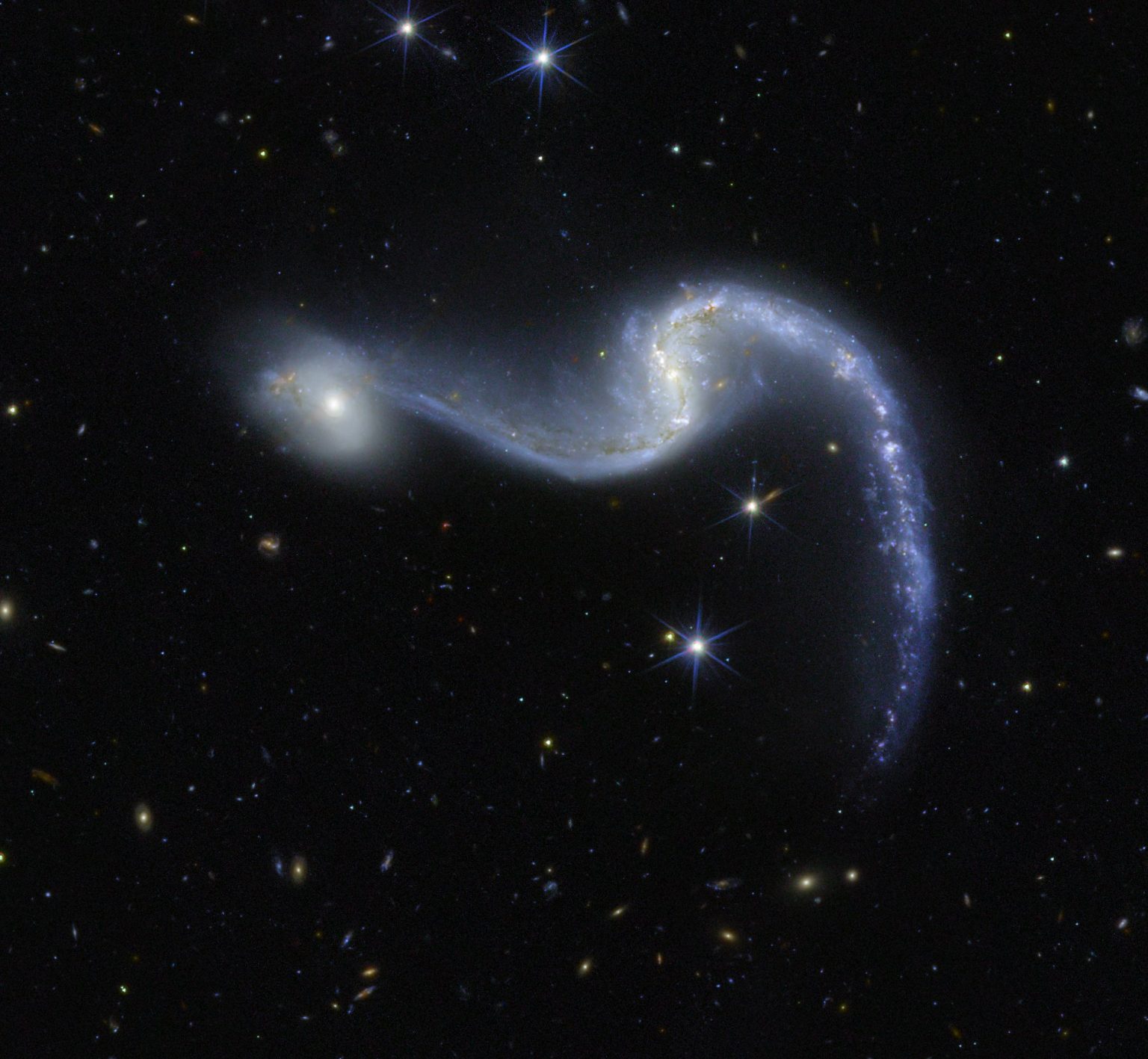
NGC 646 is a large barred spiral galaxy. It is located approximately 392 million light-years from Earth. Analysis of its redshift indicates that it is moving away from us at a rate of 8,145 km per second.
In the photo, NGC 646 is next to a smaller galaxy, PGC 6014, which you can see to its left. They look like neighbors, but that’s just an illusion. In reality, they are separated by a distance of 45 million light-years. Thus, any gravitational interaction between the galaxies, if it exists, will be very weak and short-lived.
Although a distance of 392 million light-years seems unimaginable, NGC 646 is actually relatively close to Earth compared to the billions of other galaxies that the Euclid telescope will observe during its six-year mission.
By the end of 2026, ESA and the Euclid consortium will publish the results of the first year of observations, covering about 1,900 square degrees of the sky (approximately 14% of the total survey area). These images will show hundreds of thousands of galaxies in minute detail, providing new insights into how they form and evolve, and why barred galaxies become more common as the universe ages.
Earlier, we talked about another pair of “fake neighbors” photographed by the Hubble Telescope.
Provided by ESA

