

Argentinian astronomers used the upgraded Giant Metre Radio Telescope (uGMRT) to study the galaxy NGC 4527. It shows signs of having recently undergone a starburst and, at the same time, has certain characteristics that indicate that this could happen again in the future.
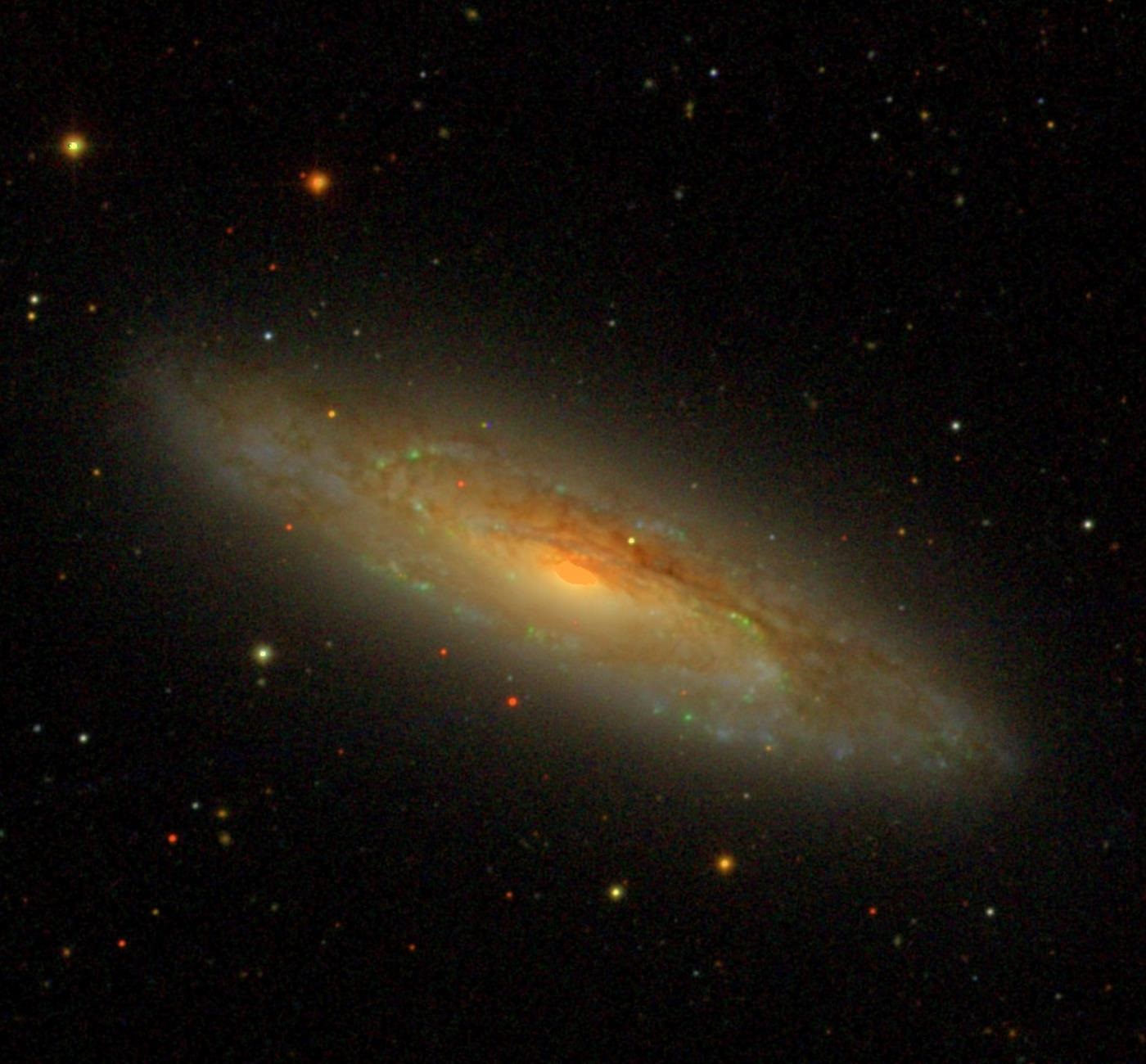
Galaxy NGC 4527
Argentinian astronomers used the upgraded Giant Metre Radio Telescope (uGMRT) to conduct high-resolution radio observations of a nearby spiral galaxy designated NGC 4527. The results of the observation campaign, published on July 2 on the arXiv preprint server, shed more light on the nature of this galaxy, indicating that it has an active galactic nucleus.
Discovered in 1783, NGC 4527 is a spiral galaxy seen edge-on in the constellation Virgo, about 49 million light-years away. It is estimated to be 104,000 light-years across and is classified as a starburst galaxy due to its high infrared luminosity (about 26 billion solar luminosities) and star formation rate of three solar masses per year.
The study was based on observations at frequencies of 700 MHz (band 4) and 1230 MHz (band 5), supplemented by archived infrared and X-ray data. They provided insights into the spatial distribution of gas and dust within the galaxy.
Research results
Previous observations of NGC 4527 have detected three supernovae that exploded within the galaxy’s disk. This indicates that it recently experienced a major burst of star formation. However, this galaxy has an extremely low star formation rate compared to classical galaxies such as M 82 and NGC 253.
As for the central region of NGC 4527, observations have detected three compact radio sources here. One of them was found in the center of the galaxy, and it exhibits a non-thermal spectral index. The other two sources appear to be symmetrically located along the galaxy’s major axis at a projected distance of approximately 1,300 light-years, and both exhibit relatively flat spectral indices.
The observation of polycyclic aromatic hydrocarbons is also interesting. These important organic compounds are present throughout the galaxy’s disk. However, in the core, these substances are rapidly destroyed due to high energy.
In general, astronomers conclude that NGC 4527 may have an active core. And usually its radiation stimulates the ring of star formation located around the center. However, both are currently “dormant.” It is as if the galaxy has taken a break between two bursts of gas transforming into stars.
According to phys.org

