

Astronomers have discovered that the giant planet WASP-189b has a composition similar to that of its host star, marking the first direct confirmation of one of the fundamental concepts of astrobiology. This discovery was made possible by the first-ever simultaneous measurement of the levels of gaseous magnesium and silicon in the planet’s atmosphere. The team used the Gemini South telescope, part of the Gemini International Observatory.
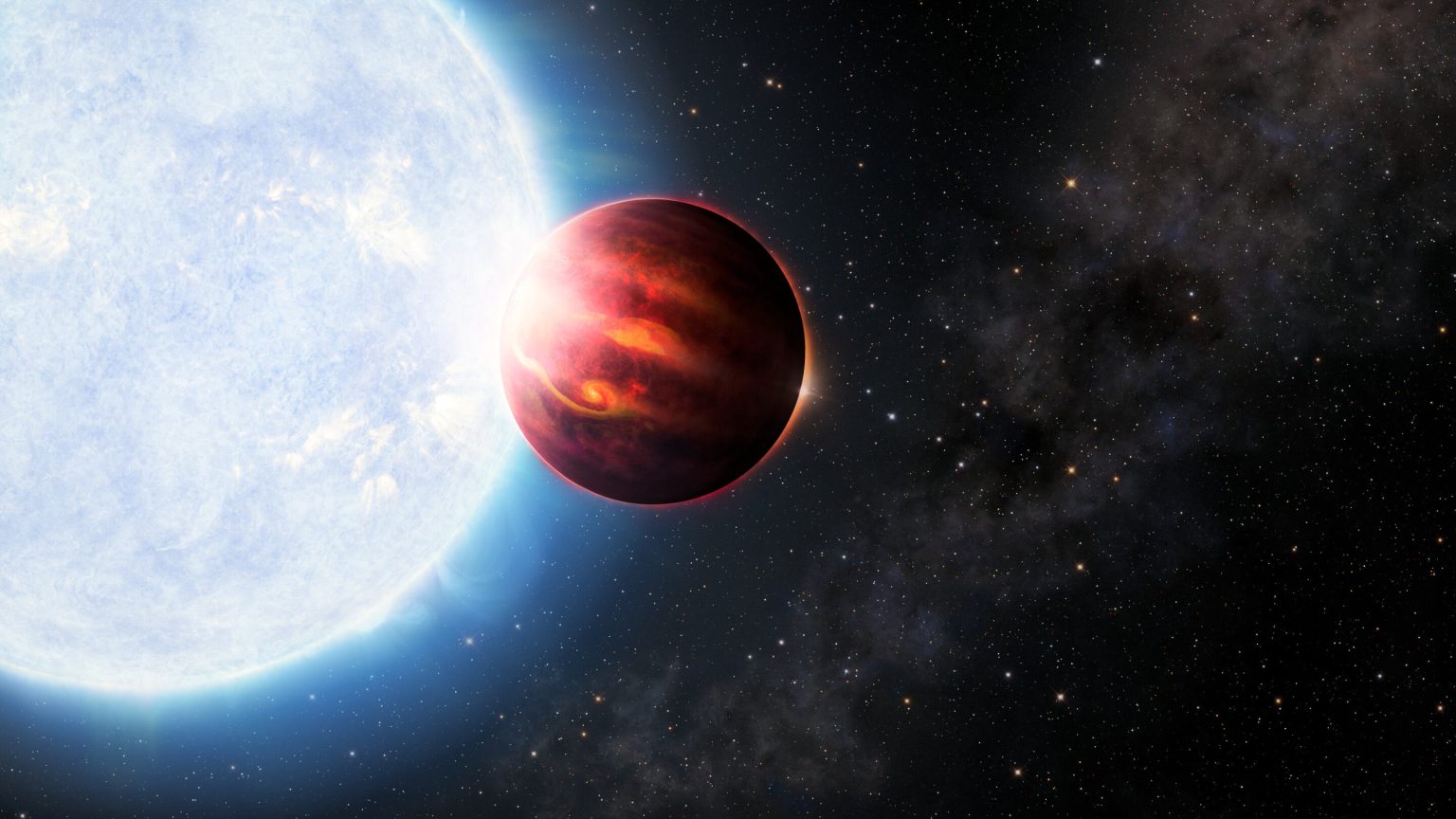
Measuring magnesium and silicon in an exoplanet
Approximately 320 light-years away in the constellation Libra lies WASP-189b, an exoplanet known as an ultra-hot Jupiter (UHJ). The temperature at UHJ is high enough to vaporize elements that make up rocks, such as magnesium (Mg), silicon (Si), and iron (Fe), providing a rare opportunity to observe these elements using spectroscopy—a method that breaks down light into its constituent wavelengths to detect chemical substances.
An international team of astronomers led by Jorge Antonio Sanchez, a graduate student at Arizona State University (ASU), observed the exoplanet WASP-189b using the high-resolution Immersion GRating INfrared Spectrograph (IGRINS) mounted on the telescope. This powerful instrument enabled them to simultaneously measure the magnesium and silicon content in the exoplanet’s atmosphere.
This is the first time such a measurement has been made, and the data show that WASP-189b has the same magnesium-to-silicon ratio as its host star. This discovery provides the first observational evidence for a widely accepted hypothesis regarding planetary formation and opens up a new avenue for understanding how exoplanets form and evolve.
Development of the theory of rocky planet formation
It is believed that hot giant planets, such as WASP-189b, possess an outer gaseous layer whose chemical composition is shaped by the disk of material in which they formed, known as a protoplanetary disk. Researchers suggest that the ratio of the elements that make up rocks in the protoplanetary disk corresponds to the ratio in the parent star, since both formed from the same primordial cloud of matter.
This established chemical link between a star and the planets forming around it is commonly used to model the composition of rocky exoplanets. Previously, this connection was based on measurements within our Solar System, and to date it has not been directly observed on planets in other systems.
Scientists emphasize the importance of studying the planet WASP-189b, as it serves as a crucial reference point for observations aimed at understanding the formation of terrestrial planets; it provides measurable data that supports the hypothesis that the composition of stars is similar to that of the rocky material surrounding them, which is used to form planets.
What does this mean for astrobiology?
This hypothesis not only provides insight into the process of planetary formation, but is also fundamental to the field of astrobiology, which involves the study of environments suitable for life within the Solar System. By measuring a star’s chemical composition, scientists can determine the abundance of rock-forming elements in its exoplanets, which in turn determines the geochemical conditions that make a planet habitable. For example, the Earth’s mountain-forming elements are partly responsible for our protective magnetic field and plate tectonics, and they contribute to the release of vital chemicals into our atmosphere, oceans, and soil.
While the field of exoplanet research focuses primarily on characterizing Earth-like planets and determining the conditions conducive to life on rocky worlds, empirical data confirming the correlation between the compositions of stars and planets represents a fundamental step forward. The level of spectral resolution required for this type of research is currently available only with ground-based telescopes.
Future high-resolution multi-wavelength observations aimed at studying exoplanet atmospheres similar to that of WASP-189b will help identify a wider range of chemical elements present on distant worlds. Such research will provide a deeper understanding of the conditions that determine the origin, evolution, and potential habitability of planets.
According to phys.org

