

Studying solar activity is not only fundamental science, but also key to the safety of our technological world. Coronal mass ejections and solar flares can disable satellites, power grids, and navigation systems. However, sometimes these studies give us true artistic masterpieces, born at the intersection of science and art.
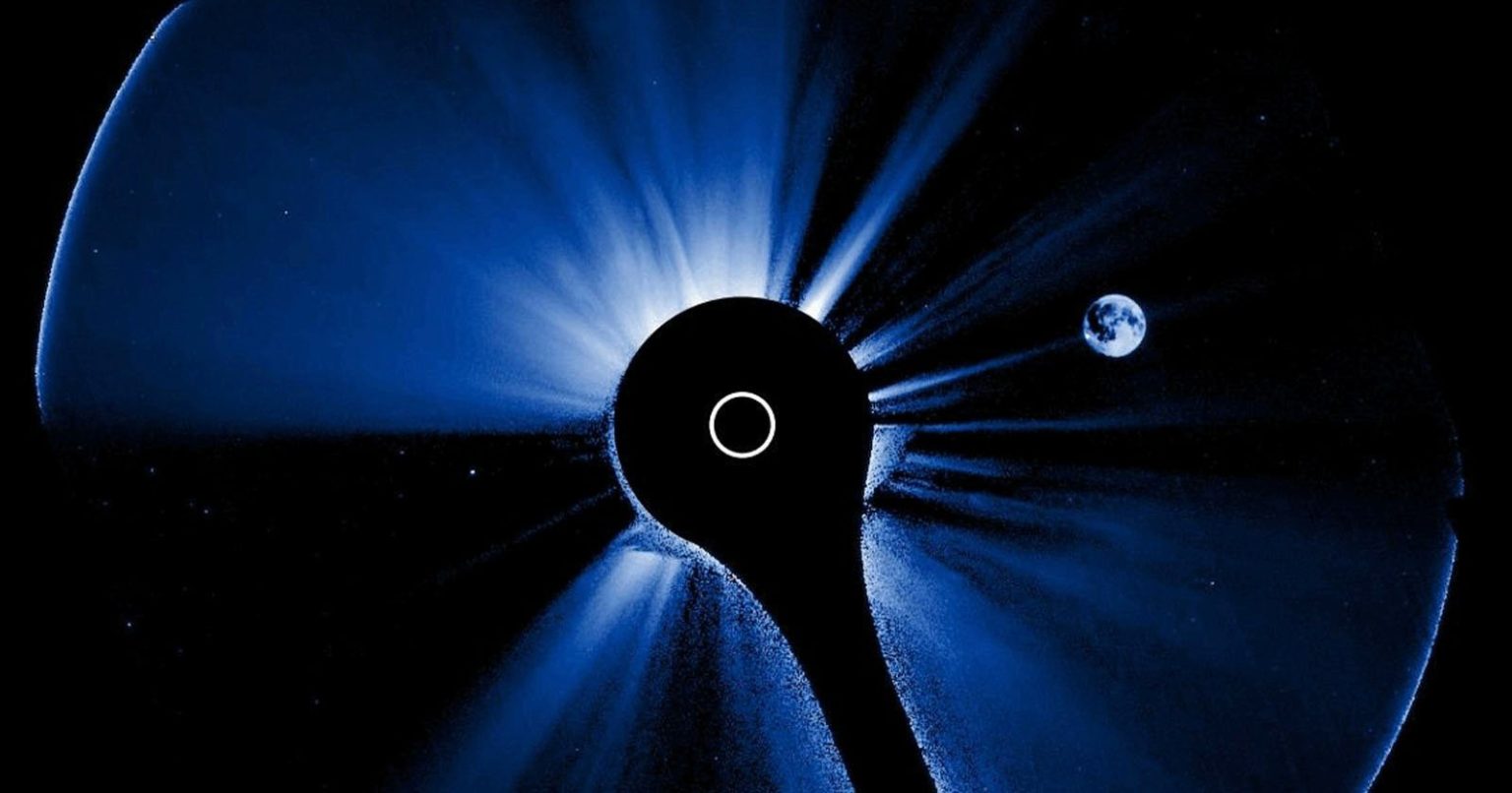
Recently, scientists from the National Oceanic and Atmospheric Administration (NOAA) obtained unique images from one of their coronagraphs. This special device, installed on board the satellite, works on the principle of an artificial solar eclipse. It covers the bright solar body with a special disk, allowing for detailed study of the hot plasma corona around it, which is usually invisible due to the intense light of the star.
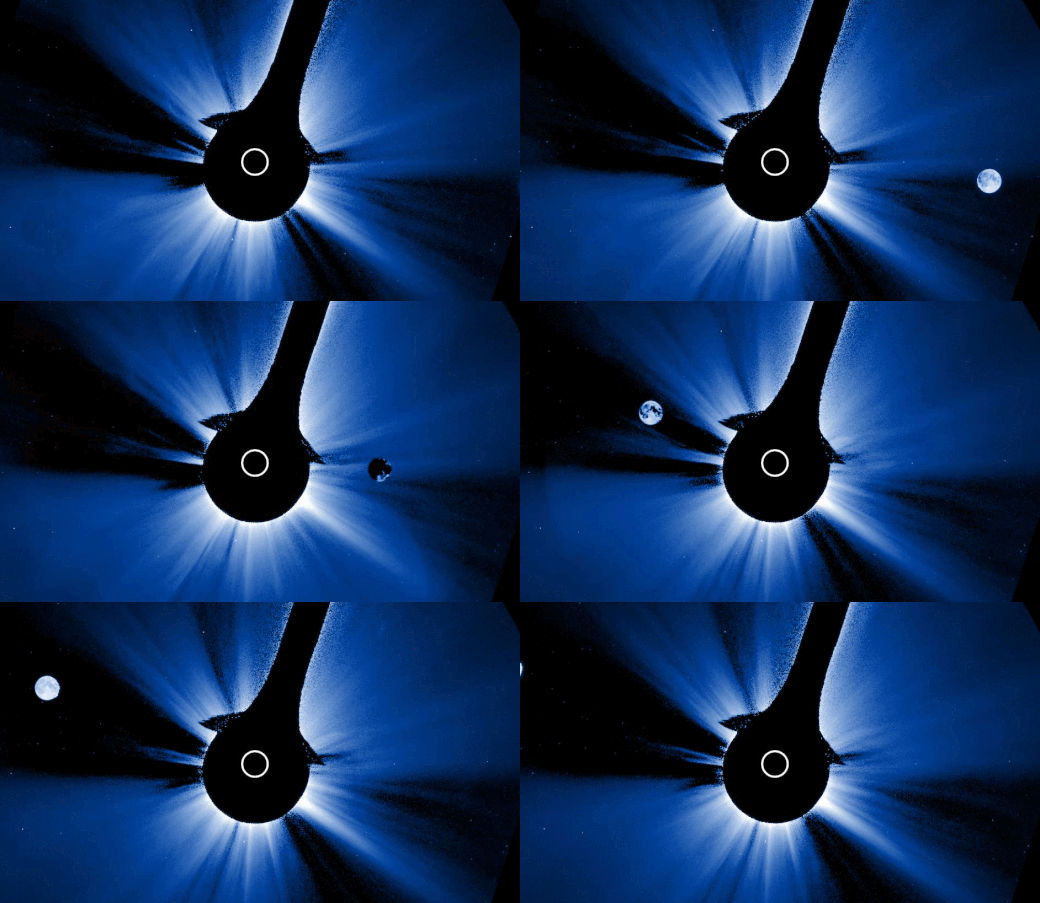
The compact coronagraph CCOR-1, we are talking about, is part of the GOES-19 satellite equipment. This spacecraft is in geostationary orbit, meaning it moves in sync with the Earth’s rotation. This position is ideal for continuous monitoring of space weather.
The Moon in the Earth’s rays
The coronagraph lens captured an impressive phenomenon: the clear silhouette of the Moon passing in front of the solar disk. But the most surprising thing is that in the photograph, the Moon does not look like a dark silhouette, but like a fully illuminated sphere. This effect has nothing to do with changes in the phases of the Moon.

The source of this mysterious light was our own planet. Bright sunlight reflected from Earth’s atmosphere and surface illuminates the night side of the Moon. This phenomenon, known as “earthshine,” is responsible for giving the moon such a ghostly appearance in the photograph. Similarly, a short flash appears, which can be seen in the video — it is also a reflection from our planet.
Space monitoring on guard for Earth
Such observations are not only an aesthetic pleasure. They clearly demonstrate the capabilities of modern space technology. Coronagraphs such as CCOR-1 are an important link in the system for warning of dangerous solar storms.
In addition, satellite observatories constantly monitor the state of our planet. They record the consequences of natural disasters: from destruction caused by large-scale fires to the collapse of giant icebergs in distant ocean waters.Each of these images provides valuable data for science, helping us to better understand and protect our common home, planet Earth.
Earlier, we explained how long it takes to fly to the Moon in a spacecraft.
According to noaa.gov

