

At the dawn of the Solar System, collisions involving planets and giant asteroids were a common occurrence. It is believed that such an impact led to the formation of the Moon. It is also sometimes used to explain the dichotomy of the two hemispheres of Mars. But what about Venus?
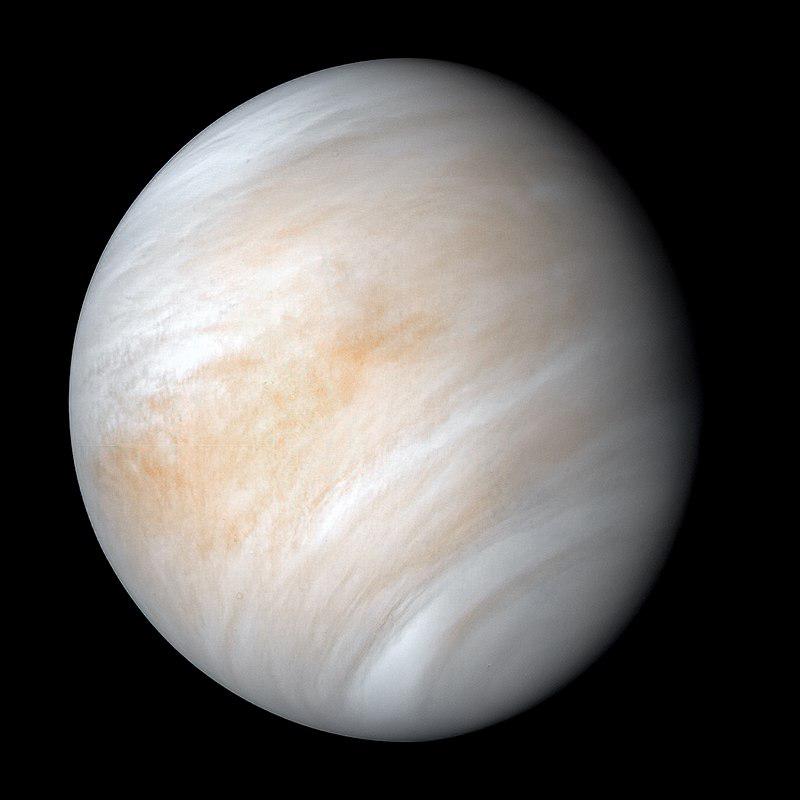
Venus differs significantly from Earth and Mars in both its lack of moons and its slow retrograde rotation around its axis. Scientists have long suspected that these features could be explained by the effects of a giant impact. Researchers from the University of Zurich decided to test this assumption. They used advanced computer simulations called smoothed particle hydrodynamics to model what would have happened if Venus had been hit by massive objects early in its formation. These simulations allow us to track the behavior of materials during extreme collisions, making them ideal for studying planetary impacts.
The team simulated Venus as it probably was after its initial formation: a differentiated planet with an iron core comprising 30% of its mass and a mantle of forsterite comprising the remaining 70%. They then simulated collisions with objects ranging in mass from 0.01 to 0.1 times the mass of Earth.
The simulations examined various collision scenarios: speeds ranging from 10 to 15 km/s, different impact geometries (from head-on to oblique), different initial thermal profiles, and different rotation speeds of Venus. By conducting these digital experiments, researchers were able to analyze how such events could affect Venus’ rotation periods after the collision and the formation of the debris disk.
The results of the study show that a wide range of collision scenarios are compatible with Venus’ current rotation speed and direction. These include head-on collisions with non-rotating Venus and oblique collisions with rotating Venus by bodies the size of Mars.
However, the most important thing they discovered was that collisions corresponding to Venus’ current rotation speed usually result in the formation of very small debris disks that remain within the synchronous orbit. This means that their material then falls back onto the planet, preventing the formation of permanent moons. As a result, scientists came to the final conclusion that a giant collision could be compatible with both Venus’ unusual rotation and the absence of moons.
Earlier, we reported on how giant “pancakes” were baked on the surface of Venus over thousands of years.
According to Phys.org

