

Our galaxy, the Milky Way, is far from being a static light in the cosmic darkness. It is a dynamic, living organism, whose history is “recorded” in the movements of its stars. Thanks to modern technology, astronomers have learned to read this record and have made an incredible discovery: the outer regions of the galactic disc are swept by a giant wave spreading out from the centre. It is like ripples on water from a stone thrown into a pond. But what was that “stone” for our galaxy?
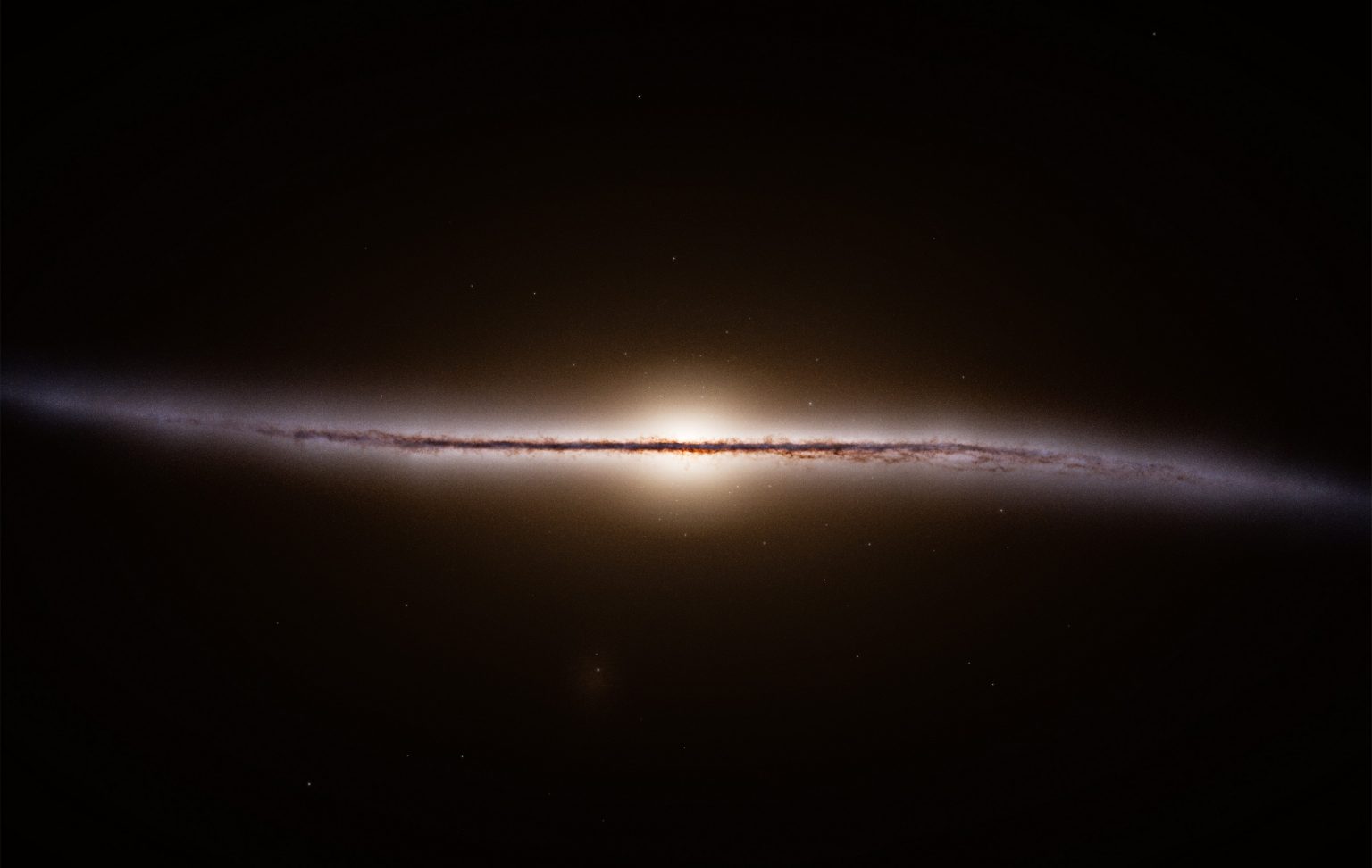
The key to this discovery was data from the Gaia space telescope, which has been meticulously mapping the spatial location and velocities of billions of stars in our galaxy for more than a decade. Italian scientists led by Eloisa Poggio analysed the motion of two types of stars: young giants and Cepheids located at great distances from the centre of the Milky Way.
The researchers studied not the horizontal movement of stars, but their vertical movement — up and down relative to the galactic plane. The result was impressive. Both groups of stars showed the same, consistent pattern: they moved in a peculiar “corrugated” structure with alternating rises and dips. This pattern is a manifestation of a giant wave spreading across the outer disc of the galaxy.
What is a galactic wave?
Imagine a calm surface of water into which a stone has fallen. The impact creates concentric circles that spread out towards the banks. The amplitude of these waves increases with distance from the epicentre. Astronomers observe a similar phenomenon in the Milky Way.
“This observed behaviour is consistent with what we would expect from a wave,” explains Eloise Poggio.
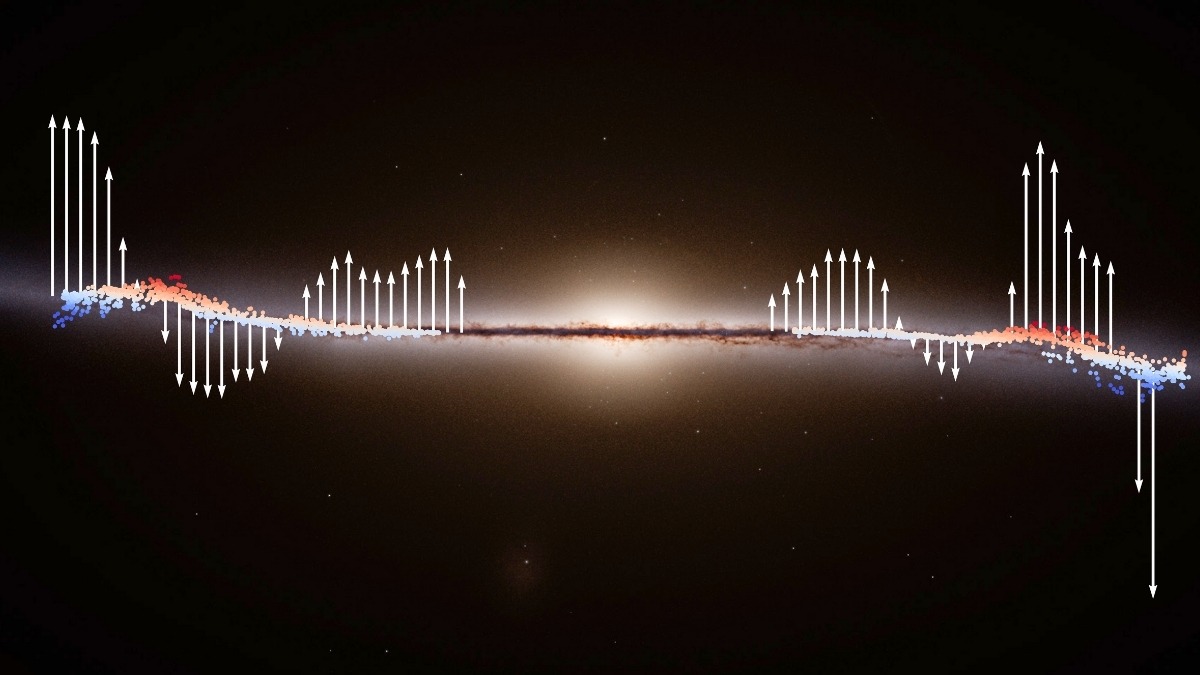
The wave detected in young stars is likely a continuation of oscillations in the galaxy’s gas disc. Stars born from this gas inherit its motion, allowing us to see a structure that would otherwise be invisible. The amplitude of these galactic “ripples” increases with distance from the centre, reaching a maximum at the very edges of the disc.
Who “threw the stone”?
The most important question that concerns scientists is what exactly caused this massive wave? The exact answer is still unknown. But the main suspect is the Sagittarius dwarf galaxy. This small galaxy is now slowly being absorbed by the Milky Way, but in the past it may have been much closer to the galactic disc. Its gravitational influence could have been the very “stone” that disturbed the tranquillity of our stellar “pond”.
Another possibility is a connection with the recently discovered Radcliffe wave, although it is significantly smaller and located in a different part of the disc. “These two waves may or may not be related. Therefore, we would like to conduct further research,” notes Poggio.
This discovery once again clearly demonstrates that the Milky Way is a dynamically active system that is still experiencing the events of its turbulent past. This system does not simply exist, but “breathes” and fluctuates, reacting to external interventions.
The next major release of data from the Gaia telescope is expected in 2026. It will provide even more accurate data on the movements of stars, and then scientists hope to finally unravel the mystery of the origin of the giant wave and understand what exactly causes our galaxy to perform this cosmic dance.
The results of the study are described in Astronomy & Astrophysics.
Earlier, we reported on how a shockwave larger than the Milky Way caused chaos among five galaxies.
According to Science Alert

