

When the James Webb Space Telescope (JWST) began operating in 2022, it expanded the horizon of the observable Universe. Among the first surprises were Little Red Dots (LRDs) – faint objects that already existed just 600 million years after the Big Bang. Their brightness indicated an incredible mass, comparable to that of a galaxy. Strange objects have become one of the mysteries generated by the discovery of the telescope in deep space. Scientists have attempted to find an explanation for these strange objects.
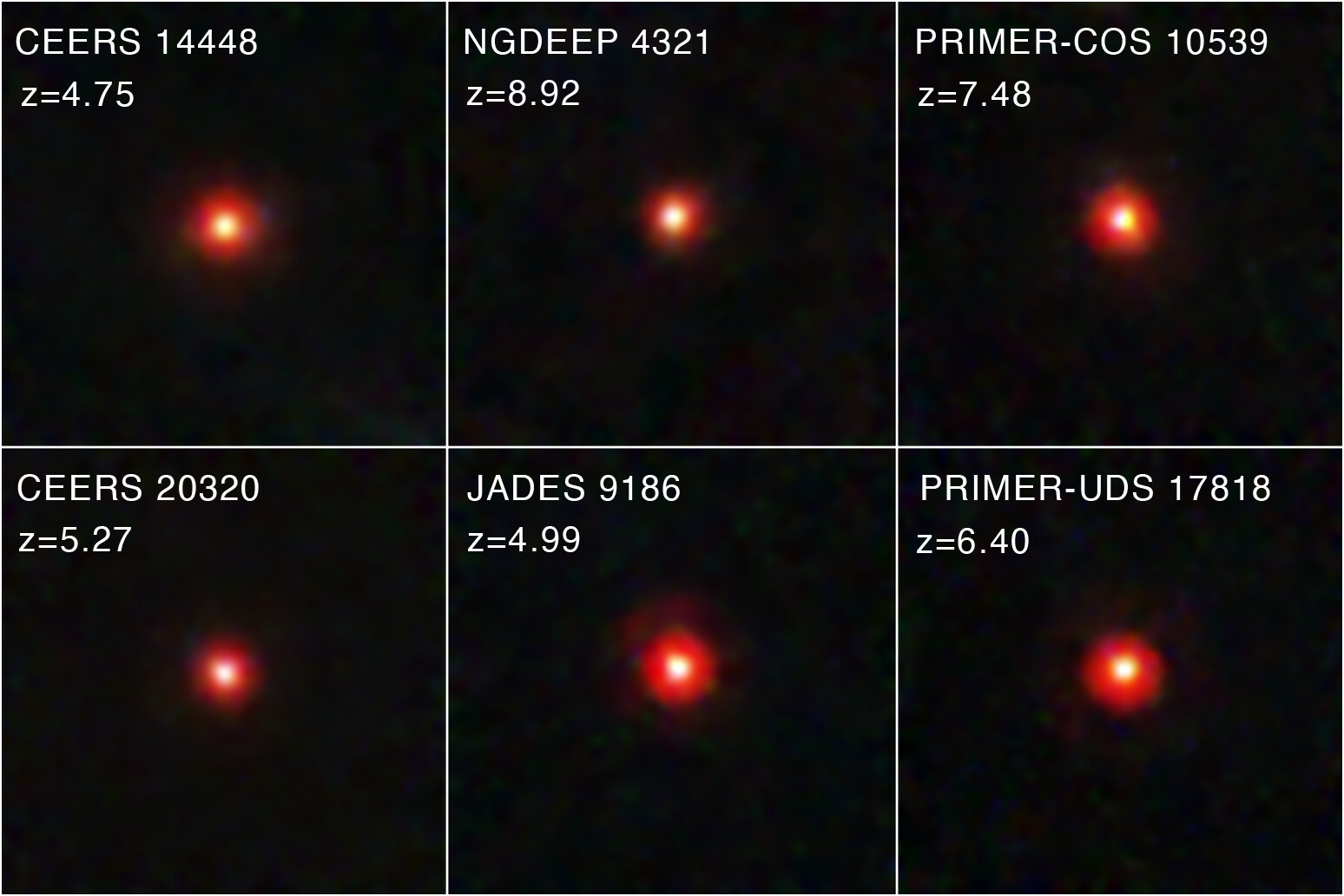
Initially, the prevailing opinion was that LRDs were active galactic nuclei with supermassive black holes, which explained their red color, formed by heated gas and dust in accretion disks. However, observations did not confirm the hypothesis: no X-rays were detected, the infrared spectrum was unusual, and variability was minimal. Furthermore, the presence of so many supermassive objects at such an early stage contradicted standard cosmological models.
Giant stars
A new study by scientists from the University of Virginia and the Harvard-Smithsonian Center for Astrophysics (D. Nandal, A. Loeb) offers a radically different explanation. Scientists have suggested that LRDs are not galaxies, but hypothetical supermassive stars with a mass of about a million suns. Theoretically, such stars could only have formed in the early Universe, which at that time consisted only of pure hydrogen and helium (Population III) – these are considered to be the “seeds” of future supermassive black holes.
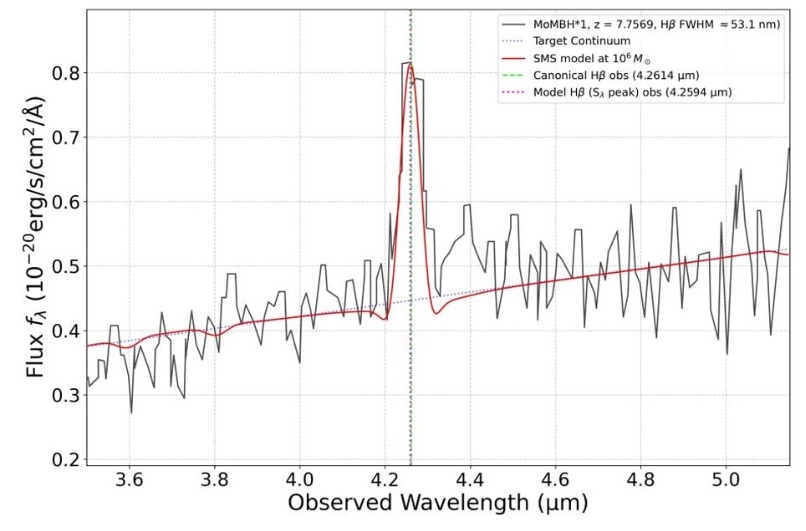
Nandal and Loeb created detailed models of the atmospheres of metal-free supermassive stars. It turns out that the luminosity of such stars perfectly matches that observed in Little Red Dots. The most important argument was the spectrum: the model successfully reproduced the unique V-shaped shape of the Balmer break and the presence of a strong Hβ line in the emission near the absorption lines, which is characteristic of Little Red Dots. This is explained by the extremely dense and extended photosphere around supermassive stars.
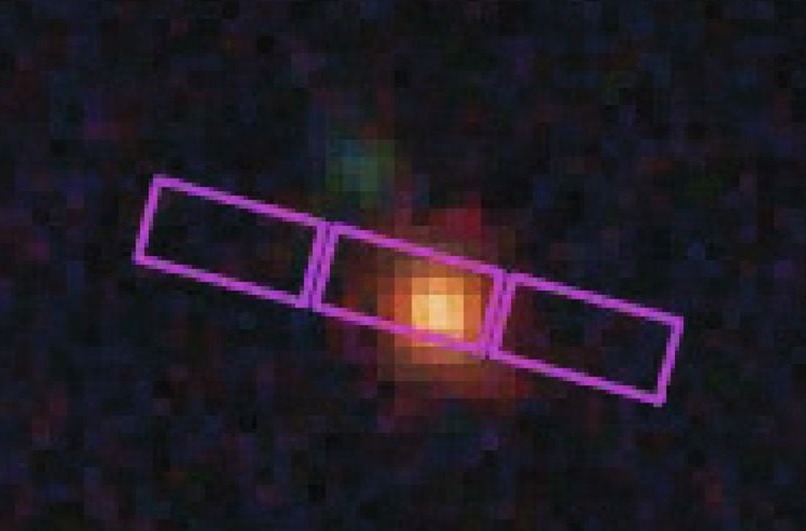
The theory of supermassive stars offers an elegant and unique explanation for all the studied properties of “Little Red Dots,” unlike complex models of active galactic nuclei, which require additional explanation. The hypothesis also answers the main mystery: how did supermassive black holes appear so early? Supermassive stars, whose lives lasted no more than 1,000 years, collapsed into black holes, becoming the seeds for future quasars. Their rarity is consistent with the small number of LRDs.
Future research
Although the supermassive star model is very convincing, definitive confirmation will require new data and improved models. Observing Little Red Dots is the limit of James Webb’s capabilities. At present, this discovery has the potential to change our understanding of the early Universe, pointing to supermassive stars as a key stage in the birth of giant black holes and the evolution of the cosmos. If the theory is confirmed, it will shed light on one of the most profound questions in astronomy.
Earlier, we reported on how quasars were discovered.
According to Science Alert

