

A group of researchers studied the glaciers covering the slopes of Martian craters. They conclude that 80% of their volume consists of pure water ice. This indicates that in the past, the red planet experienced one global glaciation or several smaller but very similar glaciations.
Ice on Mars
Mars is a cold but very dry planet. Low atmospheric pressure causes water on its surface to change from a solid to a gaseous state. Therefore, it is believed that this substance on the planet exists mainly as a seasonal component of polar ice caps. However, new research has shown that this is not the case.
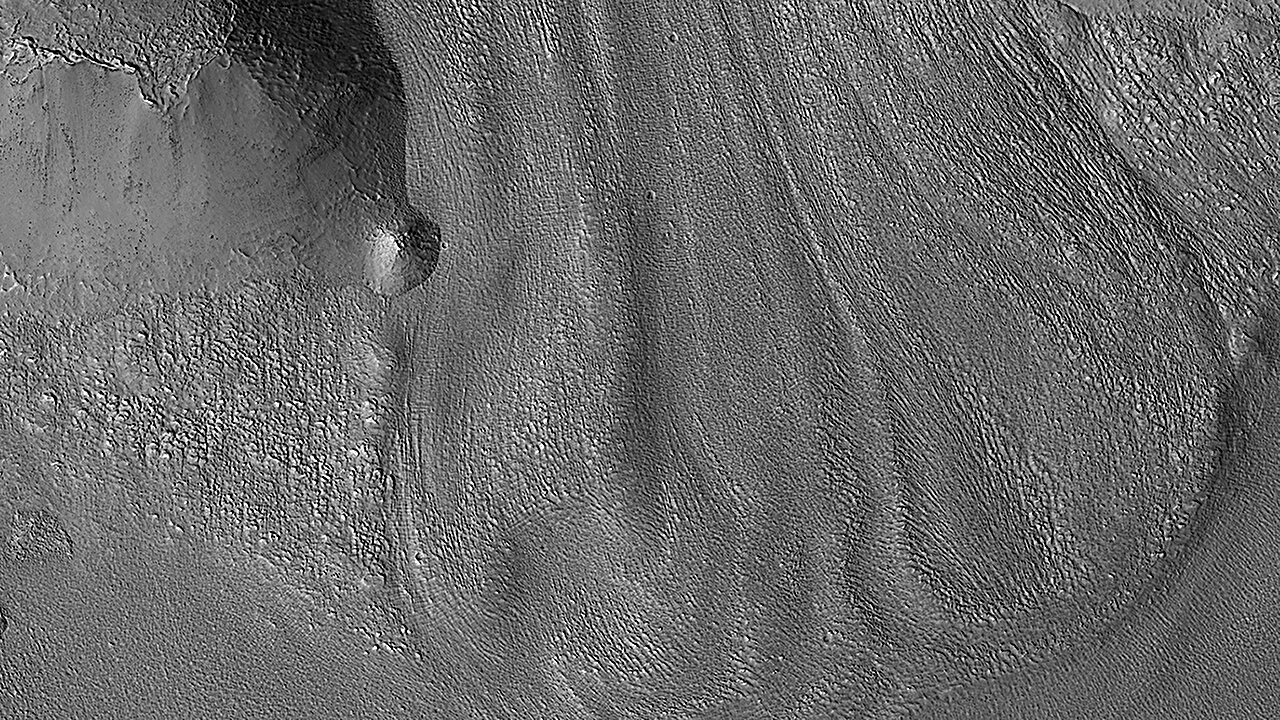
Recently, researchers from Israel, the US, and the UK studied formations resembling solidified honey on the slopes of some craters on the dark planet. It has long been known that these are contaminated glaciers hidden under dust, but no one knows how much water and how many rocks there are.
And now scientists have used the Mars Reconnaissance Orbiter to study this question. More precisely, the SHARAD radar on board revealed some interesting information. Its waves are partially capable of passing through the surface, and thanks to this, the dielectric properties of glaciers and the tangent of the loss angle have been measured.
Global glaciation on Mars
In total, scientists investigated five sites on Mars. Two of them had been studied before, two were known but had not yet been researched, and one they found on their own at the very beginning of the study. And all of them yielded roughly the same result: the proportion of ice in the glacier is about 80%.
That’s quite a lot. In fact, this geological structure is only covered with powder on the surface, while inside it is almost pure ice. This is a very important result for future colonization, as it means that there is not so little water available for use.
However, even more important is that the results for different glaciers are very similar. After all, they are located in different regions of Mars. So, there’s been at least one global ice age that covered the whole planet. Or several local ones, but very similar.
All this is very interesting because it means that in the past there had to be a lot of water on Mars, as the most daring theories suggest. To confirm this, scientists plan to study other glaciers on Mars.
According to phys.org

