

Using the Anglo-Australian Telescope (AAT), astronomers observed a nearby globular cluster known as NGC 6569. The results of the observations, published on December 22, indicate that this galaxy is actively losing stars due to tidal disruption.
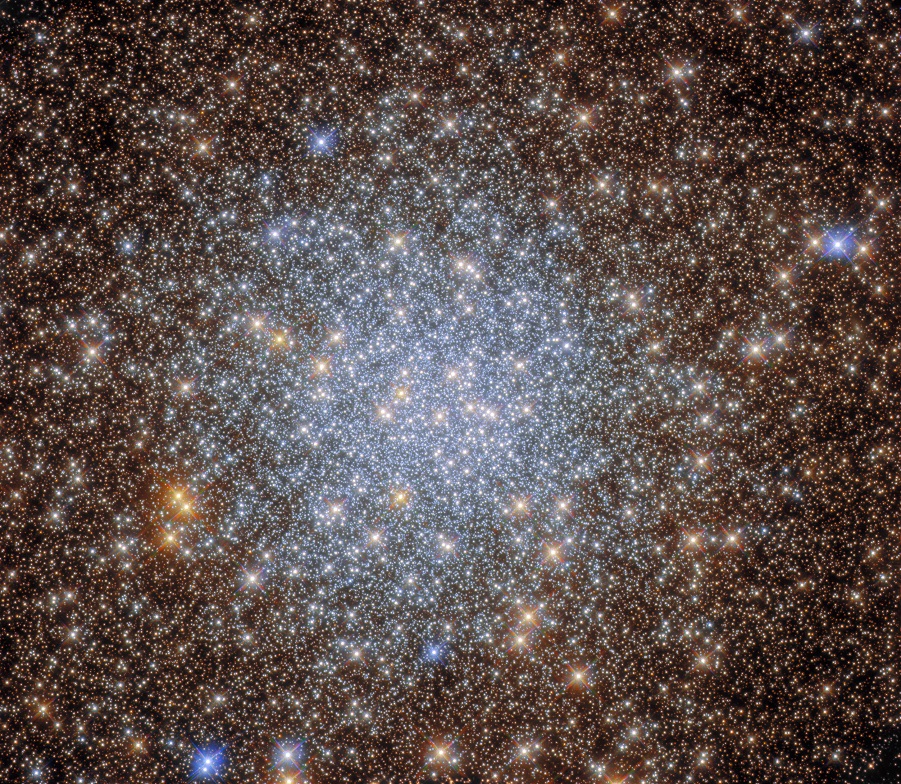
Globular cluster
NGC 6569 is a globular cluster in the bulge of the Milky Way, located about 35,500 light-years from Earth. With a mass of about 230,000 solar masses and a metallicity of -0.8 dex, it is a relatively massive and moderately metal-rich cluster, estimated to be 13 billion years old.
A team of astronomers led by Joanne Hughes of the University of Seattle recently observed NGC 6569 using the AAT as part of the Milky Way Bulge Extra-Tidal Star Survey (MWBest) project, which aims to study the decay of globular clusters (GCs) in the inner Milky Way. In general, theoretical models suggest that globular clusters within 6,500 light-years of the galactic center can lose up to 80% of their mass in the field.
Observations show that in the galactic halo, about 26% of globular clusters have tidal tails, and 42% of them have distinct non-tidal features; however, these features rarely appear around globular clusters.
Tidal debris in NGC 6569
Using the Anglo-Australian Telescope, Hughes’ team obtained medium-resolution spectra of 303 stars in NGC 6569. Analyzing these spectra, they found spectroscopic evidence for the existence of tidal debris associated with this cluster.
According to the publication, astronomers have identified 40 stars between 7 and 30 arcminutes away from the center of NGC 6569, which they interpret as genuine debris. Five of these stars appear to be part of a halo of tidal debris surrounding this cluster.
Loss of stars due to tidal disruption
In addition, the researchers compared the dynamically bound stars of the NGC 6569 cluster with the surrounding field. They found that about 35% of the local stellar population has the same proper motion. By combining chemical-dynamic constraints with dynamic analysis, they estimated that the cluster experiences constant moderate stratification, losing about 5.6% of its mass every billion years.
Observations also suggest that NGC 6569 is moving through a tube of its own inflowing debris. However, further research, in particular N-body simulations, is needed to test this hypothesis.
Overall, the authors of the article concluded that the structural features of NGC 6569 are fully consistent with the ongoing mass loss derived from chemical-dynamic analysis. This indicates that the cluster is actively losing stars in the bulge field.
Research results indicate that NGC 6569 is actively losing stars due to tidal disruption, contributing to the replenishment of the bulge field at a current rate of 1.0–1.6 solar masses per year, which corresponds to approximately 5.6% of its current mass per billion years.
According to phys.org

