
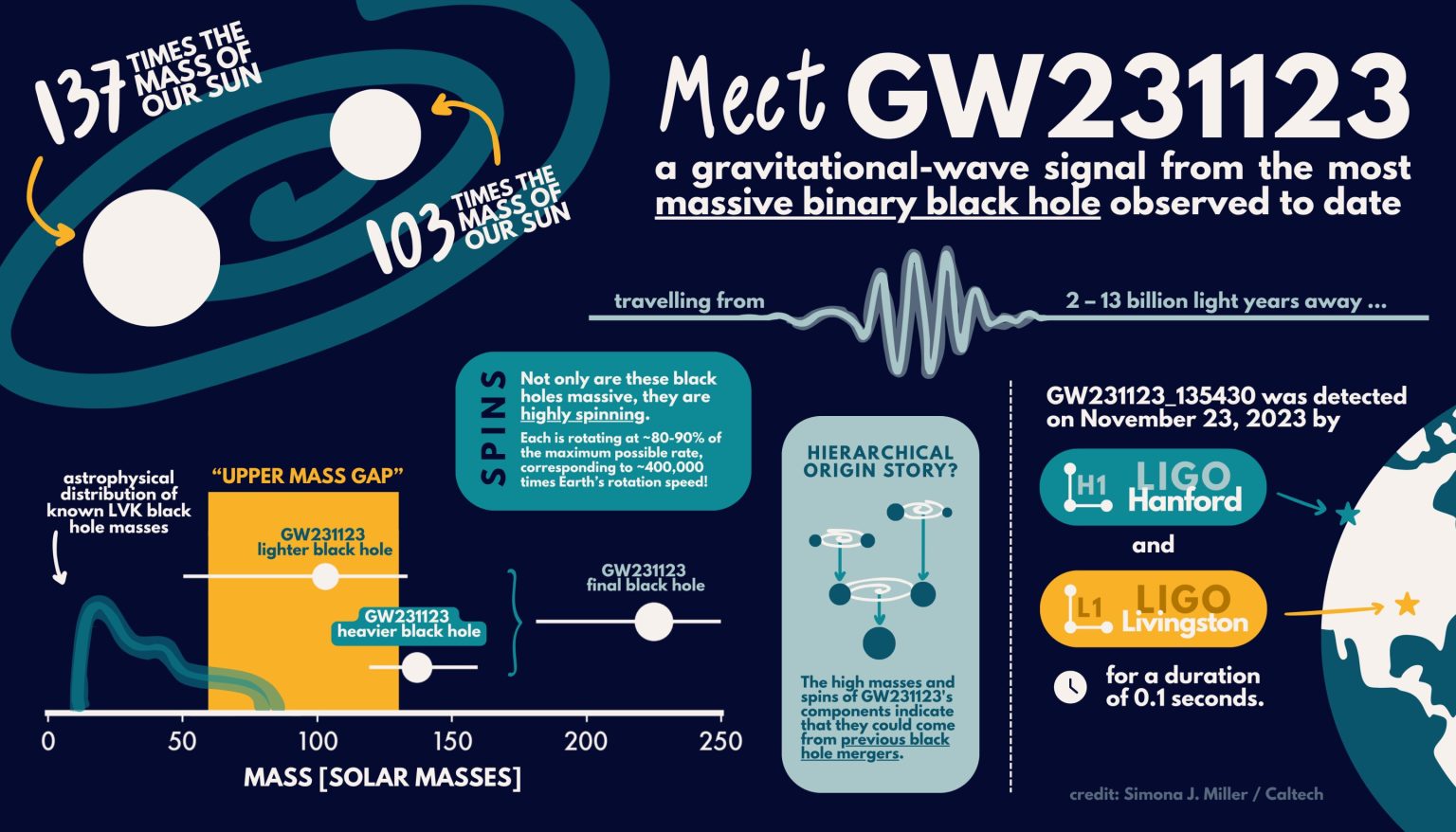
The LIGO-Virgo-KAGRA collaboration, which brings together scientists working on three gravitational wave detectors, discovered the GW231123 event. It represents the merger of two black holes, resulting in an object with a mass 225 times greater than that of the Sun.
LIGO-Virgo-KAGRA collaboration
An international team of scientists has reported the discovery of gravitational wave burst GW231123, during which the merger of two black holes with the largest masses ever observed during such events was recorded.
The LIGO-Virgo-KAGRA gravitational wave detector system helped them achieve this. It combines three scientific instruments scattered around the world. The first of these, LIGO, is actually a system of two separate giant detectors. One is located in Livingston, Louisiana, and the other in Genford, Washington.
It was with their help that gravitational waves from the merger of two black holes were first detected in 2015. At that time, their combined mass was 62 times greater than that of the Sun. Now, LIGO works together with Virgo, located in Italy, and KAGRA in Japan.
The largest merger of black holes
During their operation, gravitational wave detectors have already detected about 300 black hole mergers. Until now, GW190521, which was recorded in 2021, was considered the most massive of them. At that time, the total mass of black holes was 140 times greater than that of the sun.
However, during GW231123, whose waves reached Earth on November 23, 2023, the black holes had masses 140 and 100 times greater than the Sun, and the resulting object was 225 times larger than our star.
The most interesting thing about all this is that the original black holes could not have formed from stars through direct collapse. This means that each of them should have already undergone at least one merger. In addition, they rotate extremely quickly.
The high mass and extremely rapid rotation of black holes in GW231123 push the boundaries of both gravitational wave detection technology and modern theoretical models. Extracting accurate information from the signal required the use of models that take into account the complex dynamics of rapidly rotating black holes.
According to phys.org

