

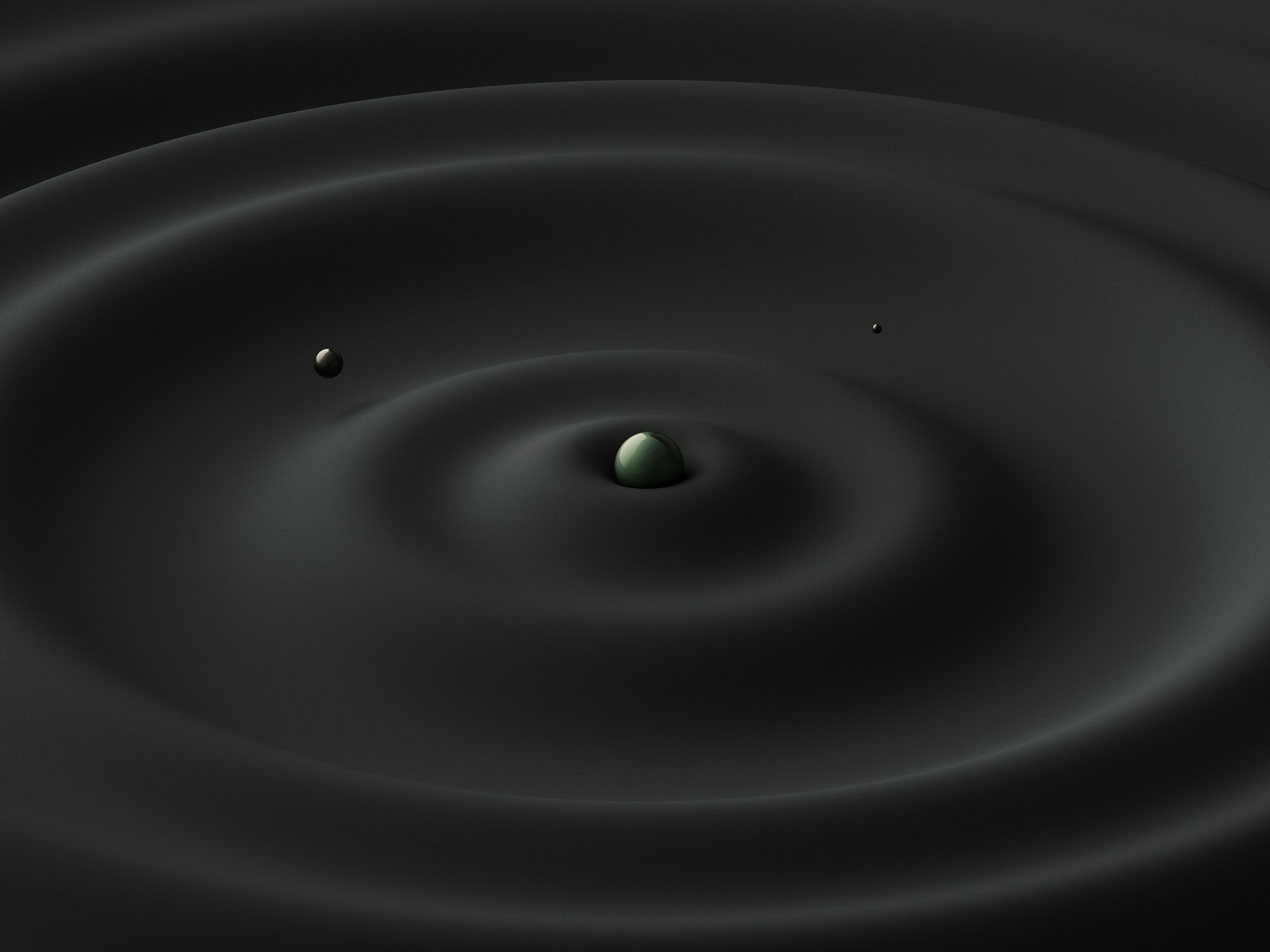
Just as ocean waves form ripples on the surface of the water, gravitational waves in space-time could have initiated the evolution of the Universe. The new theory suggests that it was these waves, rather than hypothetical “inflaton” particles, that caused the rapid expansion of the Universe after the Big Bang and the distribution of matter.
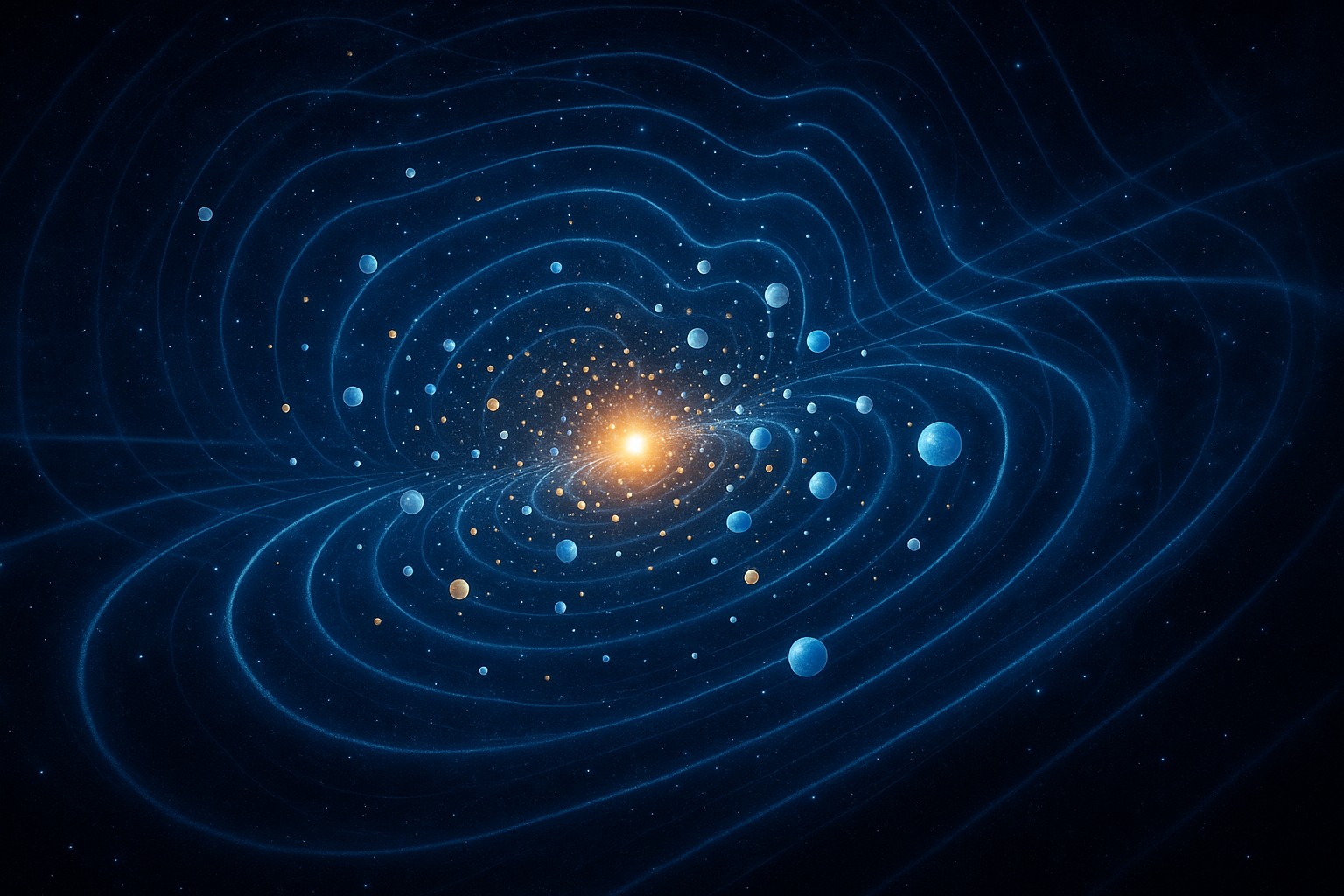
We still do not know exactly what happened in the first moments after the Big Bang 13.8 billion years ago. The dominant theory includes a period of super-rapid expansion — inflation — which explains the smoothness and large size of the Universe. Its driving force was thought to be the inflaton — a particle or field that has never been directly observed.
“For decades, we have been trying to understand the early Universe based on unobservable hypothetical elements,” says astrophysicist Raúl Jiménez from the University of Barcelona. This model also faces challenges, such as explaining the early massive galaxies discovered by JWST.
Alternative in gravity
Jiménez and colleagues proposed a different approach. They used a simplified model of the Universe — de Sitter space — which is consistent with general relativity and observations. In this model, quantum fluctuations of space-time itself, i.e., gravitational waves, generate specific turbulence. Researchers have discovered that these initial gravitational waves could not only independently trigger the inflation process, but also directly create inhomogeneities in the density of the primordial hot plasma.
These small changes in density caused by gravitational waves proved to be key. They created regions dense enough for gravitational collapse. According to scientists, it was these clumps that became the seeds of the first stars, galaxies, and black holes.
“This proposal is interesting in its simplicity. We do not add speculative elements, but show that gravity and quantum mechanics may be sufficient to form the Universe as we know it,” Jiménez emphasizes.
Path to verification
The theory offers an elegant solution that eliminates dependence on a hypothetical inflaton as the driver of inflation and structure formation.
However, further theoretical calculations and analysis of observational data, especially of mysterious early galaxies, will be needed to confirm this idea. The study was published in the journal Physical Review Research.
Earlier, we explained about the Big Bang theory.
According to Science Alert

