

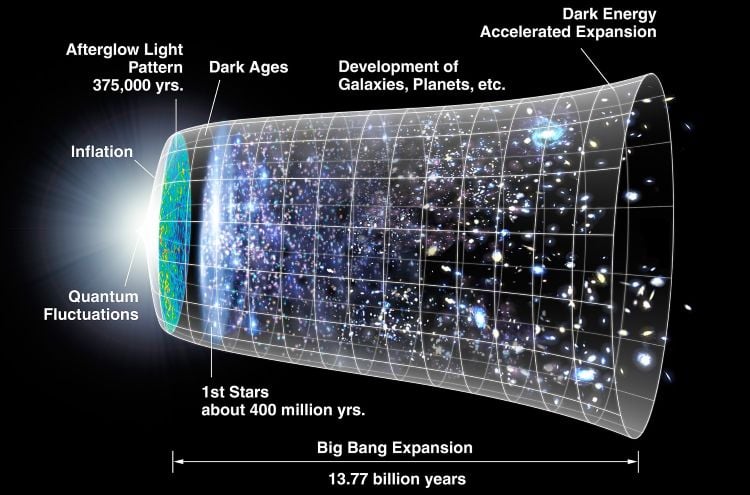
The journal Physical Review Research has published a study by a team of scientists from Spain and Italy that offers an alternative to the widely accepted inflationary model of the origin of the Universe. Traditionally, this model explained that immediately after the Big Bang, the Universe underwent extremely rapid expansion.
However, new computer simulations show that known physical phenomena — gravitational waves and the laws of quantum mechanics — may be sufficient to describe the first moments of the Universe’s existence. In other words, the inflationary phase might not have occurred.
In their work, researchers rely on a phenomenon known from Einstein’s theory of relativity: gravitational waves. These are “fluctuations” in space-time that arise as a result of grandiose events such as collisions between black holes. Scientists have linked these waves to the mathematical model of “de Sitter space,” created in the 1920s by Dutch mathematician Willem de Sitter in collaboration with Albert Einstein.
“The most interesting thing about this model is its simplicity and verifiability. We do not add any fictional elements, but merely show that gravity and quantum mechanics may be sufficient to explain how the structure of the cosmos came into being,” says co-author Dr. Raul Jimenez (ICREA, Spain).
Gravitational waves were only directly detected in 2015 thanks to the LIGO observatory. Since then, studying them has opened up new opportunities for understanding black holes, neutron stars, and extreme phenomena in the Universe. Now, scientists suggest that they may hold echoes of the earliest history of the cosmos.
Although we still do not know what happened before the Big Bang and the origin of our Universe, a new theory suggests that perhaps the phenomena we have already learned to observe are sufficient to answer this question.

