

The Ohio State University (OSU) has unveiled a new concept for a centrifugal nuclear thermal rocket (CNTR) that could significantly reduce travel time to Mars. Unlike classic solid-fuel NTP engines, CNTR uses liquid uranium, held in cylinders by rotation, which directly heats the working fluid in the prechamber*. This approach promises higher efficiency and lower risk of damage to fuel elements, according to the development team.
The prechamber is a preliminary chamber/heat exchange zone. In the CNTR concept, propellant (hydrogen, etc.) is fed into it, passes through a ring channel around the heat source (liquid uranium in a rotating cylinder), heats up, and then expands into the nozzle. There is no combustion there – it is heating and mixing/stabilization of the flow.
According to published materials, CNTR aims for a specific impulse* of about 1800 s – twice that of the best solid-core NTPs of the 1960s (~900 s) and about four times higher than chemistry (~450 s). This paves the way for shorter Mars missions: estimates show the potential to reduce round-trip time to ~420 days and ensure a safe one-way flight in about six months.
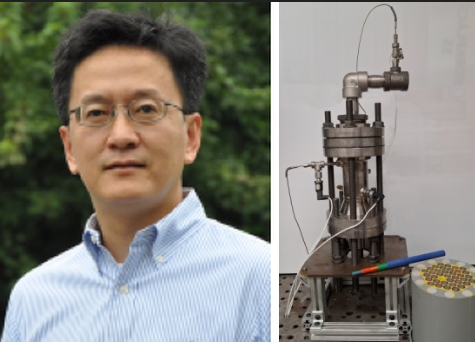
Source: osu.edu
Specific impulse (Isp) shows the fuel efficiency of a rocket engine: how many seconds of thrust it provides per unit of propellant weight. As with a car’s fuel consumption of 10 per 100 km, the higher the Isp, the further you can travel on the same mass of propellant – and if the engine also has a lot of thrust, this changes the rules of the game for flights to Mars.
The developers emphasize the flexibility of CNTR: in addition to hydrogen, it can run on ammonia, methane, propane, or hydrazine, which is important for the use of resources in space (ISRU) on asteroids or in the Kuiper belt. At the same time, engineers face a number of non-trivial challenges: stable start/stop, minimization of uranium losses, and development of fault-tolerant modes. The university reports that the project is supported by a NASA grant, and work on a prototype is underway; in the best-case scenario, they hope to achieve basic readiness of the concept within a few years.
Why is this important? Higher specific impulse while maintaining high thrust means either faster flights or larger scientific payloads. For astronomy, this means the ability to deliver larger telescopes and cryogenic systems to distant locations (Uranus, Neptune, Kuiper Belt objects) in direct trajectories without complicated gravitational maneuvers. Faster launch windows also reduce radiation risks for crews and increase the frequency of automated missions to monitor changes in distant systems.
Want to know how long it currently takes to fly to Mars, Venus, or even Jupiter – and why some missions fly faster than others? We explain in an accessible way how launch windows, Goman maneuvers, and gravitational maneuvers reduce months and years of travel time. We compare the times for automatic and potentially manned flights and explain what affects the route and fuel consumption. Go to the article “How long does it take to fly to other planets in the Solar System?” and choose your ideal trajectory for traveling through the Solar System!
Provided by: osu.edu, interestingengineering

