

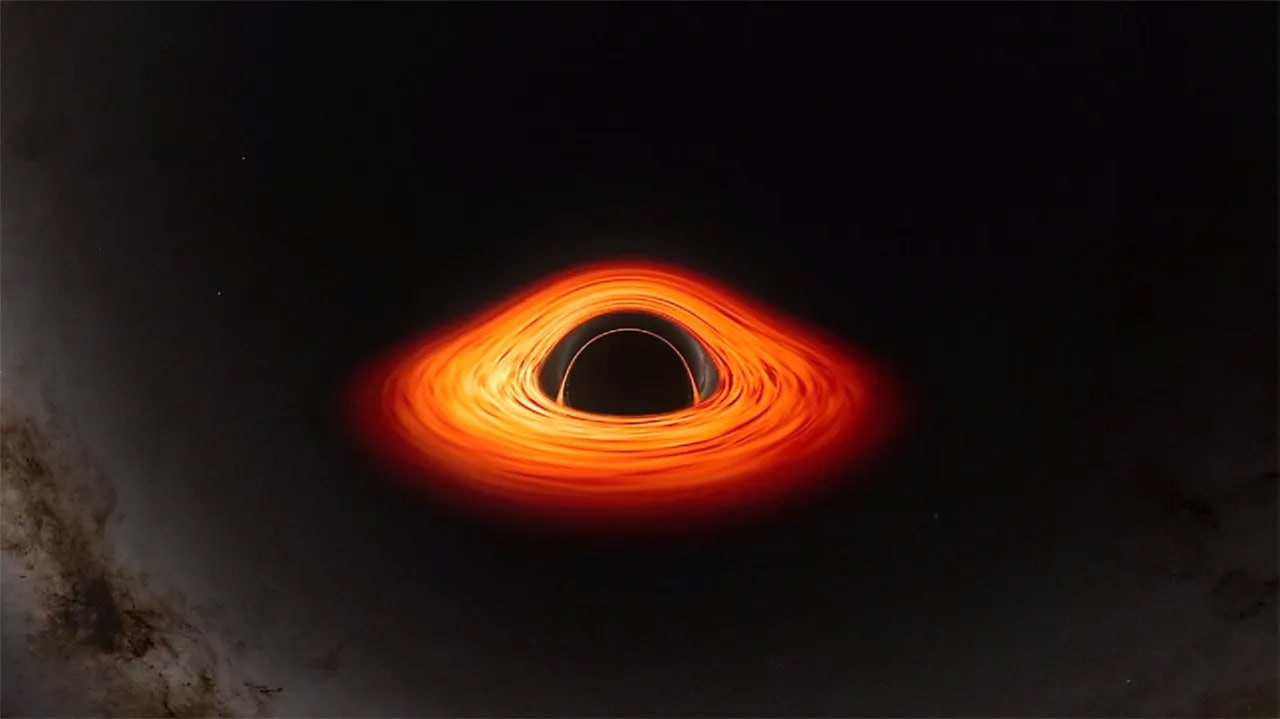
The LIGO gravitational wave observatory celebrated its tenth anniversary with one of the most compelling results in its history. On January 14, 2025, its detectors in Louisiana and Washington recorded the clearest signal of two black holes merging. This event confirmed Stephen Hawking’s theorem, proposed back in the 1970s: the area of a black hole’s event horizon never decreases.
The results of the discovery were published on September 10 in the journal Physical Review Letters.
Gravitational waves were first detected in 2015. At that time, LIGO confirmed the existence of these space-time vibrations, predicted by Einstein a hundred years ago. Since then, scientists have recorded more than 300 similar events. However, most of them looked like short pulses occurring at the moment of collision between two black holes.
The January event, named GW250114, is notable for being the first time that not only the moment of merger itself, but also the so-called “ringdown” phase, has been clearly recorded. During this phase, the newly formed black hole quiets down, vibrating in space-time like a bell that gradually fades away.
According to the researchers, the initial total area of the event horizons of the two black holes was approximately 240,000 square kilometers, and after the merger, it increased to about 400,000 km². This increase confirms Hawking’s prediction that the area of a black hole never decreases.
“We hear this signal loud and clear, and it allows us to test the fundamental laws of physics,” said study co-author Katerina Hatzioannou.
One of the founders of LIGO, Nobel Prize winner Kip Thorne, emphasized: “If Hawking were alive, he would be delighted to see that the area of the merged black hole is increasing.”
“This discovery shows how far we’ve come in ten years. Our detectors are working better than ever before,” added LIGO collaborator Aaron Zimmerman.
This study has become one of the most reliable tests of general relativity under conditions of extreme gravity. Over the past decade, the LIGO, Virgo, and KAGRA teams have improved the calibration of their instruments and reduced noise levels, allowing them to detect the extremely weak ringdown signal. In the future, even more sensitive observatories, such as Cosmic Explorer in the US and Einstein Telescope in Europe, will allow us to obtain even more accurate data about black holes.

