

Thanks to the capabilities of the James Webb Space Telescope (JWST), astronomers were able to peer into the heart of the Butterfly Nebula and see its previously unknown details.
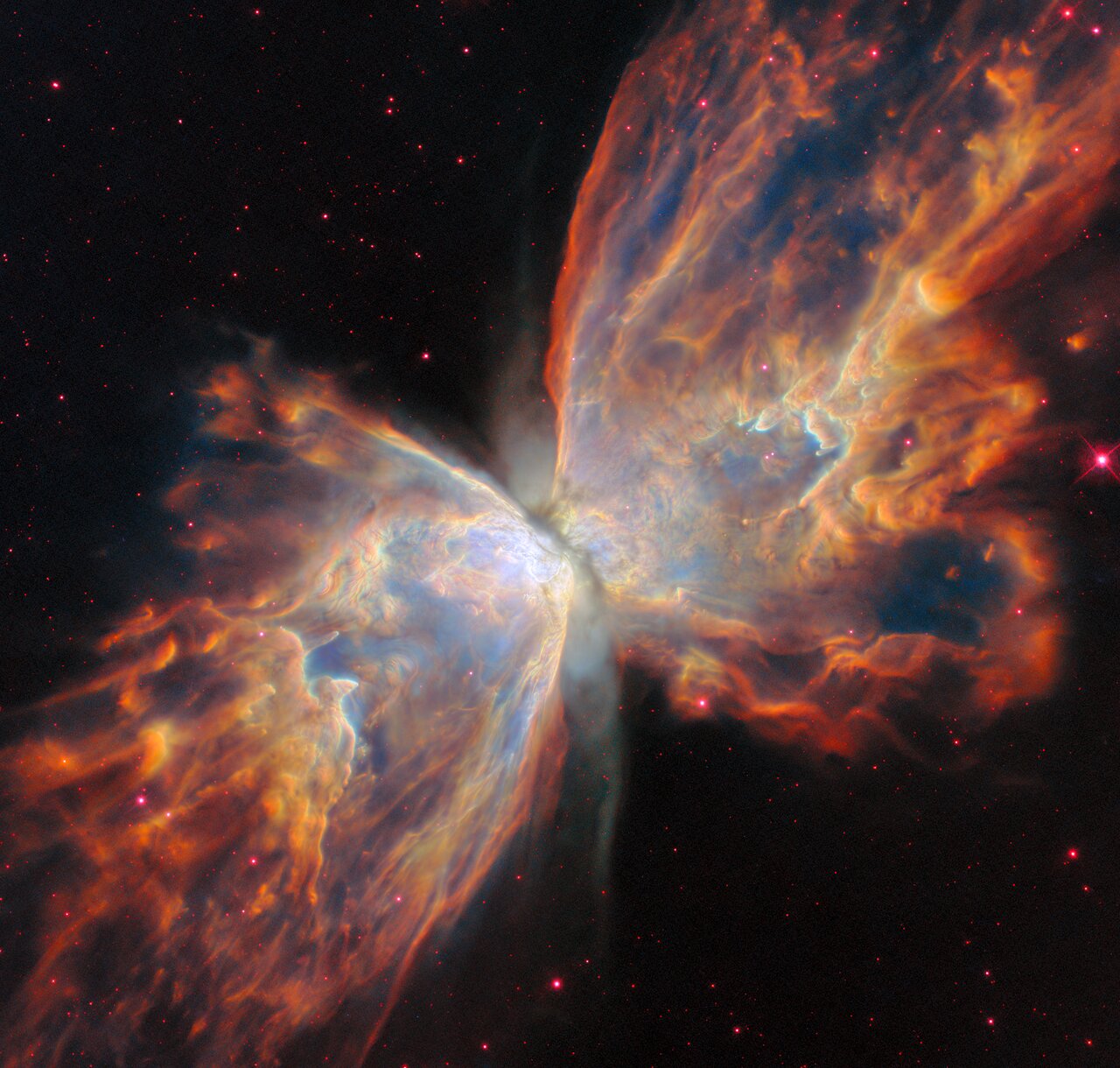
Planetary nebulae are among the most beautiful yet fleeting cosmic phenomena. They are formed at the end of the life cycle of stars with masses ranging from 0.8 to 8 solar masses, when they turn into red giants and then eject the outer layers of their atmosphere into the surrounding space. The planetary nebula phase is extremely short-lived by astronomical standards, lasting only about 20,000 years.
The NGC 6302 nebula, also known as the Butterfly Nebula due to its distinctive shape, is located about 3,400 light-years away in the constellation Scorpio. It is one of the most studied planetary nebulae. In the past, it has been photographed repeatedly by both ground-based observatories and the Hubble Telescope. Now James Webb has joined them.
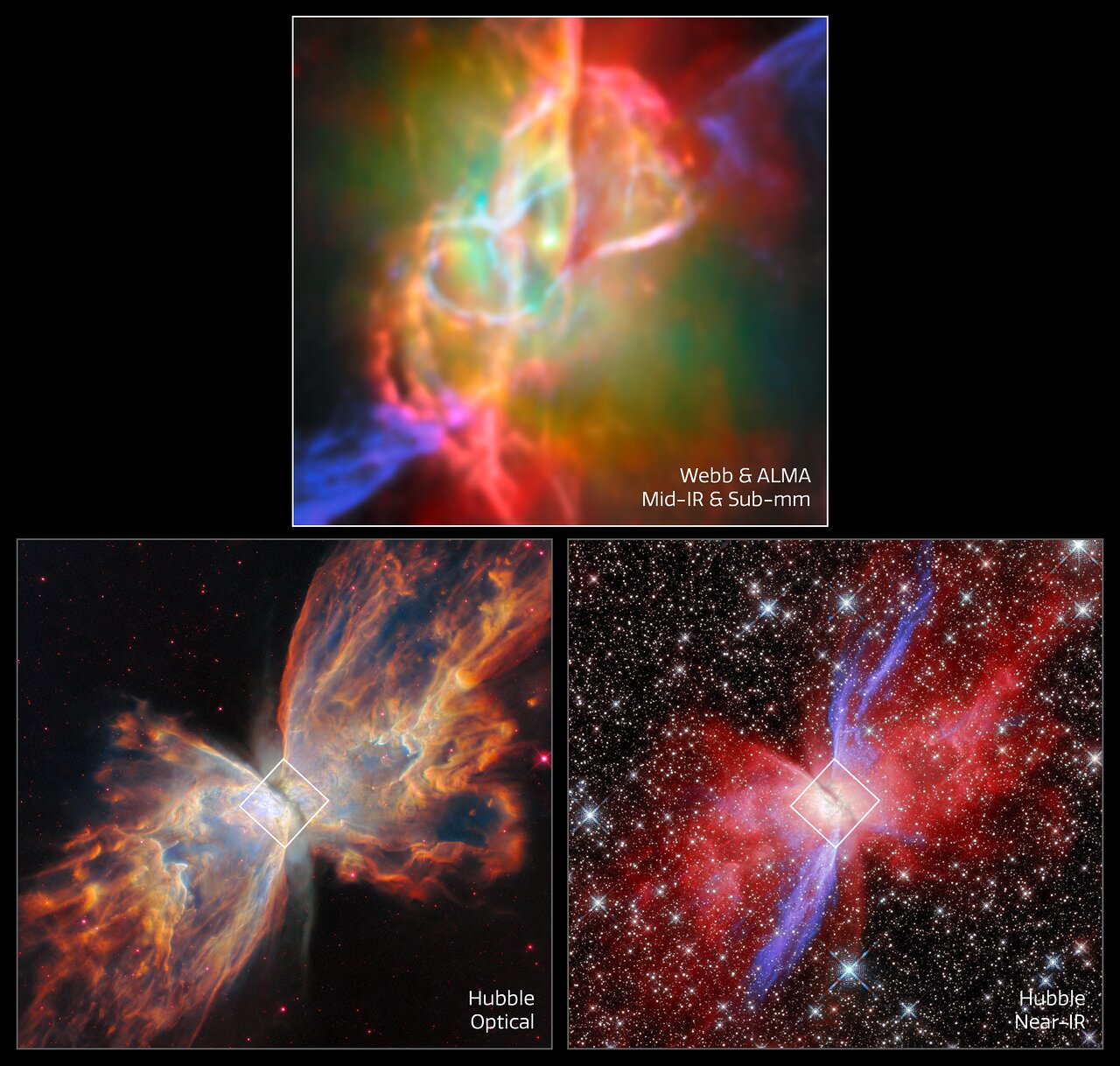
NGC 6302 is a bipolar nebula, meaning it has two lobes that diverge in opposite directions, forming the “wings” of a butterfly. The dark band of dusty gas represents the “body” of the butterfly. This band is actually a toroidal shape, which we see from the side. It hides the central star of the nebula — the exposed core that feeds it with energy and makes it glow. It is precisely the dusty toroidal shape that is likely responsible for the nebula’s characteristic shape, as it prevents the gas from flowing out of the star evenly in all directions.
Thanks to the fact that JWST conducts observations in the infrared range, it was able to penetrate the dust veil and determine the exact location of the stellar core, which had previously remained unknown. Its temperature is 220,000 °C, making it one of the hottest objects of its kind known to us.
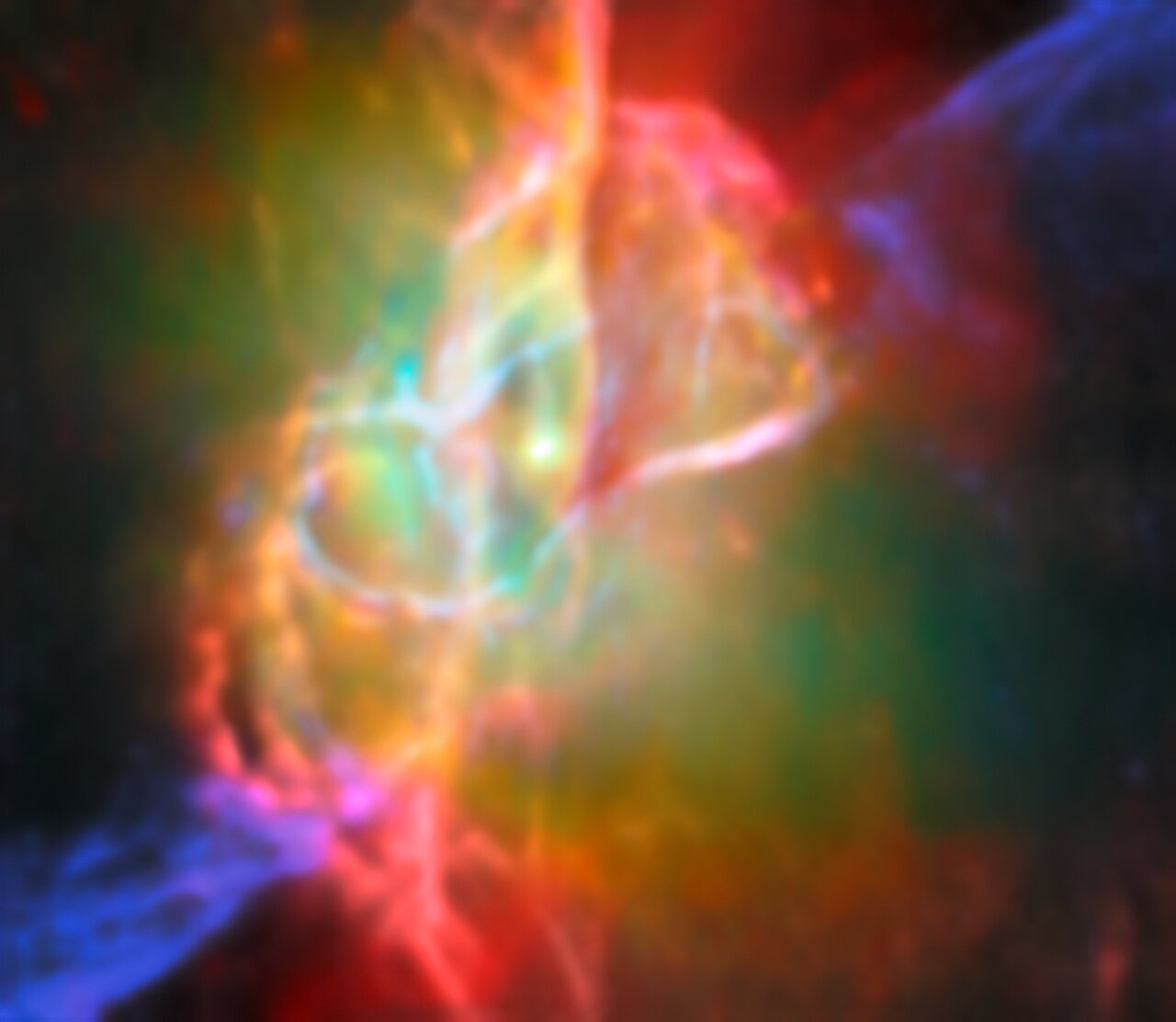
It is this “stellar engine” that is responsible for our ability to observe the Butterfly Nebula. When the core cools down, it will cease to be visible. At the same time, part of the stellar radiation is blocked by the dust torus surrounding it. JWST data show that it consists of crystalline silicates such as quartz, as well as irregularly shaped dust grains. Dust grains are about a millionth of a meter in size — which is large for cosmic dust. This indicates that they grew over a long period of time.
Outside the torus, the radiation of various atoms and molecules acquires a multilayered structure. The ions that require the most energy to form are concentrated close to the center, while those that require less energy are located further away from the central star. Of particular interest are iron and nickel, which form a pair of jets shooting out of the star in opposite directions. In the future, these elements will scatter throughout space and become part of the next generation of stars and their planets.
Astronomers have also detected light emitted by carbon molecules known as polycyclic aromatic hydrocarbons (PAHs). They form flat ring-shaped structures, very similar to honeycombs in beehives. On Earth, they are found in smoke from fires, car exhaust fumes, or, for example, burnt toast. Given the location of the PAHs, the research team suggests that these molecules form when a wind “bubble” from the central star bursts into the gas surrounding it. This may be the first evidence ever of PAHs formation in an oxygen-rich planetary nebula, providing important information about the details of how these molecules form.
According to Esawebb

