

For the first time in history, astronomers have been able to track the transformation of a dying star over more than a century. They ‘ve managed to establish that it heats up faster than any other typical star ever observed.
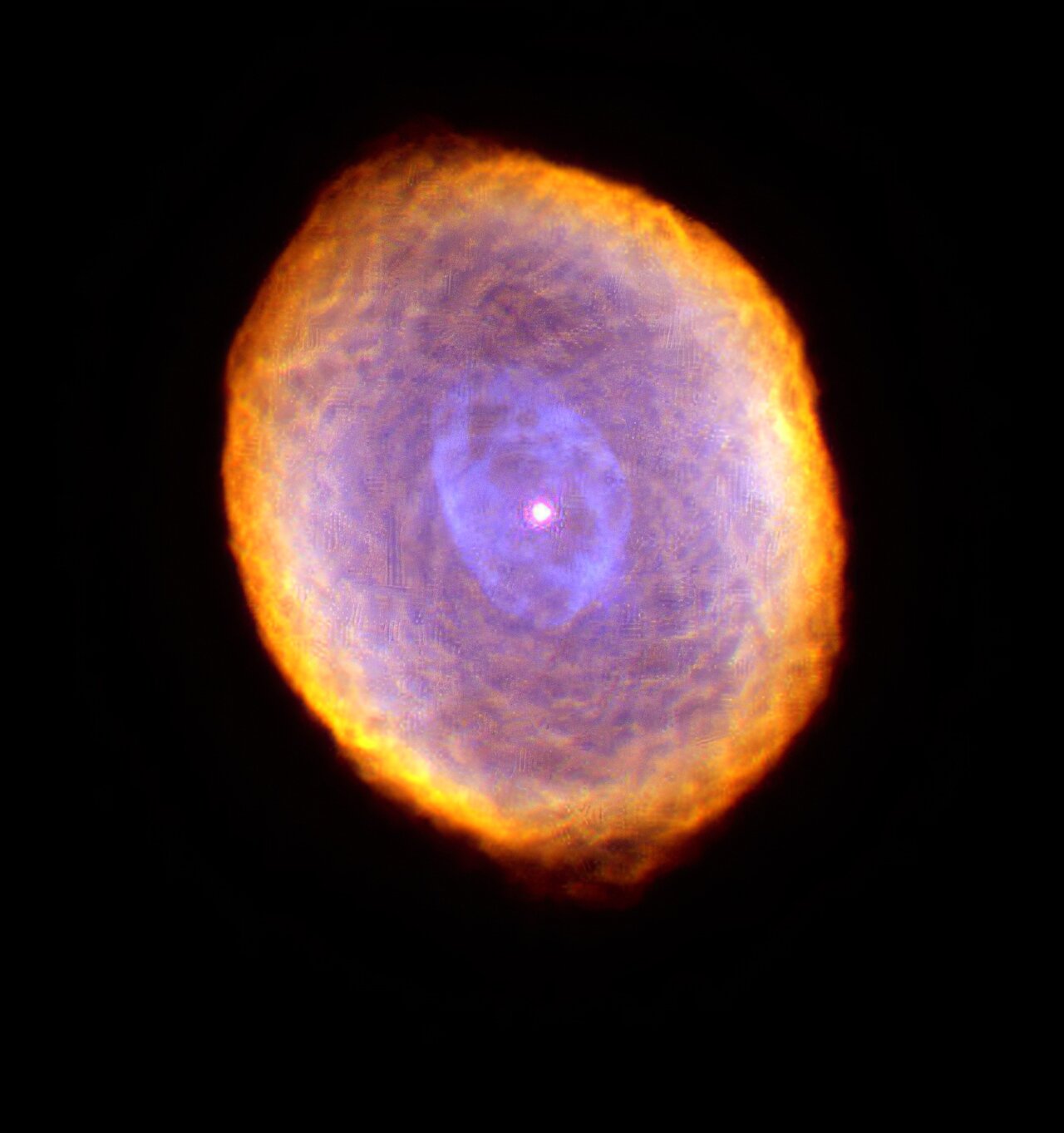
The subject of the study, published in The Astrophysical Journal Letters, was the planetary nebula IC418, also known as the Spirograph Nebula. It is located 4,000 light years from Earth and resembles a kind of burial shroud.
In the past, IC418 was a normal sun-like star. But over billions of years of life, it completely exhausted its reserves of hydrogen fuel, after which it began to expand, turning into a red dwarf. It has now reached the final stage of its life cycle. The dying star has begun to lose its atmosphere, which has formed a gas and dust cocoon around it. Its exposed core quickly heats up and ionizes the surrounding dust and gas with its radiation, which glows and forms beautiful vortex structures. Our Sun will suffer the same fate in about 5 billion years.
Regular observations of IC418 have been conducted since 1893. An international team of researchers attempted to assess how the star has changed over time.For this purpose, they analyzed 130 years of observations, ranging from measurements made by the human eye at the end of the 19th century to images captured by modern telescopes. Scientists verified, calibrated, and combined the data, then compared it with models of stellar evolution. This allowed them to measure the star’s heating rate, determine its current mass, and even estimate the star’s mass before it began its transformation.
The results of the study reveal that the characteristic green light of the nebula, emitted by oxygen atoms, has become approximately 2.5 times stronger since Victorian astronomers first studied it. This change is caused by a rapid increase in the temperature of the central star, which has risen by approximately 3,000 °C since 1893, or approximately 1,000 °C every 40 years. By comparison, the Sun heated up by the same amount during its formation, but it took 10 million years to do so.
However, despite the fact that the star is heating up faster than ever before, it is still slower than recent models predicted. This calls into question current theories about how stars age and die, and may force astronomers to rethink the mass of stars capable of producing carbon, an element necessary for life. The results of the study also show that the night sky can change much faster than we usually think, and some changes can be seen within a human lifetime.
Earlier, we reported on how the James Webb Telescope photographed a vortex created by a pair of dying stars.
According to Phys.org

