

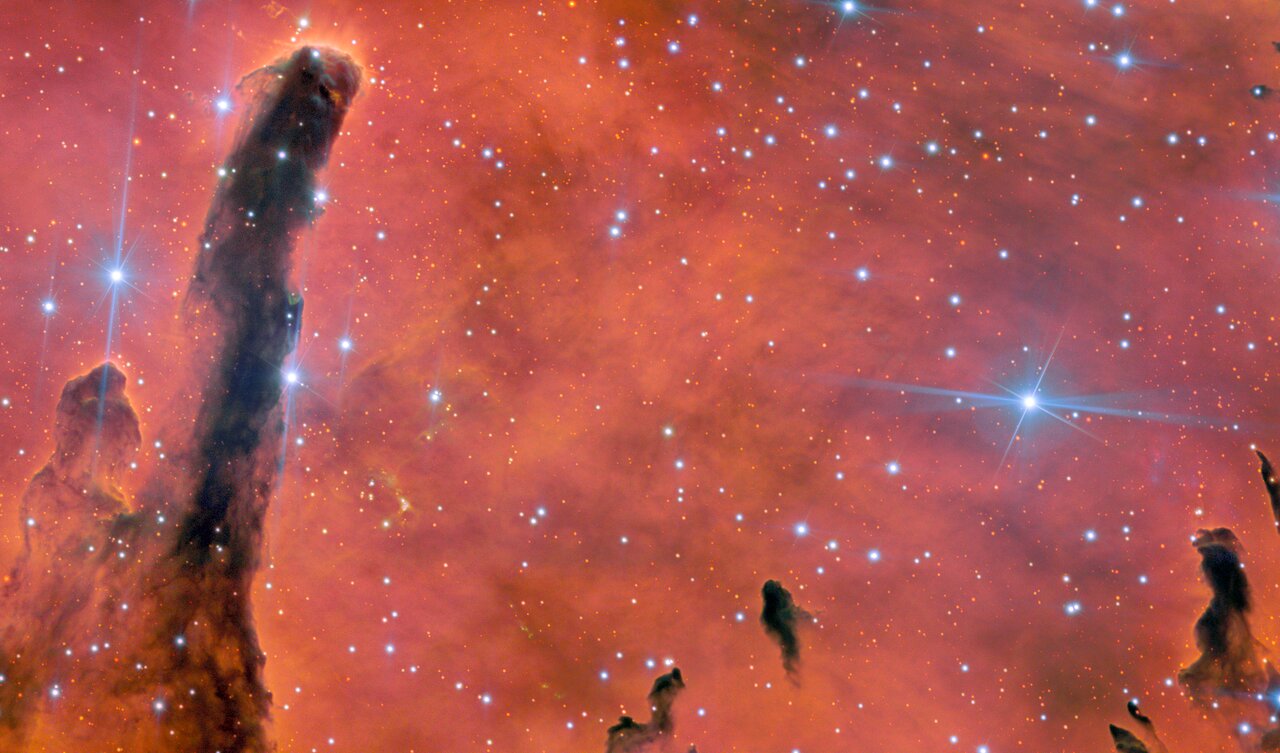
In honor of the 25th anniversary of the Gemini International Observatory, the NOIRLab research laboratory has published an amazing image of a deep space object. It shows the emission nebula NGC 6820.
The Gemini International Observatory consists of two 8.1-meter telescopes: Gemini North, located in Hawaii, and Gemini South, located in Chile. They began observations in 2000.
In honor of the 25th anniversary of the observatory’s opening, its employees published an image taken by the Gemini North telescope. The object for the photograph was chosen by students participating in a summer internship. They named it “Heavenly ʻŌhiʻa Rains” in honor of the famous Hawaiian legend about the lovers Ōhiʻa and Lehua.
The photo shows the emission nebula NGC 6820, located about 6,000 light-years from Earth. It is a cloud of interstellar gas and dust that glows under the influence of ultraviolet radiation emitted by nearby stars. The abundance of red hues is due to the glow of hydrogen atoms.
The stars that feed NGC 6820 are part of the open star cluster NGC 6823. In the image, they appear as scattered patches of blue-white light. The intense radiation emitted by these hot, massive stars accelerates the gas in the nebula, creating characteristic dark pillar-like structures.
This image was taken as part of the NOIRLab Legacy Imaging Program. Its goal is to use telescope observation time dedicated to collecting data specifically for color images to share them with the public as part of astronomy outreach.
Earlier, we reported on how astronomers photographed a bat-shaped nebula.
According to NORILab

