

An international group of astronomers has announced the discovery of a huge exoplanet orbiting a star previously thought to be solitary. It is hidden in the gas and dust disk surrounding it.
By studying the process of planet formation in protoplanetary disks around young stars, researchers can learn more about the formation of our Solar System. In a process known as core accretion, particles in the disk stick together under the influence of gravity, eventually forming larger solid bodies such as asteroids or planets. As they form, young planets begin to carve out gaps in the disk, similar to the grooves on a vinyl record.
However, observing these young planets is extremely difficult due to interference from gas and dust in the disk. To date, only three reliable detections of young planets in protoplanetary disks have been made.
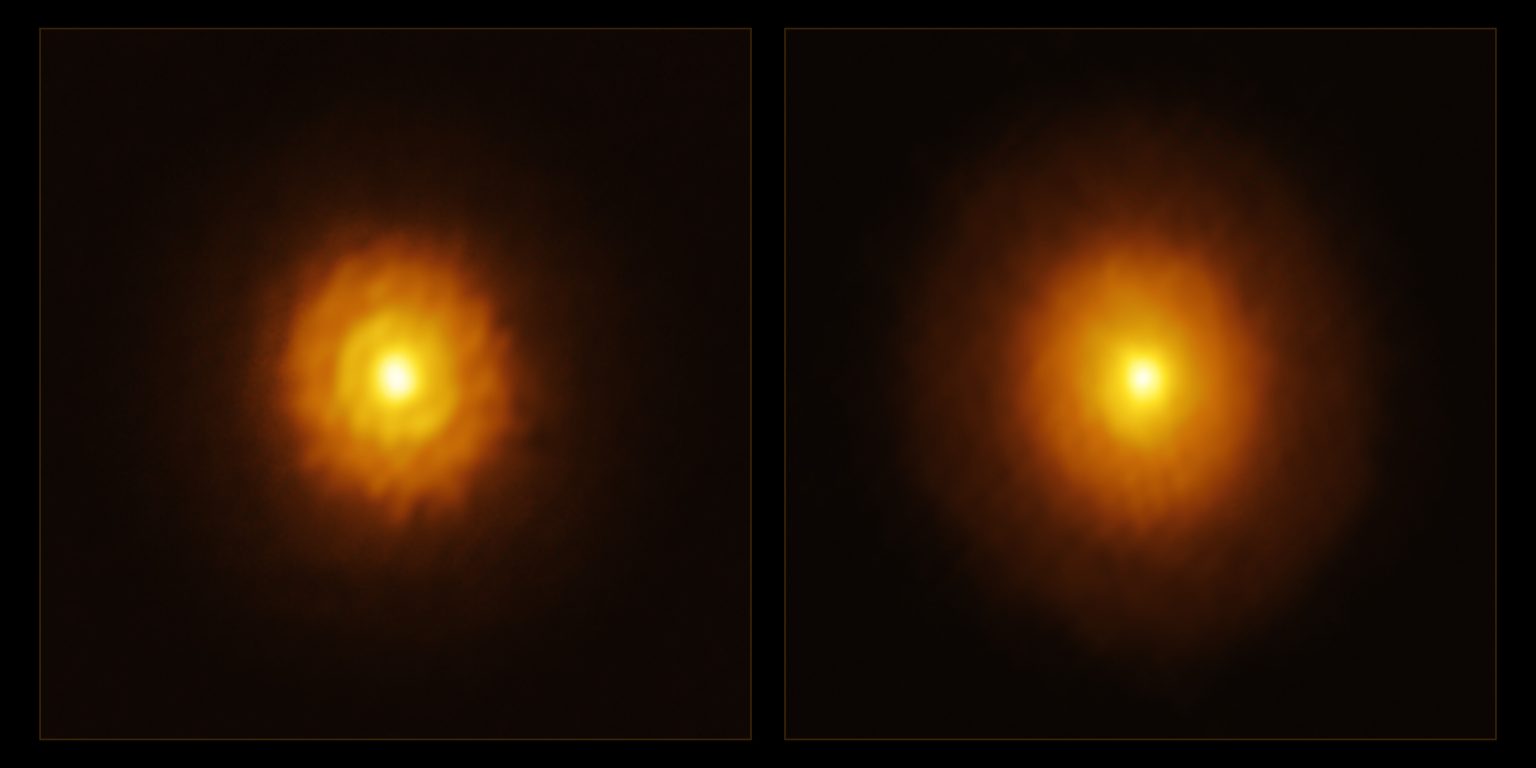
In 2023, astronomers used the ALMA radio telescope array to study the protoplanetary disk around the star MP Mus (PDS 66). The results showed that it appears to be completely alone in the universe. The disk surrounding it had no gaps where planets could form, and was completely flat and featureless.
However, these results seemed strange to researchers, since the disk is between seven and ten million years old. This time should be sufficient for some signs of planet formation to appear. So they decided to give MP Mus another chance. They conducted repeat observations of the disk using ALMA, but this time at a different wavelength.
This approach has led to positive results. New observations have revealed a cavity near the star and two gaps further away. This suggests that MP Mus may not be alone after all. In turn, data from the Gaia observatory showed that the star “was oscillating.”
Using a combination of Gaia and ALMA observations, as well as computer simulation, researchers concluded that the oscillations were likely caused by a gas giant with a mass between 3 and 10 times that of Jupiter. It is located at a distance of 1 to 3 AU from the star.
This is the first time that an exoplanet in a protoplanetary disk has been indirectly detected in this way — by combining precise data on the star’s motion obtained with Gaia with radio observations of the disk. This also means that there may be many more hidden planets in other discs just waiting to be discovered.
According to researchers, the upcoming upgrade of ALMA, as well as the commissioning of next-generation radio telescopes such as the Very Large Array (ngVLA), will enable them to discover a portion of the hidden population of young exoplanets. This, in turn, will provide an opportunity to learn more about the process that led to the formation of our Earth.
Earlier, we reported on a system discovered by astronomers in which the orbits of exoplanets resembled an old-fashioned merry-go-round.
According to Eurekaalert

