

Every star in the galaxy is a source not only of heat and light, which are essential for life on the planet orbiting around it, but also of harmful radiation. Usually, it is protected by a magnetic field and connected to oceans of lava deep within the planet.
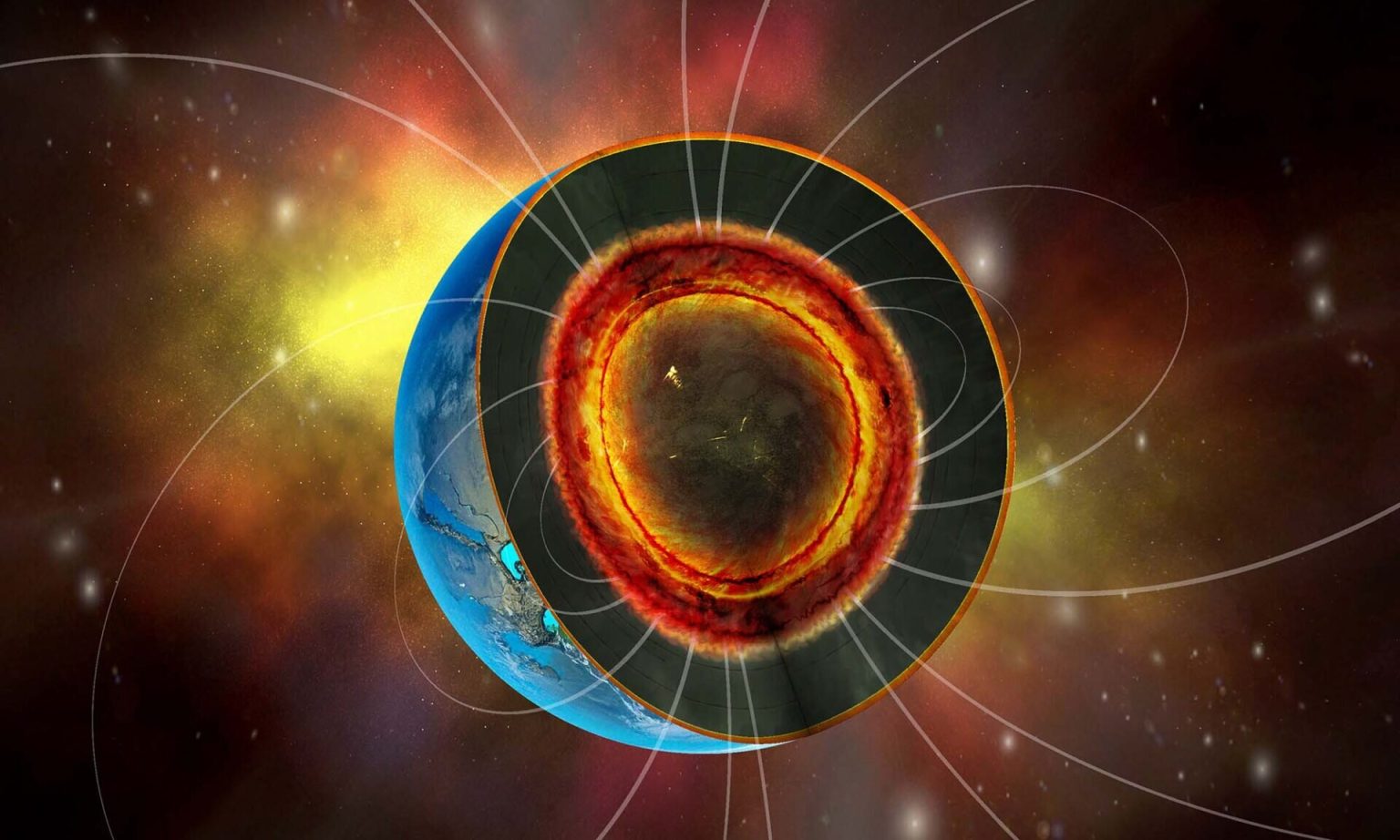
Magmatic oceans forming magnetic fields
Deep beneath the surface of distant exoplanets known as super-Earths, oceans of molten rock may be doing something extraordinary: generating magnetic fields strong enough to shield entire planets from dangerous cosmic radiation and other high-energy harmful particles.
The Earth’s magnetic field is generated by motion in its liquid iron outer core. But larger rocky worlds, such as super-Earths, may have a solid or completely liquid core layer that is unable to produce magnetic fields in the same way.
In an article published in Nature Astronomy, researchers from the University of Rochester, including Miki Nakajima, an associate professor in the Department of Earth and Environmental Sciences, report on an alternative source: a deep layer of molten rock called the basaltic magma ocean (BMO). These findings could change scientists’ understanding of the internal structure of planets and have implications for the habitability of planets beyond our Solar System.
Scientists believe that a strong magnetic field is very important for life on the planet. Most terrestrial planets (such as Venus and Mars) do not have one because their cores do not have the physical conditions necessary for a magnetic field to form. Instead, super-Earths may generate a dynamo in their core and/or magma, which could increase their planetary habitability.
Characteristics of super-Earths
Super-Earths are larger than Earth but smaller than ice giants such as Neptune. Scientists believe that they are mostly rocky, like Earth, with a solid surface rather than layers of gas like Jupiter or Saturn. Super-Earths are the most common class of exoplanets discovered in our galaxy, but they are strangely absent from the Solar System. Despite their name, “super-Earth” refers only to size and mass, not whether these planets are similar to Earth in other ways.
Since super-Earths are so common, they provide an important opportunity to understand how planets form and evolve. Many super-Earths orbit within the so-called habitable zone of their stars, where liquid water could exist. By studying their composition, atmosphere, and magnetic fields, scientists gain clues about the origins of planetary systems and signs of conditions that could allow life to develop elsewhere.
Study of the properties of the basaltic magmatic ocean
Scientists believe that shortly after its formation, Earth probably had a BMO. This layer of partially or completely molten rock at the base of the planet’s mantle could have influenced its magnetic field, heat transfer, and chemical evolution. Since super-Earths are larger than Earth and subject to significantly higher internal pressures, they are likely to form long-term BMOs. This makes BMOs a key factor in understanding the internal structure, magnetic fields, and potential habitability of super-Earths.
To recreate the extreme pressures inside super-Earths, Nakajima and his colleagues conducted laser shock experiments at the University of Rochester’s Laser Energy Laboratory, combining them with quantum mechanical simulations and planetary evolution models. They focused on studying molten rock under conditions similar to those expected in BMOs.
Researchers have discovered that under such enormous pressure, molten rock in the deep mantle becomes electrically conductive — so much that it can sustain a powerful magnetic field for billions of years. This suggests that on super-Earths, which are three to six times larger than Earth, the BMO dynamo, powered by the movement of molten rock, can generate stronger and longer-lasting magnetic fields than those formed in Earth’s core, potentially creating habitable conditions throughout the galaxy.
According to phys.org

