

In today’s space industry, not only satellites that observe Earth in visible light but also spacecraft capable of detecting the thermal activity of objects are becoming increasingly valuable. One such system is the British HotSat-2—a new satellite from SatVu that is being prepared for launch as part of the SpaceX Transporter-16 mission from Vandenberg Air Force Base in California. According to the data provided by the company, the device has already undergone integration prior to launch.
HotSat-2 will be the second satellite in the SatVu constellation. Its key feature is its MWIR (mid-wave infrared) sensors, which allow users to see not just the shape of objects, but their thermal behavior: what is active, what is idle, and how activity changes between day and night. SatVu explicitly states that such information is useful for national security, economic monitoring, and climate research. The company also reports that HotSat-3 is already in production and is scheduled for launch in 2026.
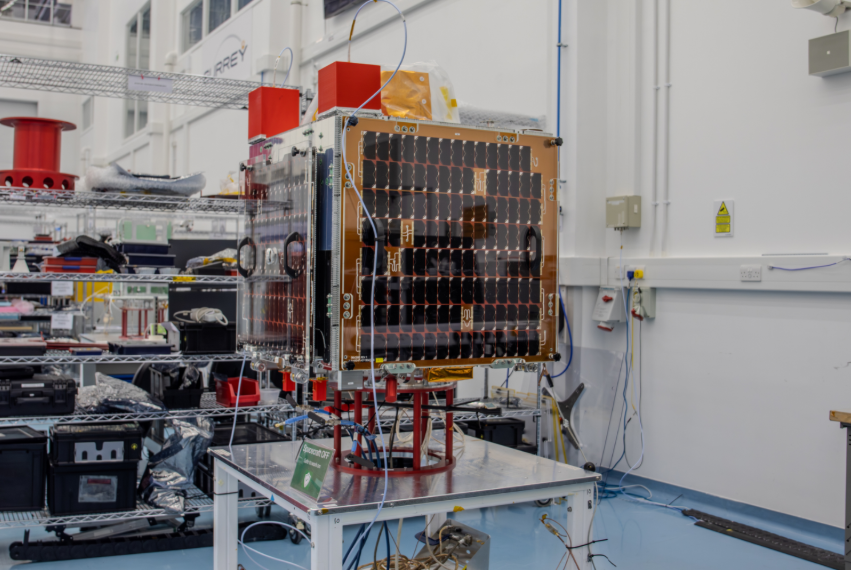
It is important to note that this is not an X-ray image taken from space, but a detailed thermal observation. Similar data obtained from the first HotSat-1 satellite has already been used to analyze activity at the Yongbyon Nuclear Research Center: thermal signatures helped determine which facilities on the site were operational. In addition to security applications, this technology is suitable for monitoring the energy sector, infrastructure, heat loss in buildings, and urban heat islands.
How does it work? A typical satellite observes what is illuminated by the Sun. HotSat-2 operates differently: it detects thermal radiation from roofs, equipment, pipes, industrial facilities, and heated surfaces. In other words, it shows not only that it’s stationary, but also that it’s currently running. That is precisely why such a satellite can be useful at night for monitoring factories, power plants, ports, or large infrastructure facilities.
Why is this important? Although HotSat-2 was designed primarily for Earth observation, the development of such systems also benefits space science: it accelerates advancements in infrared detectors, thermal calibration, on-board data processing, and compact MWIR cameras. These are important technological capabilities for future infrared space missions, as well as for observing thermal processes on the Moon, Mars, or artificial objects in orbit.
According to satellitevu

