

The NOIRLab research center has published a mesmerizing photo. It shows a nebula in the constellation Cygnus, inside which a gamma-ray pulsar is hidden.
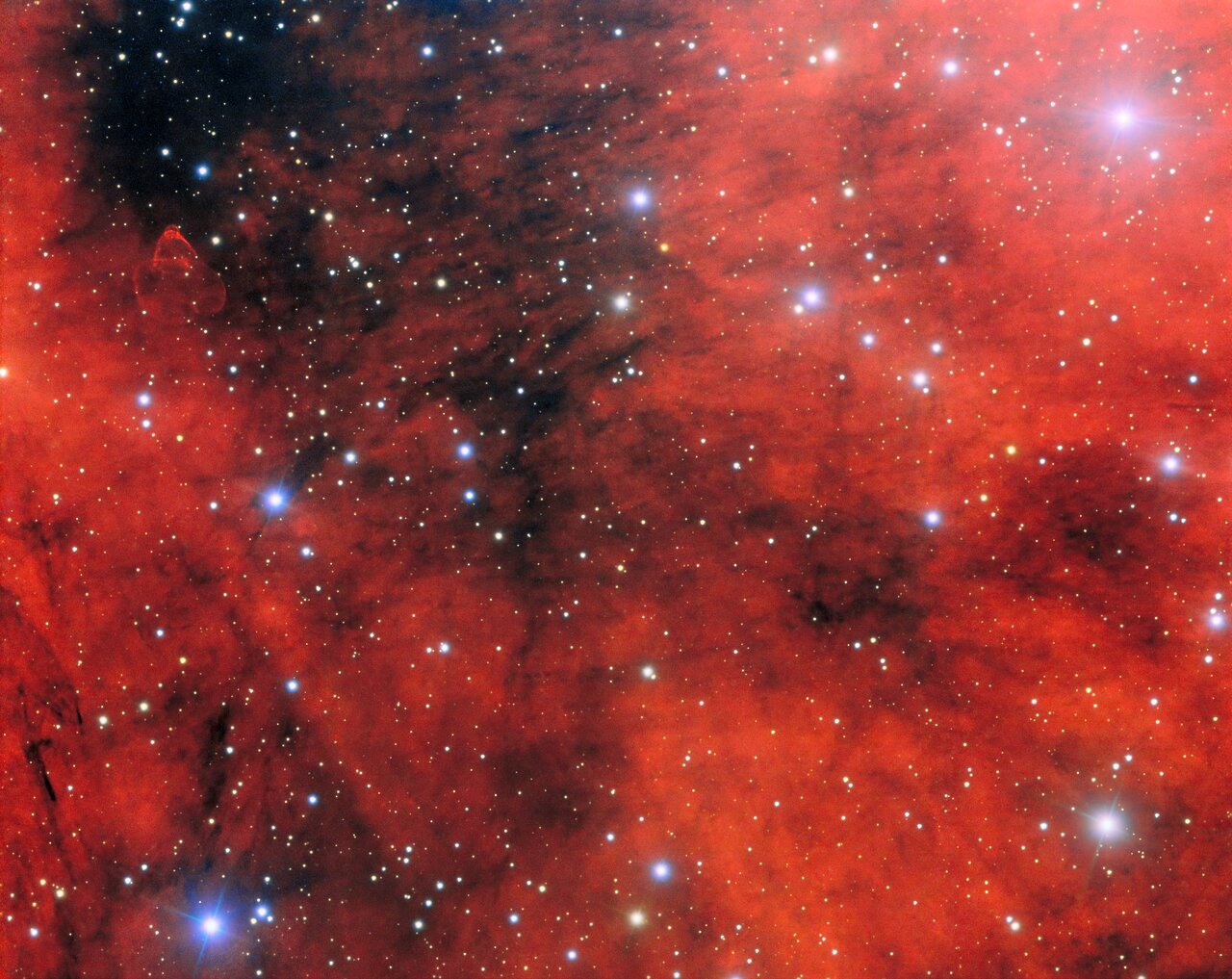
The image was obtained using the GMOS spectrograph installed on the 8.1-meter Gemini North telescope. It is located in Hawaii and is part of the Gemini International Observatory.
The Gemini North image shows a seemingly tranquil cloud region. However, in reality, it hides a very curious object that cannot be seen with the naked eye — the gamma-ray pulsar PSR J2030+4415.
Pulsars are extremely dense objects formed as a result of the gravitational collapse of stars with masses 10–25 times greater than that of the Sun. When they die, these supermassive stars explode into supernovae, leaving behind their cores as objects known as neutron stars. Neutron stars have a mass approximately 1.5 times greater than that of the Sun, compressed into a sphere with a diameter of about 20 km. For comparison: one teaspoon of neutron star material would weigh as much as Mount Everest.
Highly magnetic and rapidly rotating neutron stars are known as pulsars. They emit jets of electromagnetic radiation from their poles during rotation, similar to the gamma rays emitted by PSR J2030+4415. When astronomers see a beam of radiation periodically directed toward Earth, it creates an effect similar to a lighthouse. Because of this feature, when astronomers first discovered pulsar radiation, they even considered the hypothesis that it was of artificial origin for some time.
PSR J2030+4415 is surrounded by a so-called pulsar wind nebula. It consists of supernova material ejected and carried away by winds generated by the pulsar. Evidence of the shock wave is visible in the upper left quadrant of the Gemini North image.
According to NOIRLab

