

A research team from the Center for Applied Space Technology and Microgravity (ZARM), the Department of Environmental Process Engineering (UVT) at the University of Bremen and the German Aerospace Center (DLR) has made significant progress toward a self-sustaining mission to Mars: fertilizer that can be produced exclusively from Martian resources.
Beneficial properties of cyanobacteria
The fertilizer is based on cyanobacteria, also known as blue-green algae. They possess a number of characteristics that make them particularly well-suited for use on the Red Planet: they can utilize carbon dioxide from Mars’ atmosphere, produce oxygen, and extract essential nutrients directly from Martian dust.
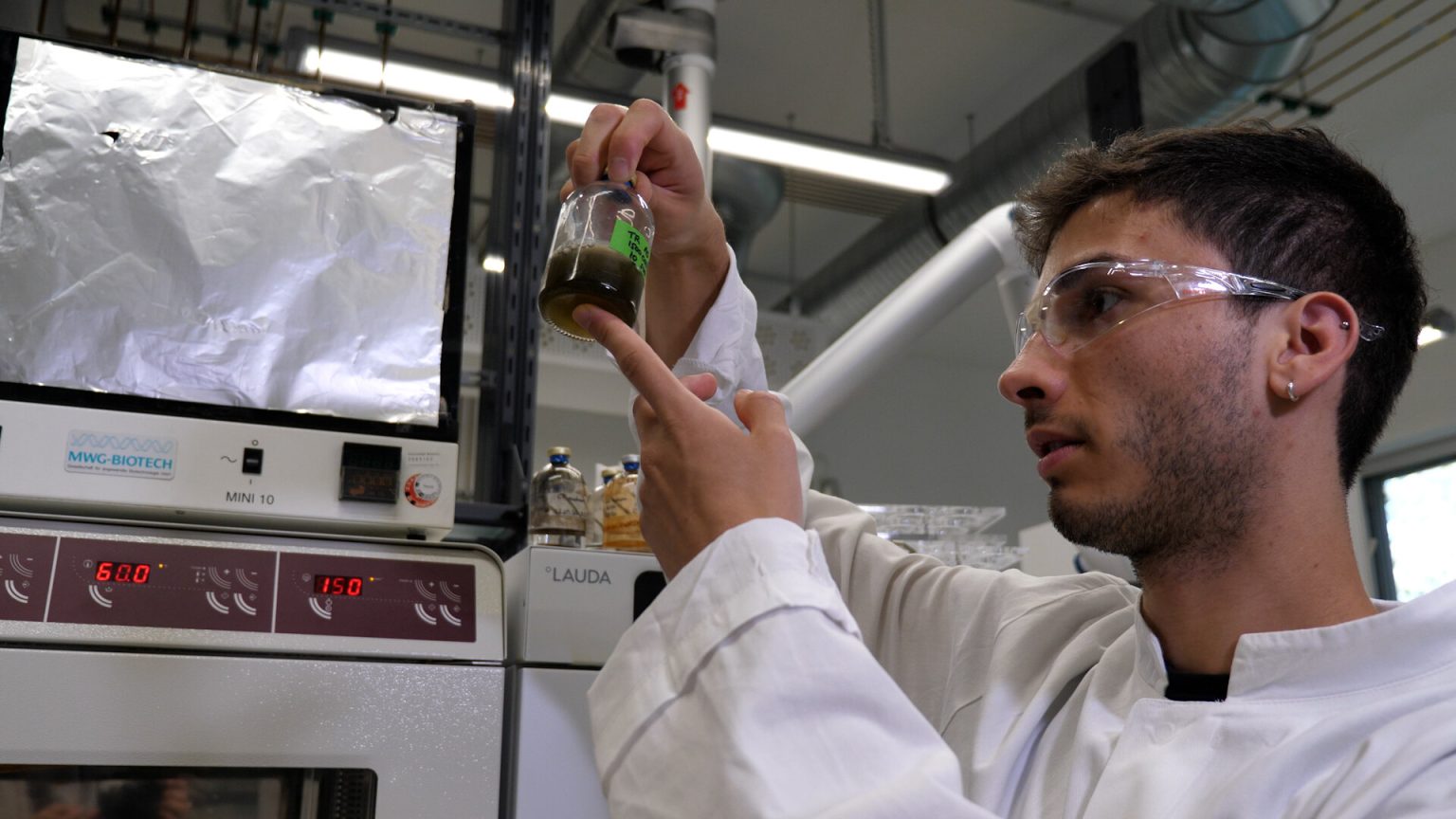
Cyanobacteria were grown using artificially created Martian resources, including synthetic regolith designed to mimic Martian dust. The cyanobacteria are then converted into a nutritious fermentation product. This is done by microbes through an anaerobic fermentation process that takes place without oxygen and uses only materials that are potentially available on site.
Producing fertilisers in Martian conditions
In a study published in the Journal of Chemical Engineering, researchers investigated how to optimize the fermentation process. Heating the biomass before processing led to faster decomposition, whereas a working temperature of 35 degrees Celsius proved to be ideal for the fermentation process.
Furthermore, a relationship was established between the amount of biomass used and the ammonium yield. This is important because it allows us to determine how much cyanobacterial biomass needs to be added to achieve the correct ammonium concentration in the fertilizer. A simulated Martian dust (MGS-1) was used as the primary source of mineral nutrients, demonstrating that fermentation can be carried out using local resources.
The resulting fertilizer was used to cultivate duckweed (Lemna sp.), a fast-growing freshwater plant rich in protein that has been consumed as food in Southeast Asia for centuries. It is particularly worth noting that just one gram of dry cyanobacteria yielded 27 grams of fresh, edible plant matter.
Prospects for future missions to Mars
“You can imagine a vegetable garden on Mars that is run entirely from local resources—without bringing soil, fertilizer, or water,” explains Tiago Ramalho of the University of Bremen. “This self-sufficiency is important to make future Martian settlements as sustainable as possible!”
Lemna spp. has great potential not only for space missions: it grows quickly, is rich in nutrients, easy to cultivate, and completely edible. It has already been approved as a food product in the EU and is considered a contender for the role of a sustainable superfood of the future, both on Earth and in space.
In addition to producing food, the system offers another advantage: the process generates methane, which can be used as an energy source.
The study shows that plants can be grown using Mars’ natural resources, with microbes serving as an intermediate link. This, in turn, could serve as the foundation for sustainable food production on future Mars missions.
According to phys.org

