

The idea that it is the Earth that revolves around the Sun, and not vice versa, was known even to ancient Greek philosophers. And the most interesting thing is that it was based on calculations and observations that anyone can repeat on their own.
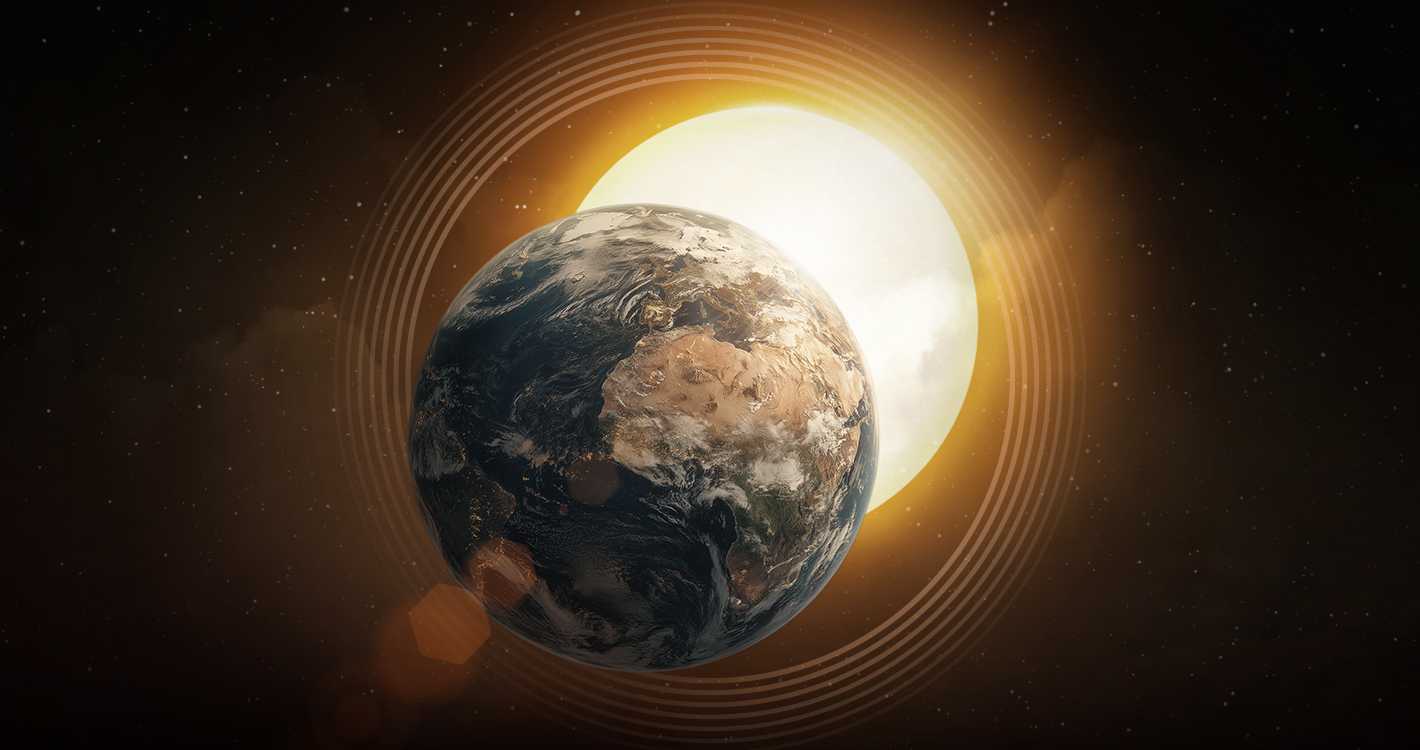
Aristarchus of Samos
Usually, when talking about the heliocentric system of the world, Nicolaus Copernicus is mentioned. However, the outstanding Polish astronomer, although he did a lot to strengthen the idea of the Earth revolving around the Sun, was not its author.
This idea was well known in ancient times, and it is associated with the name of a completely different scientist, Aristarchus of Samos. He lived in the 3rd century BC and already then defended such a view of the structure of the world. Ancient authors actively discussed it: some supported it, others rejected it. But the fact remains – it was widespread and did not seem implausible.
And the most interesting thing is that it was based not on interpretations of sacred texts or empty speculation, but on observations, measurements, and calculations. Moreover, they were easily accessible for verification both then and now.
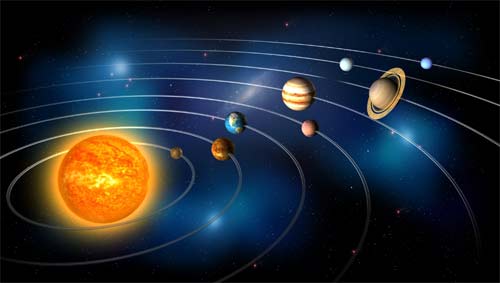
It all started with the question of how far away the Moon and Sun are from Earth. It would seem that neither can be reached; they appear to be approximately the same size, and who knows how big they are. However, there is a way to determine this.
However, it requires accepting the fact that the Moon is a sphere that does not emit light itself, but only reflects sunlight. But it is not difficult to come to this conclusion even by simply observing the phases of our satellite. This is especially evident in the first days of the new moon, when a thin crescent and the rest of the sphere are visible, like a ghost. This phenomenon was later named Da Vinci’s glow.
Distances to the Sun and Moon
Assuming that the Moon is a sphere onto which the Sun’s rays fall, it follows that when it is half illuminated, the angle between the lines connecting the Moon and the Sun and the Moon and the Earth is a right angle. Even the ancient Greeks knew how to solve problems involving right-angled triangles.
If we measure the angle between the Moon and the Sun at this moment, its tangent will be the ratio of the distances from the Moon to the Sun and from the Earth to the Moon.
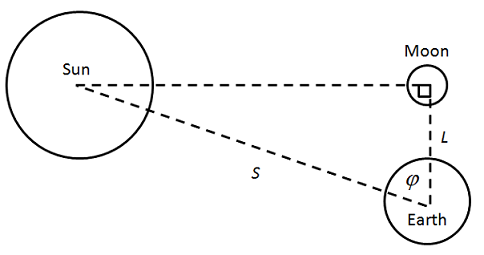
Aristarchus did not yet know what a tangent was, but he had the mathematical tools to calculate the required value, at least approximately. However, there is one major problem here. It is extremely difficult to determine the exact moment when the Moon is illuminated by the Sun exactly halfway (this configuration is called quadrature).
The angle to be measured is very close to 90°, and it is easy to make a mistake when measuring it. Aristarchus of Samos calculated it to be 87°. According to his calculations, the Sun was located 18 to 20 times farther from Earth than the Moon, whereas in reality the distance to the Sun is approximately 390 times greater.
However, this mistake did not prevent the scientist from coming to the correct conclusion that the Sun is much further away from us than the Moon. And since both appear to be approximately the same size in the sky, the daytime star must be about 19 times larger than the nighttime ornament.
Solar eclipse and the sizes of celestial bodies
But how much larger or smaller than Earth is the Moon itself? Aristarchus of Samos was aided by his observations of lunar eclipses and his understanding that they occur when the Moon passes into Earth’s shadow. The ancient Greek scientist believed that the Earth’s shadow was equal to its diameter, when in fact it is about 25% smaller because the Sun is not a point source of light.
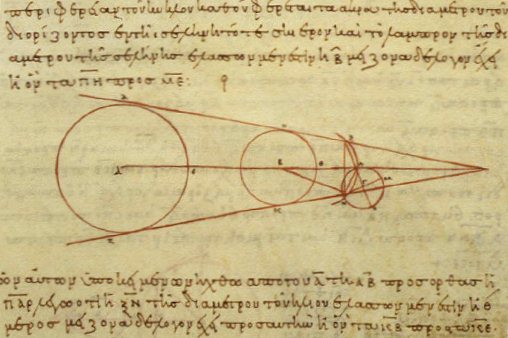
However, this error was not so significant. Aristarchus calculated that the duration of a total eclipse is 3.5 hours. He also knew that the period of the Moon’s rotation around the Earth is 27.3 days. Again, he did not know that the speed of its orbital motion is not constant. We can write the equation 2r/t = 2πR/T, where r is the radius of the Earth, t is the duration of the eclipse, R is the distance to the Moon, and T is its orbital period.
From this equation, it is easy to determine that the ratio of the distance to the Moon and the radius of the Earth (R/r) is approximately 59.6 – not far from the actual value. Using this ratio and the angular radius of the Moon, Aristarchus determined that its size is approximately three times smaller than that of Earth, which is quite close to the modern value of 0.273 times the radius of our planet.
Knowing this and the ratio of the distances from Earth to the Sun and from Earth to the Moon, we can calculate how much larger our star is than our planet. Aristarchus of Samos calculated that its radius was more than 19 times that of Earth, but less than 43 times. Of course, this was incorrect due to inaccurate angle measurements during the quadrature; however, it was still obvious that the Sun was much larger than the Earth.
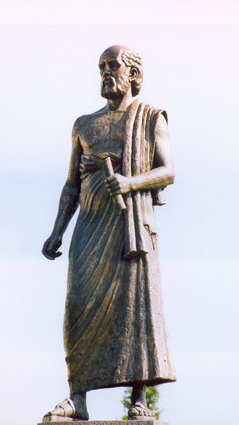
Aristarchus also suggested that smaller bodies usually revolve around larger ones, which seems logical from a common-sense point of view. Modern astrophysicists, of course, could argue about how convincing this argument is.
However, Aristarchus once again came to the correct conclusion: the Earth does indeed revolve around the Sun. In ancient times, astronomers repeatedly measured the distances to the Sun and Moon. For example, in the 1st century BC, Posidonius calculated that it was located at a distance of 9,893 Earth radii from us. This was still half the actual value, but even so, our sun seemed like a real giant compared to our planet, which was an argument in favor of heliocentrism.
But eventually, the ancient Greeks and Romans lost interest in the idea that the Earth revolves around the Sun. Historians still argue about the reasons for this. Perhaps religious issues were the cause, since in those days, belief in the immobility of the Earth was even more important for the authority of priests than it was during the Renaissance.
Another possible reason is purely scientific: the absence of visible annual parallax of stars. If the Earth revolved around the Sun, we would see it shift slightly as the seasons change. But nothing like that happens.
Aristarchus of Samos himself explained this, correctly assuming that the stars are simply very far away, which is why their parallax is small. However, this was only confirmed in the 19th century. Until then, it was a real problem that constantly cast doubt on heliocentrism. Be that as it may, it became dominant in scientific thought many centuries after the end of the classical era.

