

Lava planets are worlds similar in size to Earth that are so close to their stars that the rocks on their surfaces melt. Recently, scientists have put forward a new theory about how they evolve.
New theory of lava planets
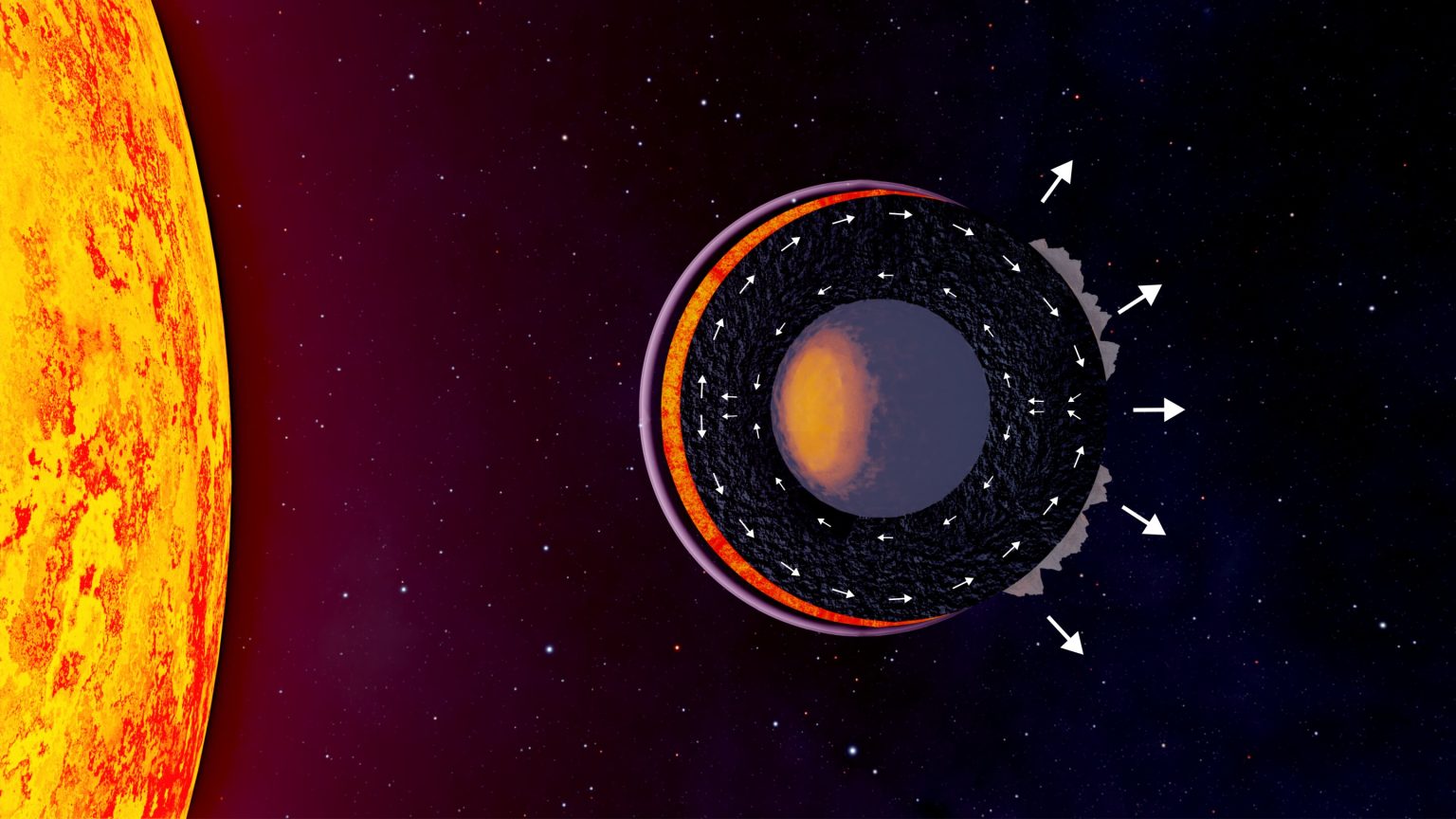
A new article recently published in Nature Astronomy, led by a professor at York University, presents a simple theoretical model to describe the evolution of the system of interconnected internal and atmospheric processes of hot rocky exoplanets, known as lava planets.
“Lava planets are in such extreme orbital configurations that our knowledge of rocky planets in the solar system does not directly apply, leaving scientists uncertain about what to expect when observing lava planets,” says lead author Charles-Édouard Boukaré.
New models provide a conceptual framework for interpreting their evolution and offer scenarios for investigating their internal dynamics and chemical changes over time. These processes, although greatly amplified on lava planets, are fundamentally the same as those that form rocky planets in our Solar System.
Lava planets are worlds ranging in size from Earth to super-Earths, orbiting extremely close to their stars, completing a full orbit in less than one Earth day. Like Earth’s moon, they are expected to be tied to their star, always showing the same side to it. The temperature on their daytime surface reaches such extreme values that silicate rocks melt and even evaporate, creating conditions unlike any in our Solar System. These exotic worlds, which are easy to observe thanks to their short orbital periods, provide unique insights into the fundamental processes that shape planetary evolution.
How these worlds are structured
The study combines knowledge in the fields of geophysical hydrodynamics, exoplanet atmospheres, and mineralogy to investigate how the composition of lava planets evolves in a process similar to distillation. When rocks melt or vaporize, elements such as magnesium, iron, silicon, oxygen, sodium, and potassium are distributed differently between the vapor, liquid, and solid phases. The unique orbital configuration of lava planets maintains a balance between vapor and liquid, as well as solid and liquid phases for billions of years, which contributes to long-term chemical evolution.
Using unprecedented numerical simulations, the team predicts two final evolutionary states:
- Fully molten inner core (probably young planets): the atmosphere reflects the overall composition of the planet, and heat transfer within the molten core keeps the night side hot and dynamic.
- Predominantly solid inner core (probably old planets): a shallow ocean of lava remains on the day side, and the atmosphere is depleted of elements such as sodium, potassium, and iron.
Testing hypotheses with the James Webb Space Telescope
Boukaré shares that this study on lava exoplanets started as a highly investigative project with low initial expectations. It is based on a new modeling approach that he developed to study molten rocky planets in collaboration with colleagues from the Institute de Physique du Globe de Paris, Université Paris Cité, published in Nature earlier this year.
Starting as a simple study, it has since opened up a promising new line of research. The predictions outlined in this paper helped secure 100 hours of observation time on the James Webb Space Telescope — the most advanced infrared observatory ever built, with a 6.5-meter segmented mirror and ultra-sensitive instruments capable of exploring the most ancient galaxies with unprecedented precision. These future JWST observations, led by co-author Professor Dang, will directly test the theoretical framework proposed in this study.
According to phys.org

