

Lunar dust can be not only a big problem for astronauts, but also a help to them. With the right approach, it can be used to build a base on our natural satellite.
Investigation of the mechanical properties of samples
Lunar dust can be a problem — but it is also literally the soil we will have to walk on if we ever want to have a permanent human base on the Moon. In this particular case, its sticky, jagged, static properties may indeed be an advantage, according to a new article recently published in the journal Research by scientists from Beihang University, who analyzed the mechanical properties of samples delivered by the Chang’e 6 mission from the far side of the moon.
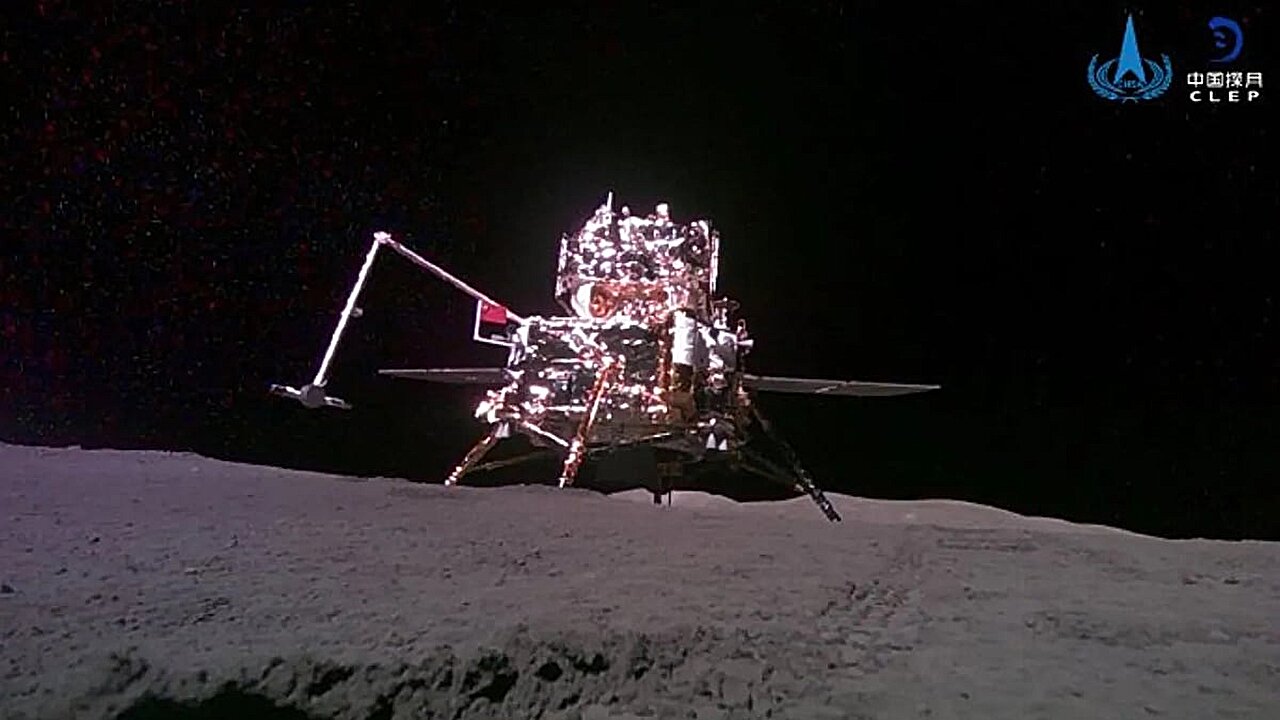
Chang’e 6 is the first mission ever to bring back samples from the far side of the Moon. It collected them from the South Pole-Aitken (SPA) basin — the largest, deepest, and oldest impact crater known to scientists in the Solar System, formed about 4.2 billion years ago. This formation has led to significant changes in the geotechnical properties of the soil compared to those collected on the near side of the Moon by NASA astronauts and Chinese landers.
But it is difficult to test these properties on Earth. Model samples cannot fully convey the true nature of the material, and there is simply not enough real lunar regolith on Earth to provide an unlimited number of samples to every interested researcher. Performing some of the tests also destroys the sample, rendering it unsuitable for further research, so the authors came up with an alternative: conducting non-destructive tests and then running a simulation.
Modeling lunar soil in the laboratory
They settled on the discrete element method (DEM) for modeling. This mathematical approach simulates the behavior of bulk materials by calculating the physical interactions, friction, and collisions of millions of individual particles. It uses the shape of the particle and some of its physical properties as input data, and can create a “digital twin” of the soil that future rovers or astronauts will have to traverse without touching any other sample.
However, to achieve this, the authors first had to touch several samples. They did this using high-resolution micro-computed tomography based on X-rays (micro-CT) to scale a part of the sample brought back by Chang’e 6. This non-invasive imaging technique, which also uses another technique called convolutional neural networks, allowed researchers to individually reconstruct nearly 350,000 separate particles for analysis.
Analysis of this dataset revealed numerous differences between the sample from the far side and the samples taken from the near side. Most notably, the sample from the far side has fewer large, coarse particles than the samples from the near side, but these particles also have low “sphericity,” which measures how close a particle is to a true sphere.
High strength of the samples studied
After connecting this dataset to their DEM program, the authors discovered that the regolith is extremely strong and is at the upper limit of measurements from Apollo-era samples. This is mainly due to the high angle of internal friction and dust cohesion. Most likely, the jaggedness of the particles, which complicates their operation in machines or in human lungs, actually contributes to an increase in their mechanical properties on the surface.
In addition, the mechanical strength of the samples was enhanced by “cementation” caused by glassy agglutinates, most likely due to the impact of a micrometeoroid. They make up approximately 30% of the sample, acting as cement that holds the other particles together.
For the construction of large infrastructure, such as Artemis’ future housing or the International Experimental Station, it is important to understand the basics of the soil. This first-of-its-kind geotechnical survey of the far side shows just how diverse the samples can be. And although it will be some time before we actually build anything on the far side (due to communication issues), it’s still good to know that when we do, we’ll have a solid foundation to work with. Even this strongest foundation can eventually destroy our machines and kill us if we remain in contact with it for too long.
According to phys.org

