

Sometimes black holes merge to form a larger object. However, this may not occur symmetrically, resulting in acceleration in a specific direction. Recently, scientists have been able to measure this recoil by studying gravitational waves.
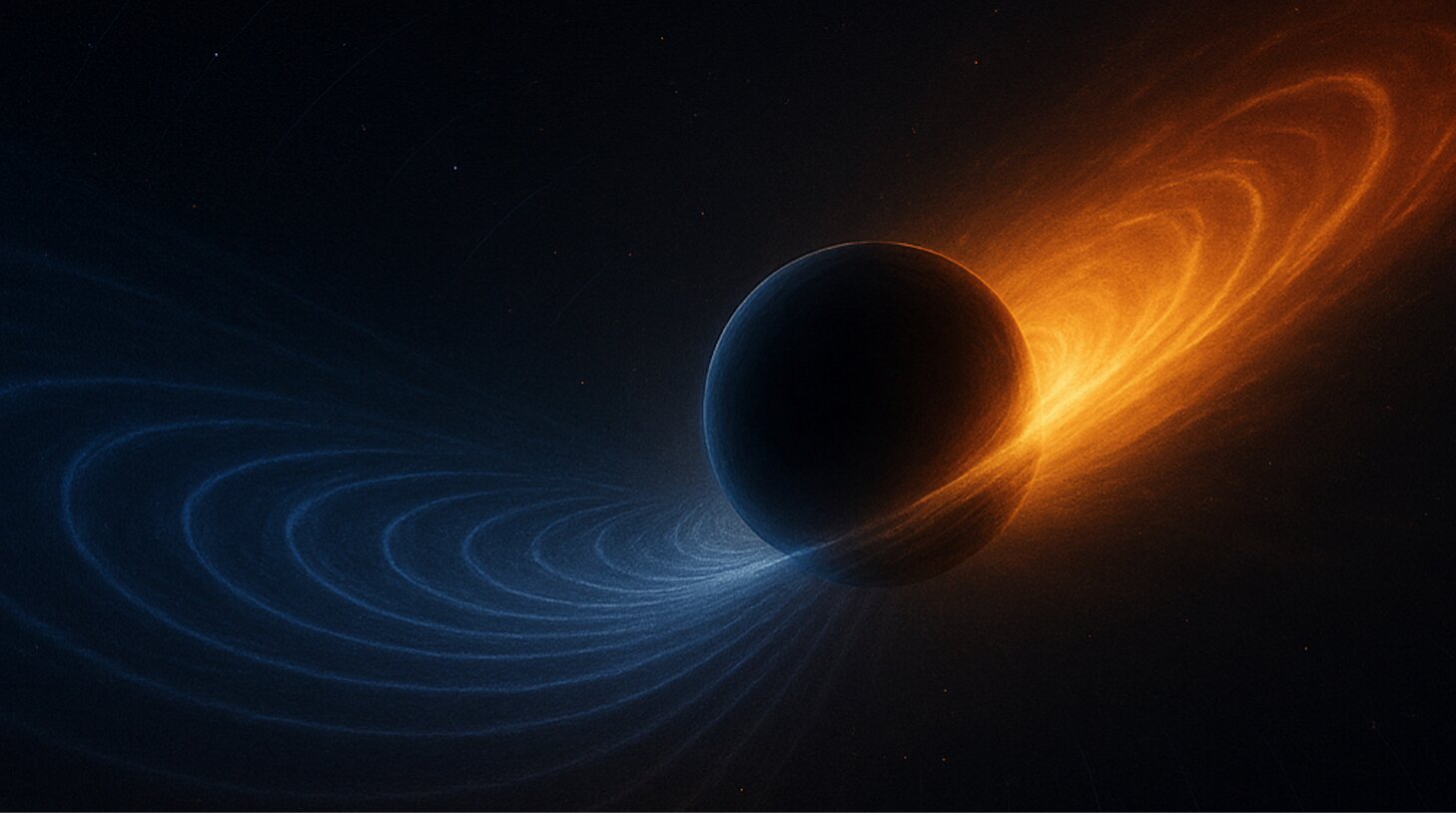
Merger of black holes
For the first time, a team of researchers led by scientists from the University of Santiago de Compostela (Spain) has been able to measure the recoil of black holes after they merge. The study of gravitational waves helped them achieve this.
For many decades, the merger of black holes and the birth of gravitational waves during this process remained a purely theoretical process. However, ten years ago, scientists were able to see it for the first time with the LIGO detector.
Since then, such events have been observed repeatedly. However, many details of the merger, which results in the birth of a new, sometimes very massive object, remain unknown. In particular, this is due to the fact that these processes are governed not by ordinary Newtonian mechanics, but by relativistic mechanics.
Recoil of black holes
And one of the most interesting features of black hole mergers is that they are not perfect, and the resulting object can receive a significant boost. It seems to bounce off to the side.
Different models give different possible recoil values. It is quite possible that it could reach as high as 1000 km/s. This is enough not only to eject the black hole from the star cluster where most of them are located, but also from our galaxy.
Observation
The only problem is how to see this recoil of a black hole, because it remains invisible. Scientists know that it has formed solely thanks to gravitational waves. However, models show that they may become witnesses.
The fact is that the unevenness of black hole mergers generates anisotropy in gravitational waves. Simply put, they propagate slightly differently in different directions. And if being at the right angle to the event, it is possible to hear information in the polyphony of signals from detectors that will allow calculating the velocity vector of the newborn object.
The method was proposed by scientists back in 2018. However, the first event to which it could be applied did not occur until 2019. It is called GW190412. And now scientists know that the black hole reached a speed of 50 km/s at that time. This was enough for it to leave the cluster in which it was born.
According to phys.org

