

A team of European researchers has successfully tested how autonomous robots can explore lava caves — natural tunnels beneath the surface of the Moon and Mars — in real field conditions. During a 21-day expedition to Lanzarote (Canary Islands), a heterogeneous team of three robots gradually mapped the entrance, dropped a sensor cube inside to build a 3D model, and then performed a complex descent into the cave, followed by an autonomous journey 235 m deep with simultaneous 3D scanning. The results were published on August 14, 2025, in the journal Science Robotics.
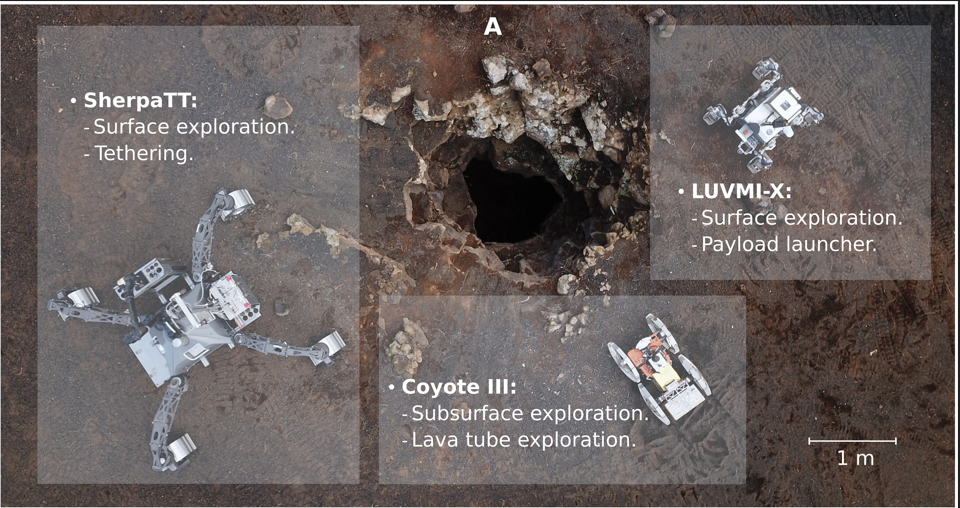
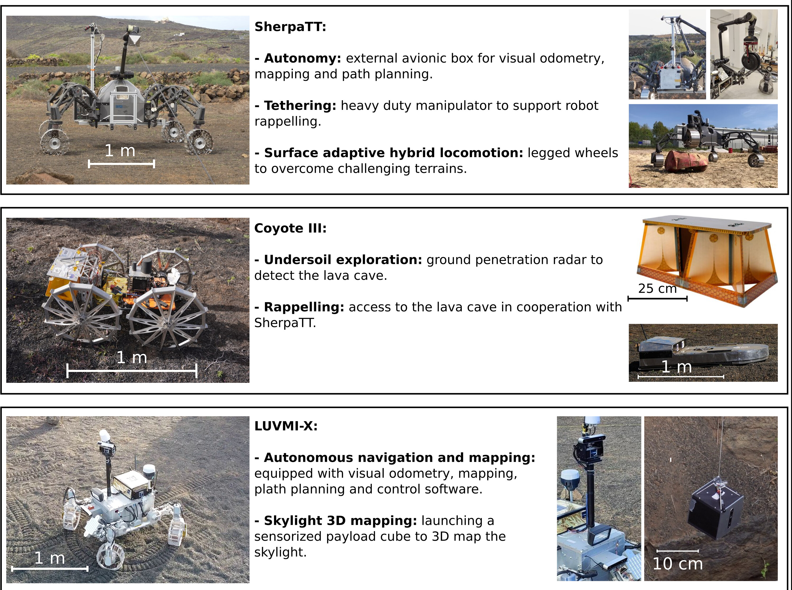
The system included the heavy SherpaTT (anchor and power support), the compact mobile Coyote III (rappelling and internal reconnaissance), and the Belgian LUVMI-X, which delivered a sensor cube to the tunnel for shooting and building a detailed 3D map of the entrance. This division of roles demonstrated the viability of cooperative autonomy in extreme subsurface conditions and allowed the team to demonstrate the full mission scenario – from accessing the cave to its initial mapping.
At the same time, the tests revealed a number of problems: the humid environment impaired the performance of the ground-penetrating radar, the sensors were periodically subject to interference, and fully autonomous navigation and communication in the cave remained a difficult task. Despite this, researchers note that teams of diverse robots are the most promising way to safely and economically explore lava caves — potential shelters for future bases and greenhouses for preserved traces of past life.
Lava caves can be ideal locations for long-term scientific stations: stable temperatures and protection from radiation reduce risks to instruments and allow for more accurate geophysical measurements (seismic, heat flow), while preserving stratigraphy — an archive of geological history. Autonomous mapping and robot cooperation algorithms, honed in such missions, are directly scalable to Mars and the Moon, accelerating the search for water ice, identifying safe locations for landing/construction, and preparing for future astrobiological experiments.
Dreaming of a weekend trip to Mars? Imagine Valles Marineris, longer than the United States, Olympus Mons, nearly 22 km high, and Phobos, a moon that is slowly being destroyed by tidal forces. Want to see which locations will be must-sees for the first colonists and space tourists? A brief guide with interesting facts and visualizations can be found here: “The main tourist attractions of Mars.”

