

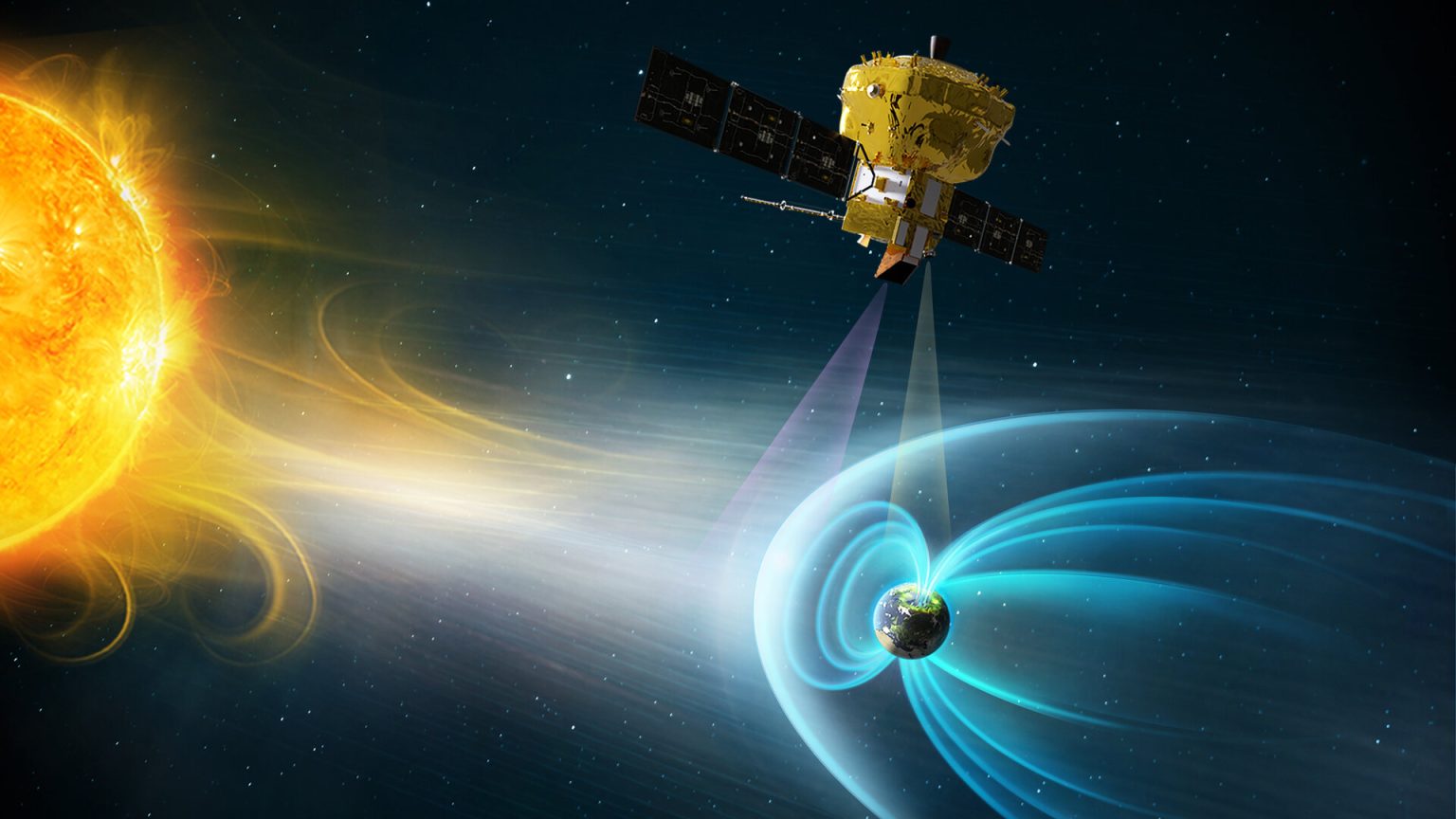
The Smile mission, developed jointly by the European Space Agency and the Chinese Academy of Sciences, is scheduled to launch on May 19, 2026. The instrument will capture X-ray images of Earth’s magnetic field for the first time and continuously record the aurora for 45 hours straight—to understand how our planet responds to particle streams and solar flares.
From launch to orbit
Representatives of the European Space Agency (ESA) have confirmed that the rocket will launch at 5:52 a.m. Central European Summer Time from the Guiana Space Centre in French Guiana. The four stages of the Vega-C will separate one after another: 57 minutes later, the spacecraft will be released into free flight, and six minutes after that, the solar panels will deploy—this moment will confirm the success of the launch.
The original launch date was postponed due to a malfunction detected on the production line for one of the Vega-C rocket’s components. After the inspections were completed, all partners confirmed the new date—May 19. The issue concerned production, not the device or the storage medium itself—both of which are in working order.
Smile will enter what is known as an elliptical orbit: at its highest point, the spacecraft will rise to 121,000 km above the North Pole—that is where the data will be collected. At its lowest point—5,000 km above the South Pole—the probe will transmit data to ground stations.
What the mission will investigate
Smile is an acronym for Solar Wind Magnetosphere Ionosphere Link Explorer. On board are an X-ray camera for observing the Earth’s magnetic field, an ultraviolet camera for capturing the aurora, and other instruments provided by the Chinese Academy of Sciences.
The mission is part of ESA’s Cosmic Vision program and is designed to deepen our understanding of solar flares and geomagnetic storms—phenomena capable of disrupting the operation of satellites and power grids on Earth.
According to esa.int

