
In a world limited to three dimensions, imagining a fourth is incredibly difficult, especially for an unprepared reader. But one genius scientist found a way to show people the hidden world using an ordinary apple.
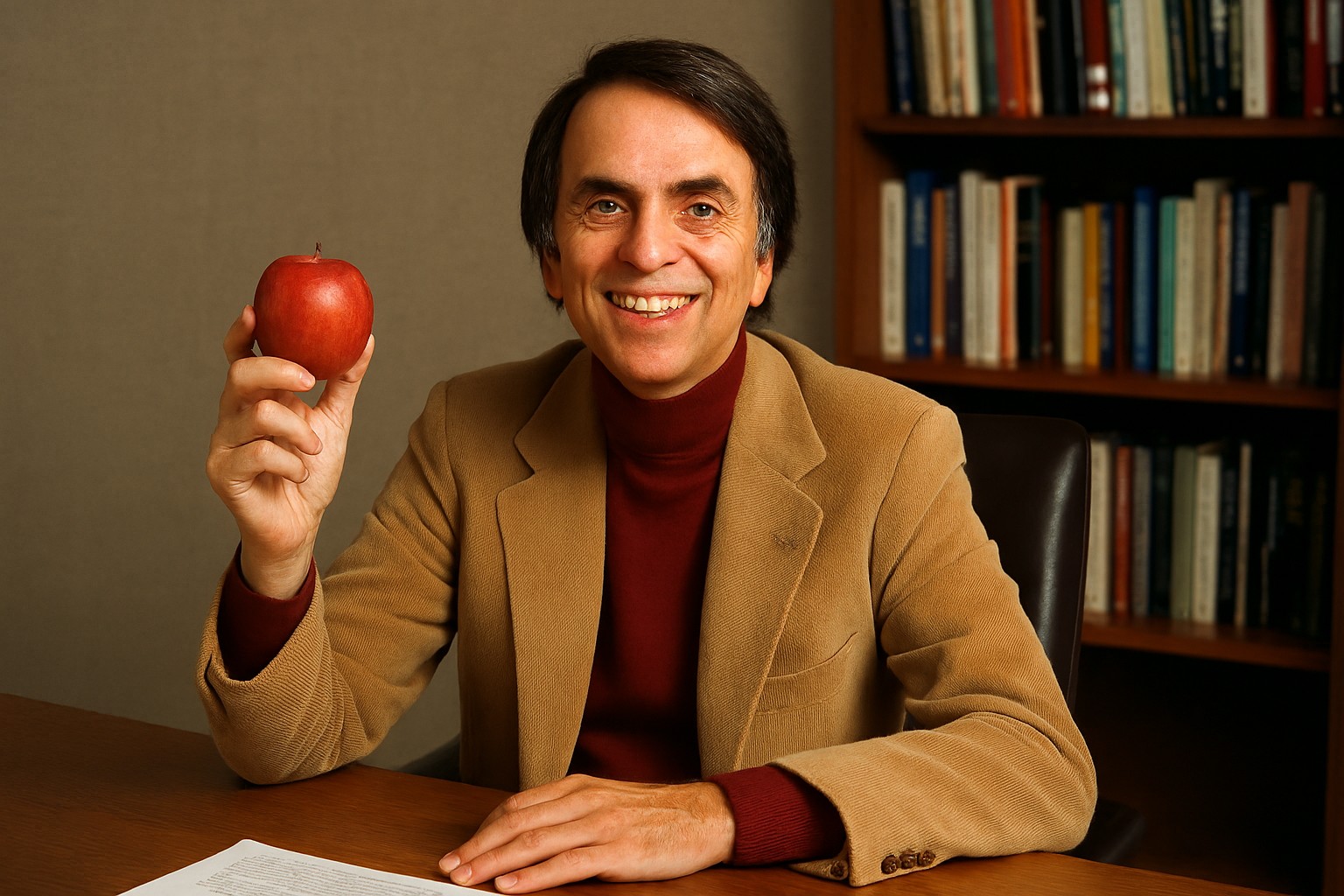
As it happens, the human mind is attuned to perceiving only three dimensions: height, width, and depth. Representing the fourth dimension seems like an impossible task, because our brains are limited by the physical world around us. But what if there is a dimension that we simply cannot see? Legendary science popularizer Carl Sagan comes to the rescue.
Known for his research into space, Sagan possessed a unique gift — the ability to explain complex scientific theories through simple stories and vivid analogies. He could turn the most complex concept into a fascinating adventure for the mind.
In search of the fourth dimension
Time is often referred to as the fourth dimension. This is logical: to determine the position of an object in the Universe, you need three coordinates in space and one in time. But there is another, more theoretical concept — a space where all four dimensions are spatial. It is precisely this concept that is so difficult to understand.
Sagan begins his explanation with a simple analogy. He invites us to imagine a two-dimensional world — a Flat World whose inhabitants have no concept of “up” or “down.” When a three-dimensional object, such as an apple, passes through this flat world, its inhabitants see only a strange phenomenon.
They do not see the apple as a whole. They only observe the point of contact that appears when the apple crosses their world. When an object moves, this point may change shape, split into several parts, or disappear. For a resident of the Flat World, this is an incomprehensible phenomenon, a set of changing forms that cannot be explained in his/her world.
From apple to hypercube
The same logic, Sagan notes, applies to us when we try to imagine the fourth dimension. We are like those inhabitants of the Flat World. Our minds cannot comprehend anything beyond our three dimensions. But we can see its “imprint” in our world.
To demonstrate this, the scientist uses a tesseract — a four-dimensional hypercube. We cannot see a real tesseract, but we can observe its three-dimensional projection, just as the inhabitants of Flat world saw only a two-dimensional trace of an apple. This projection looks like a complex cube, as if nested within itself. It is only a shadow, an attempt by our brain to reproduce something much more complex.
Truth beyond reach
Sagan’s work is not just an interesting scientific trick. Studying measurements that lie beyond our immediate experience is key to understanding the fundamental laws of the Universe. Many phenomena in physics, such as black holes or the curvature of space-time, cannot be adequately described in only three dimensions.
Carl Sagan not only dispelled the myth that complex concepts are inaccessible. He showed that the best way to understand something is through clear explanations, vivid metaphors, and engaging stories. His lesson on the fourth dimension remains a brilliant example of how to talk about the most complex things in a simple way.
Earlier, we reported on how Carl Sagan was responsible for the most famous photograph of Earth from space.
According to upworthy.com

