

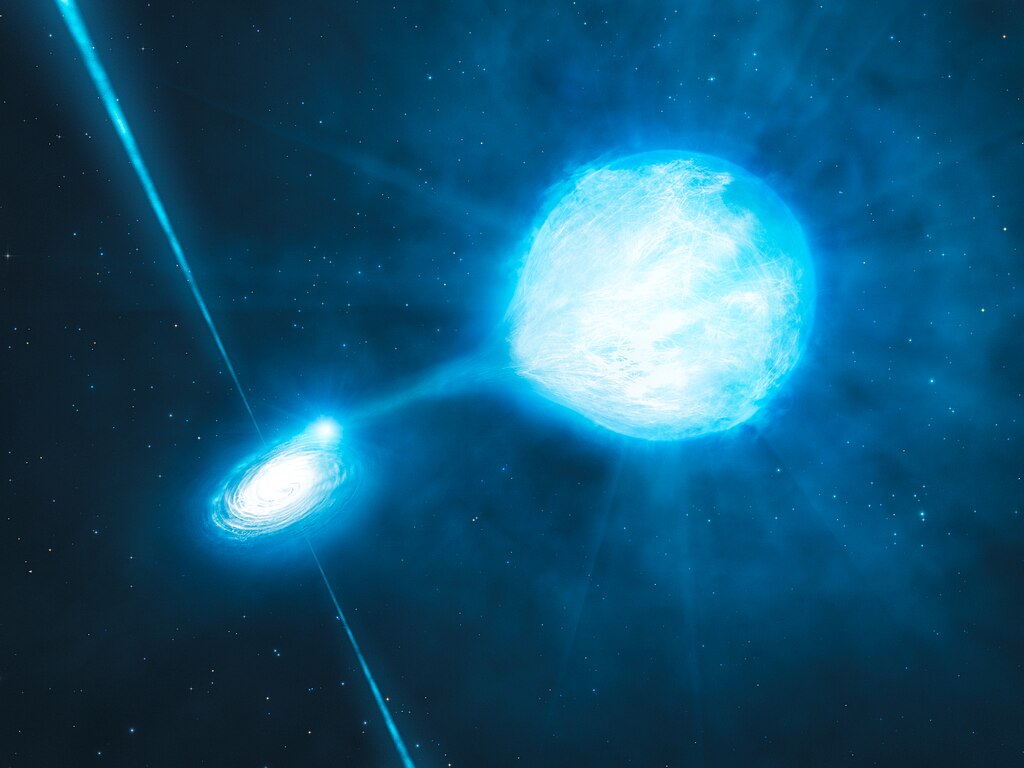
For the first time in many years, astronomers have managed to record a rare cosmic phenomenon — an intermediate-mass black hole actively consuming a star. This discovery was made by two NASA observatories: the Hubble Space Telescope and the Chandra X-ray Observatory.
An object called HLX-1 was discovered about 450 million light-years from Earth in the galaxy NGC 6099, located in the constellation Hercules. The researchers’ attention was drawn to unexpected bright bursts of X-ray radiation. This is how black holes usually “give themselves away” when they absorb matter from stars that have come too close.
What is an intermediate-mass black hole?
Unlike supermassive black holes or small black holes, intermediate-mass black holes (IMBHs) remain virtually invisible. Their mass usually ranges from hundreds to hundreds of thousands of solar masses. Due to their rarity and “silence,” such black holes are extremely difficult to detect.
This is why the HLX-1 is so valuable. It is a rare representative of this type, located not in the center of the galaxy, but on its periphery. This challenges traditional ideas about where such objects should be located.
How does a star “turn into dinner”?
When a star approaches an intermediate-mass black hole, its gravity literally tears the star apart. The matter of the star forms a hot accretion disk around the black hole (a funnel of cosmic dust and gas that spins around the black hole, gradually “feeding” it with new matter). This funnel emits intense X-rays, allowing scientists to see such objects and study their physics.
Recent observations have shown that in 2012, HLX-1 reached its peak activity, becoming 100 times brighter in the X-ray spectrum than in 2009. Since then, its glow had gradually faded, and by 2023 it almost disappeared.
Currently, a team of researchers led by Yi-Chi Chang from National Tsing Hua University in Taiwan is interested in the main question: was this a single event in which the star was completely destroyed, or was it a long process associated with an unstable gas disk?
To find the answer, astronomers continue to observe HLX-1, looking for new flares and changes in radiation.
Why is this discovery important?
This discovery is important for understanding the evolution of black holes. It confirms the theory that intermediate-mass black holes may be an intermediate link between small and supermassive black holes. They may merge with each other during galaxy collisions, gradually increasing their mass and forming the giants that scientists observe at the centers of galaxies.
However, some discoveries made by the James Webb Telescope suggest that some supermassive black holes may have formed directly from giant gas clouds, bypassing the intermediate mass stage. This means that there are several scenarios for their formation.
HLX-1 will help determine which of these processes dominates, or whether they are combined in nature. Thanks to new observations, astronomers are getting closer to answering one of the main questions in cosmology: how the largest objects in the Universe are born.

