

Astronomers working with the Hubble Space Telescope have published a new image taken by the telescope. It shows a mesmerizing landscape of gas and dust clouds lit up by tons of stars.
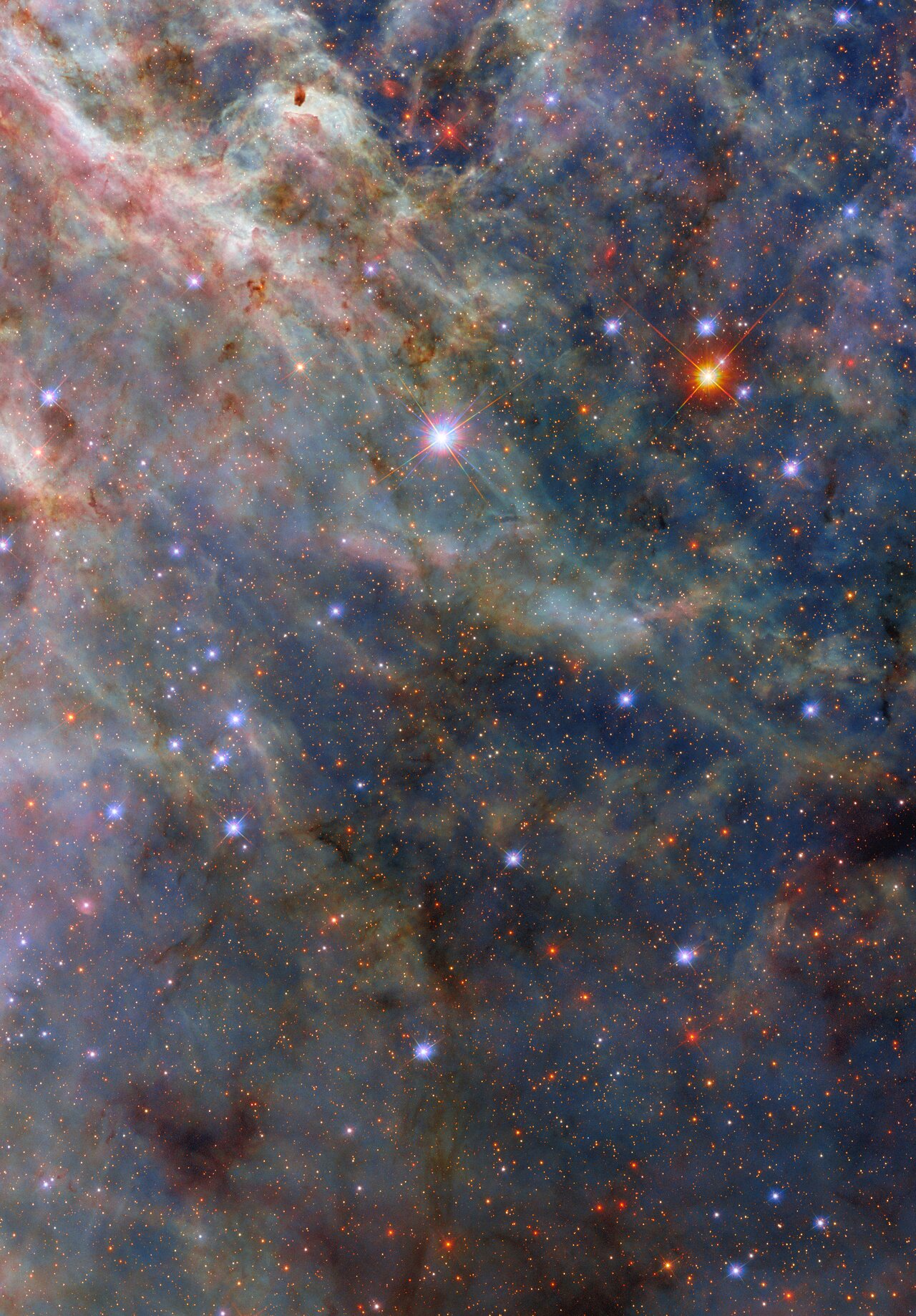
The region captured by Hubble is known as the Tarantula Nebula. It is not located in the Milky Way, but in the Large Magellanic Cloud, a dwarf galaxy located about 160,000 light-years from Earth. It is the largest of dozens of small companions orbiting our galaxy.
As for the Tarantula Nebula, it is a giant cloud of ionized hydrogen, whose length exceeds a thousand light years. It is home to some of the brightest and most massive stars known to science. Some of them are approximately 200 times more massive than the Sun. In addition, in 1987, supernova SN 1987A exploded on the edge of the nebula. It was the first supernova observed in the Earth’s sky with the naked eye in over 300 years.
The area depicted here is located far from the center of the nebula, where a supermassive star cluster called R136 is located. But it is located next to a rare type of stars called Wolf-Rayet stars. This is the name given to massive stars that have lost their outer hydrogen shell and are the source of dense and powerful stellar winds.
In the past, Hubble has photographed the Tarantula Nebula many times. Its ability to conduct multi-wave observations is crucial for capturing various details in gas and dust clouds and gaining a better understanding of how new stars are formed.
According to Esahubble

