

Astronomers have published a new image obtained by the Hubble telescope. It photographed a sparkling galaxy known as NGC 6000. It is located 102 million light-years from Earth in the constellation Scorpio.
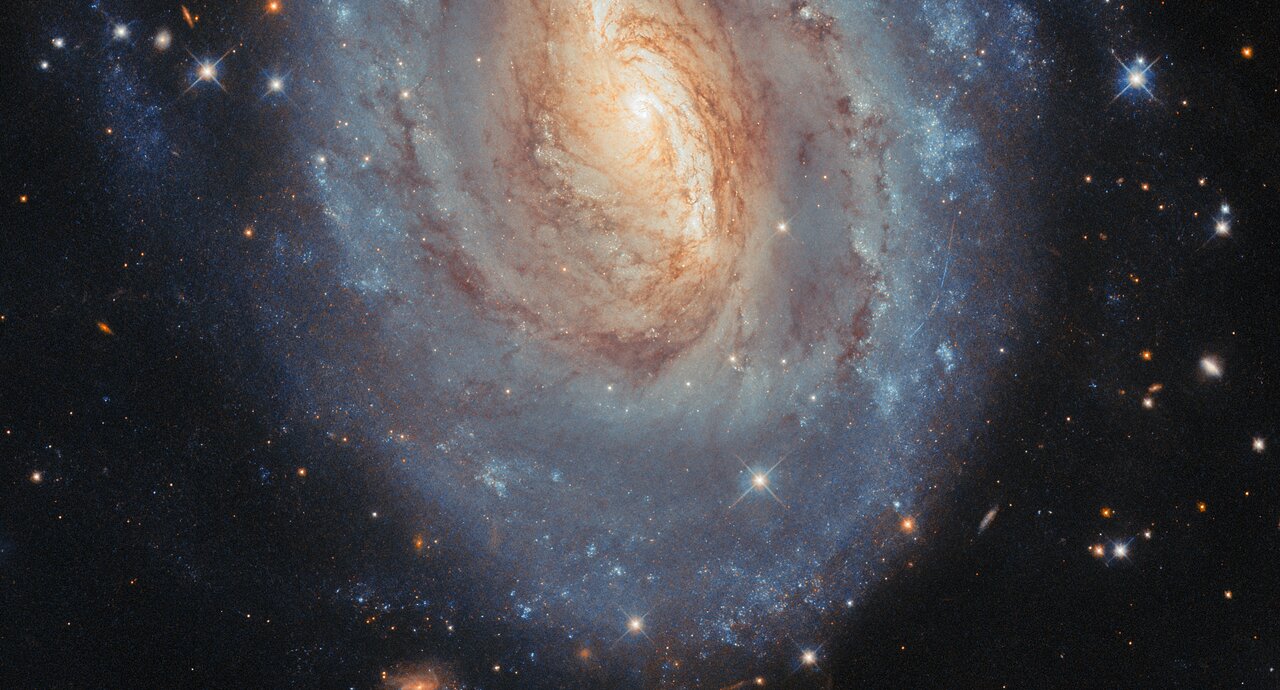
Like our Milky Way, NGC 6000 is a spiral galaxy with a bar. However, it cannot be called an exact copy of ours. The fact is that NGC 6000 has a very bright core. It is home to a supermassive black hole that actively absorbs matter, accompanied by the release of large amounts of energy.
The Hubble image also shows differences in the colors of the stars in NGC 6000. These reflect differences in their age, mass, and surface temperature. Stars in the center of the galaxy are generally older and smaller in size. Less massive stars are cooler than more massive ones and, contrary to intuition, are red in color, while hotter stars are blue. In the photo, we can see bright star clusters scattered across the spiral arms of NGC 6000. They contain young massive stars and are blue in color.
Hubble took a photo of NGC 6000 as part of a project to study galaxies with recent (21st century) supernova explosions. NGC 6000 is the site of two such events: SN 2007ch in 2007 and SN 2010as in 2010. Using Hubble’s sensitive detectors, researchers can distinguish the faint glow of supernovae years after the initial explosion. These observations help to limit the mass of their progenitor stars and may indicate whether they had stellar companions.
By enlarging the right side of the galaxy’s disk in the image, you can see something unusual: a set of four thin yellow-blue lines. This is a trace left by an asteroid from our Solar System. The four stripes were formed by four different exposures that were recorded by Hubble one after another with short pauses between them. They were combined to create this final image. The colors are explained by the fact that a filter was used for each exposure to collect only very specific wavelengths of light — in this case, red and blue.
Earlier, we reported on how Hubble photographed the “smoldering heart” of a celestial cigar.
According to Esahubble

