

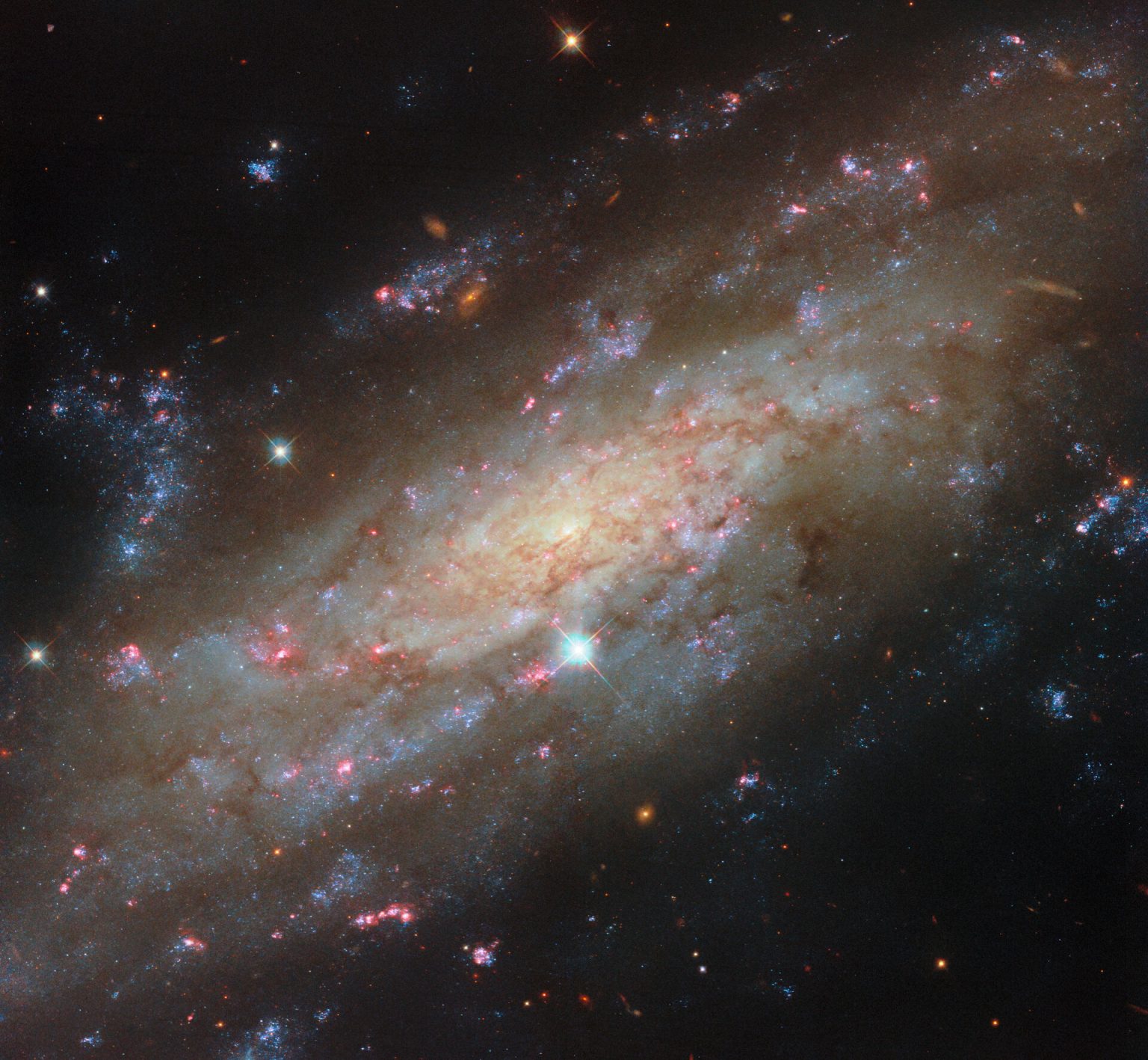
The NASA/ESA Hubble Space Telescope has captured an image of the spiral galaxy NGC 3137, located in the constellation Antlia. It belongs to a group of galaxies that, according to researchers, resembles our own cosmic neighborhood—the Local Group, of which the Milky Way is a part. The image was released on April 30, 2026.
Space analogue
Researchers believe that this group resembles the Local Group in structure: two large spiral galaxies and dwarf satellite galaxies.
NGC 3137 and its neighbor NGC 3175 play the roles of the Milky Way and Andromeda in this context. The exact number of dwarf satellites in this group remains unknown, but more than 500 candidates have already been identified.
What can be seen in the photo
Hubble has imaged NGC 3137 in six different wavelength bands. The galaxy is significantly tilted relative to our line of sight, offering a unique view of its sparse, feathery spiral structure.
At the center of NGC 3137 lies a black hole with a mass of about 60 million Suns, surrounded by a thin web of dust clouds.In the foreground are a few stars from the Milky Way that happened to be captured in the frame, with numerous distant star systems beyond them.
Star Nursery
The main attraction of the image is the dense clusters of bright blue stars and red gas clouds, which indicate the presence of hot, young stars still shrouded in the nebula where they were born. These clusters are the primary focus of the observations led by D. Thilker, in which Hubble is studying star clusters in 55 nearby galaxies.
The program aims to cover the entire cycle—from clouds where new stars are just beginning to form to the oldest star clusters that formed in the early days of their galactic homes.
Since the NGC 3175 group is considered an analogue of our galactic neighborhood, studying it provides a better understanding of the dynamics of the Local Group and the evolution of the Milky Way—something that is much more difficult to do from within.
According to esa.int

