

Astronomers working with the Hubble Space Telescope have published a new photo taken by the Hubble Space Telescope. It shows the galaxy NGC 4571.
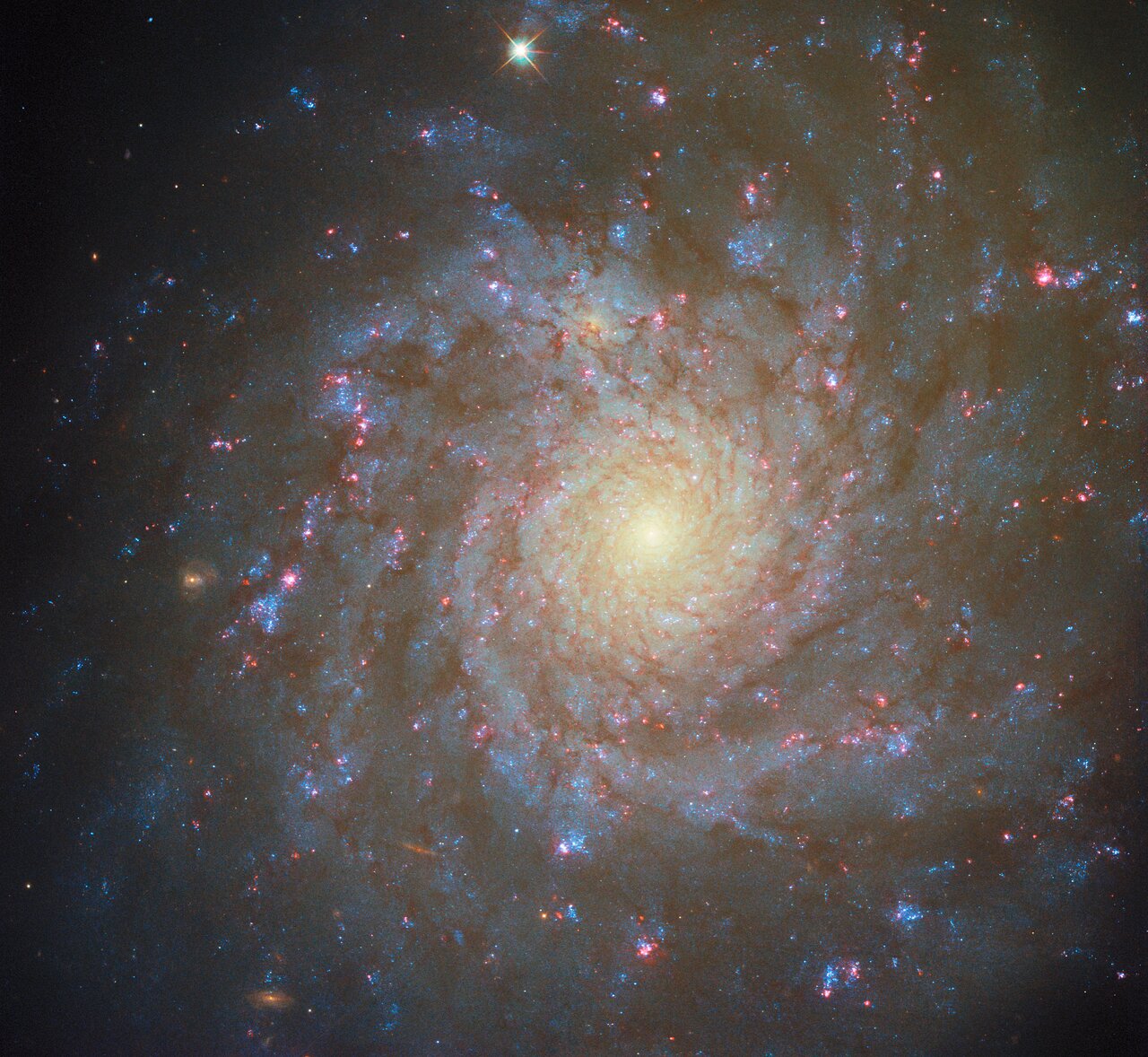
NGC 4571 is located about 60 million light-years from Earth in the direction of the constellation Coma Berenices. This constellation is interesting in that it is the only one named after a real person — Berenice (Veronica), wife of the Egyptian king Ptolemy III (3rd century BC). When her husband went off to war, she cut off her hair and placed it in the temple of Aphrodite. According to legend, the hair mysteriously disappeared, and the court astronomer explained that it had been placed in the sky and turned into new stars. Later, they became known as Coma Berenices (Veronica’s Hair), which eventually became the name of the constellation.
Like our Milky Way, NGC 4571 is a spiral galaxy. Hubble’s photo shows its feathery spiral structure and numerous star clusters. The image was taken as part of a program aimed at better understanding how dust affects observations of young stars.
The dusty spiral arms of NGC 4571 are dotted with bright pink nebulae containing massive young stars. Although the star-forming clouds are heated to about 10,000 degrees by the powerful ultraviolet radiation from the young stars at their cores, stars are born in much cooler conditions. The birthplaces of stars are giant molecular clouds ranging in size from tens to hundreds of light-years, where the temperature is only a few dozen degrees above absolute zero.
The dramatic transformation from an icy gas cloud into a hot young star occurs due to the enormous gravitational force that collects gas into dense clusters within the cloud where stars are formed. When these clusters collapse, they eventually become hot and dense enough for fusion reactions to begin in their centers, causing them to glow. The glowing clouds seen in the Hubble photo surround particularly massive stars that are hot enough to ionize the gas around their birthplaces.
Earlier, we talked about how Hubble photographed a “popular” galaxy in the constellation Leo.
According to Esahubble

