

Hubble photographed the Trifid Nebula for the second time—29 years after the first image. And this pause became a scientific discovery.
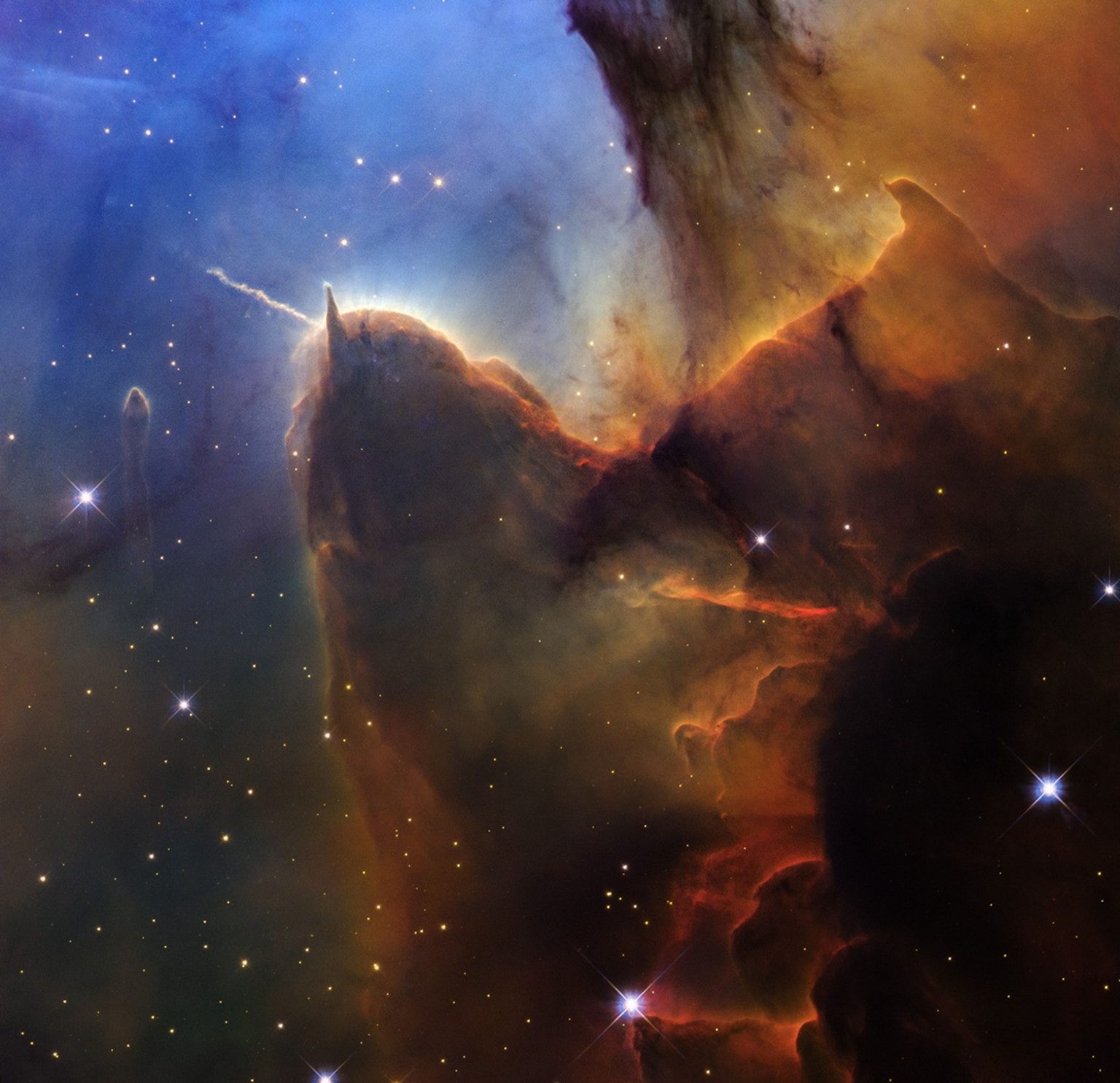
To mark the 36th anniversary of the launch of the Hubble Space Telescope, NASA has released a new image of the Trifid Nebula—a star-forming region located 5,000 light-years from Earth. But the real value lies not only in its beauty: Hubble had already photographed this same region in 1997, and now, 29 years later, it has become possible to compare the two images and see how the nebula has changed.
The photo shows a fragment of a massive gas and dust cloud that has been forming for at least 300,000 years around several massive stars (which are outside the frame). Their powerful streams of particles inflate a gigantic bubble, compressing the matter and triggering new waves of star formation. The densest parts of the cloud conceal protostars—objects that have not yet completed their formation and are therefore invisible in visible light.
“The Cosmic Sea Lemon” and its secrets
NASA astronomers have nicknamed the central structure the “Cosmic Sea Lemon”—the dark cloud really resembles a sea lemon with two “horns.”
The upper “horn” of the nebula is a jet of plasma erupting from the Herbig-Haro object HH 399, hidden within the cloud.
To the right of the “head,” another plasma jet from a different protostar is visible; a cleared space can be seen around it, which may indicate that the formation process has been completed.
A comparative analysis of images from 1997 and 2026 allows us to measure the speed of these outflows and determine how much energy the young star is releasing into its surroundings.
Why is this comparison possible right now?
Hubble observed Trifid not just to capture a new image. Over the course of 29 years, the telescope set a record for the longest interval between two observations of a single object, and this time proved sufficient to capture the actual motion of the material—something that cannot be seen in any single photograph.
An additional advantage is that during a servicing mission in 2009, Hubble was equipped with a new Wide Field Camera 3 (WFC3) with a wider field of view and higher sensitivity—so new details are visible much more clearly.
Mission Statistics
Over the course of its 36-year mission, Hubble has made more than 1.7 million observations. Based on its data, nearly 29,000 astronomers have published more than 23,000 peer-reviewed scientific papers—with approximately 1,100 of them published in 2025 alone.
Today, Hubble data is regularly combined with observations from the James Webb Space Telescope, and the new Nancy Grace Roman Space Telescope may soon join this duo—its camera is capable of capturing the entire Trifid Nebula in a single image.
According to science.nasa.gov

