

Boston Dynamics has demonstrated how its humanoid robot, Atlas, has learned to lift heavy industrial loads. The technology is based on reinforcement learning, millions of training runs in a simulator, and the robot’s ability to sense its own body rather than rely on cameras.
Millions of hours of practice
The company published a technical blog post explaining its approach to training Atlas. During training, the robot repeatedly performed the same task of lifting objects in a simulation, but under varying conditions—the load’s mass, floor friction, grip force, and the object’s starting position were all altered.
According to Boston Dynamics, the robot practiced its movements for millions of hours in parallel simulations on GPUs. Atlas received positive reinforcement for correctly performing the task: maintaining its grip and balance even when subjected to external forces.
Feels the body, not the image
Instead of cameras, Atlas relies on proprioception—the body’s internal sense of position and movement. Thanks to this, the robot can detect weight, balance, resistance, and grip strength in real time while moving objects.
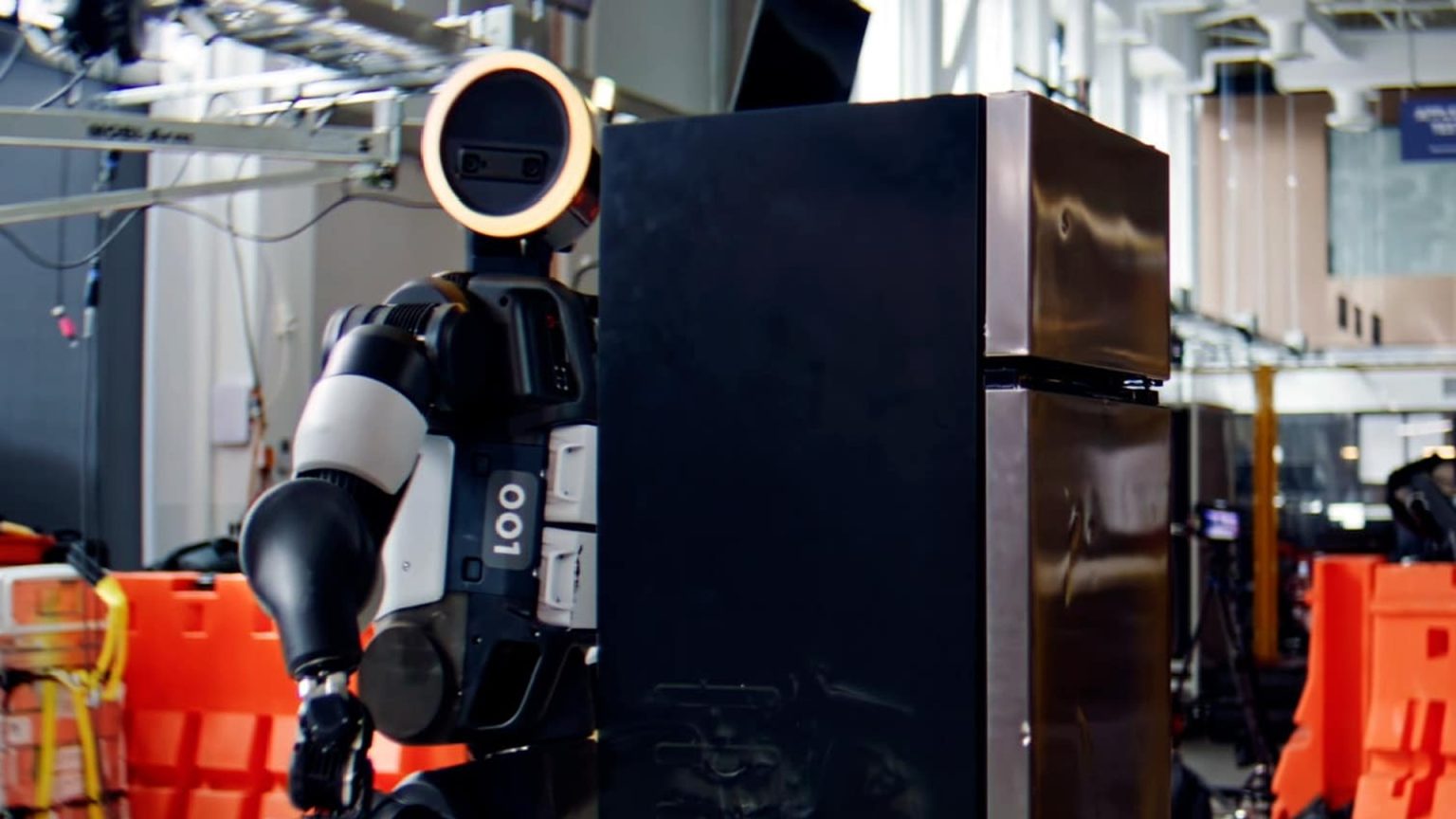
This allows it to adapt to unstable loads. In one demonstration, Atlas rotated its torso 180 degrees, sat down, picked up a mini-fridge, and carried it across the lab—even though the contents inside were shifting.
A smaller gap between simulation and reality
One of the main challenges in robotics is the gap between simulation and reality. Behavior that works perfectly in a virtual environment often fails in real-world conditions due to friction, signal delays, or sensor noise. Atlas addresses this issue through its simplified design.
The design uses only two types of actuators—devices that convert energy into mechanical motion, essentially the robot’s muscles—and both arms and legs are symmetrical. This makes the simulation more accurate and significantly reduces unpredictable deviations when transitioning to a physical system.
Joints without cables
The engineers also removed the cables from the joints. Now Atlas can rotate them continuously without restrictions or wear and tear. According to the company, this allows it to perform movements that are beyond the capabilities of traditional humanoid robots.
Atlas was trained with loads weighing 23–32 kg, but during testing it lifted a refrigerator weighing over 45 kg. Boston Dynamics also links the robot’s acrobatic stunts, such as handstands and backflips, to industrial needs. Such movements develop balance, agility, the ability to recover from slips, and endurance in high-temperature conditions.
According to interestingengineering.com

