

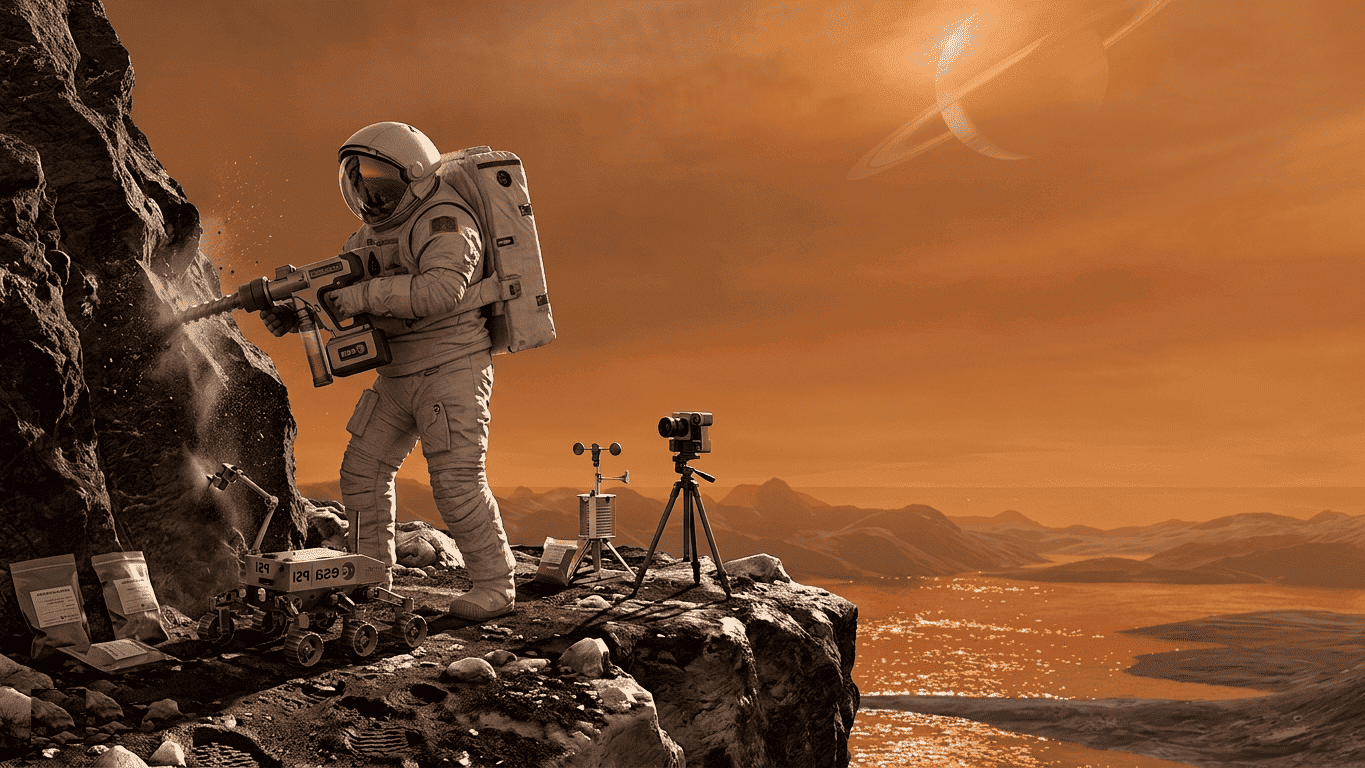
A world with methane seas, a dense atmosphere, and conditions conducive to the emergence of life—Titan is increasingly being cited as the next major goal of human space exploration after the Moon and Mars. This June, an international group of scientists and engineers will gather in the United States for the first time to discuss the realistic prospects for a crewed mission to this distant moon of Saturn.
How it all begins
The first Human Exploration of Titan Summit will be held in Boulder, Colorado, on June 11–12 to assess the realistic prospects for a human mission to Saturn’s moon. “It’s not too early to start thinking about this,” says Amanda Hendrix, director of the Planetary Science Institute (PSI) and president of the nonprofit organization Explore Titan.
The organizers aim to bring together scientists, engineers, and industry representatives to determine what preparatory missions are needed on the path to Titan. Among the summit’s main topics are the scientific objectives of crewed expeditions and the role of robotics as a first step.
Robots will be the first to fly
One Earth-based spacecraft has already visited Titan. In January 2005, the European Space Agency’s (ESA) Huygens probe landed on the moon’s surface, setting the record for the farthest landing from Earth. The data it transmitted revealed the dynamics of the atmosphere and the surface features: icy “rocks,” dry riverbeds, dunes, and lakes.
The next step will be NASA’s Dragonfly mission—an octocopter drone powered by nuclear energy, scheduled for launch no earlier than 2028. After a six-year journey, the spacecraft will spend three years flying between different regions of the surface to investigate conditions that could support life.
What makes Titan special
Researcher Ms. Hendrix describes Titan as a “dynamic world” that resembles early Earth. Unlike the Moon or Mars, it has a dense atmosphere—the pressure near the surface is even higher than on our planet.
This means that a pressure suit is not necessary: protection against the cold and a source of oxygen—which is absent in the nitrogen-methane atmosphere—are sufficient. The low gravity, combined with the dense air, theoretically allows for movement using wings or a jetpack.
It’s a long way
A manned mission is still a long way off. Researchers believe that before sending humans, we need orbital probes—perhaps an unmanned flight around the moon—as well as radar and infrared mapping of the surface.
“There are many things that robots can and should do. But there are tasks that only humans can perform,” says Hendrix. The summit aims to “plant the seed”—to convince the scientific community that human presence on Titan is a real, albeit distant, possibility.
According to space.com

