

Astronomers have discovered relatively cold clouds of molecular hydrogen inside structures known as Fermi bubbles. The latter are not only huge, but also extremely hot, so there is a certain mystery here.
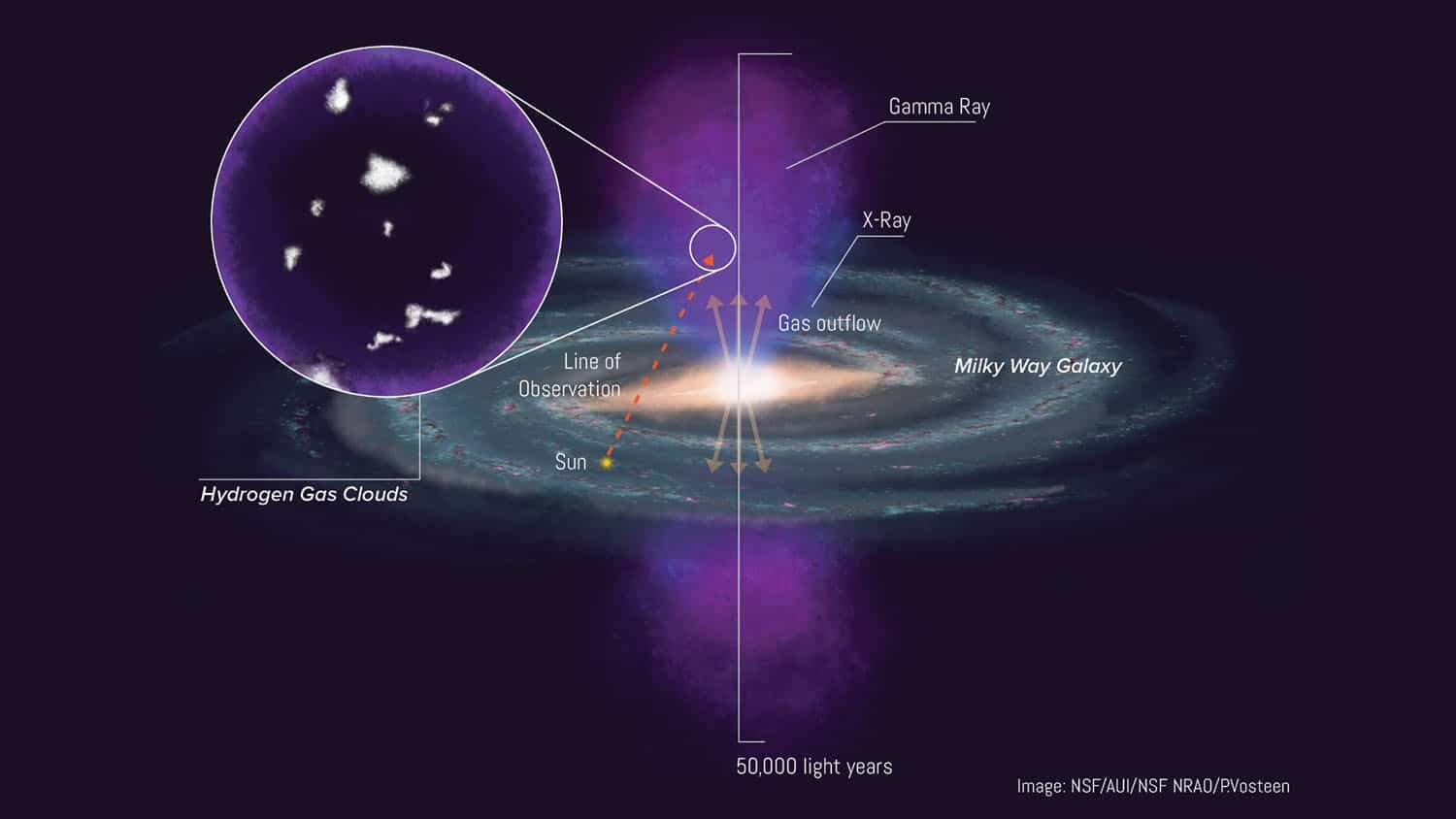
Clouds in Fermi bubbles
Can something cold remain cold inside something much hotter? The authors of a study published in The Astrophysical Journal Letters state that the answer is yes. At least, if the hot medium consists of Fermi bubbles.
Each has a diameter of 25,000 light years, and if they emitted light in the visible spectrum, they could occupy half of our sky. However, they are only visible in the X-ray and gamma ranges, therefore they were only discovered in 2010.
Fermi bubbles have a temperature of about 1 million Kelvin, so it is easy to imagine the surprise of the research team when they found dense clouds of neutral hydrogen inside them, each with a mass of tens of solar masses. And all of them were cold.
Ice cubes in hot chocolate
Actually, gas clouds aren’t so cold. Each one has a temperature of around 10,000 Kelvin, which is actually hotter than the surface of our sun. However, this is still 100 times less than in the surrounding environment. Experts compare their discovery to finding ice cubes in hot chocolate.
How can this be? A comparison with hot chocolate provides a clue. Ice cubes can be found in it if they have just been thrown in. With Fermi bubbles and gas clouds inside, it’s the opposite. The ejection from the center of the Milky Way had to have created them less than 10 million years ago.
In that case, the hydrogen clouds should have been in the same place where we see them now. And now we are simply watching them evaporate into a more favorable emission environment. And the most interesting thing is that this conclusion is fully consistent with previous observations in ultraviolet light.
The latter have shown that there are gas flows with temperatures ranging from 100,000 to 1 million Kelvin inside Fermi bubbles. This is exactly what the evaporation of neutral hydrogen from clouds should look like.
According to phys.org

