

Scientists working on the Dark Energy Survey (DES) program have published the first complete release of data collected over six years of operation. It contains a vast amount of data on supernovae, galaxy clusters, and other distant objects that can tell us a lot about how our Universe has evolved.
Data for six years
A team of scientists working in the international collaboration Dark Energy Survey (DES) has released the first complete set of data collected by the project over six years of operation. Parts of the data and even entire discoveries made on their basis have been published repeatedly in the past. But everything that the camera has seen is being published together for the first time.
The aim of the project is to establish the parameters of dark energy — a phenomenon so elusive that it does not interact with radiation and matter even through the force of gravity, only through the expansion of the Universe. And in order to find out anything about it, we need to observe a multitude of objects that are at varying distances from us.
With this goal in mind, the US Department of Energy built a special telescope that can scan more than 5,000 square degrees of the celestial sphere in a very short period of time. It determines the impact of dark energy on the Universe using four different methods: observing baryon acoustic oscillations, Type Ia supernovae, galaxy clusters, and weak gravitational lensing. And now all this data is available to physicists.
Dark energy
The problem of dark energy began in the late 1990s, when scientists studied the motion of the most distant galaxies, which we see as they were in the early Universe. It turns out that they are flying apart with additional acceleration, which is explained by dark energy.
The name is conditional, since no one yet understands what it represents. More accurately, one can come up with millions of possible theories of a law whose manifestations are very difficult to observe. It was precisely in order to narrow the field of search that the DES project was proposed 25 years ago.
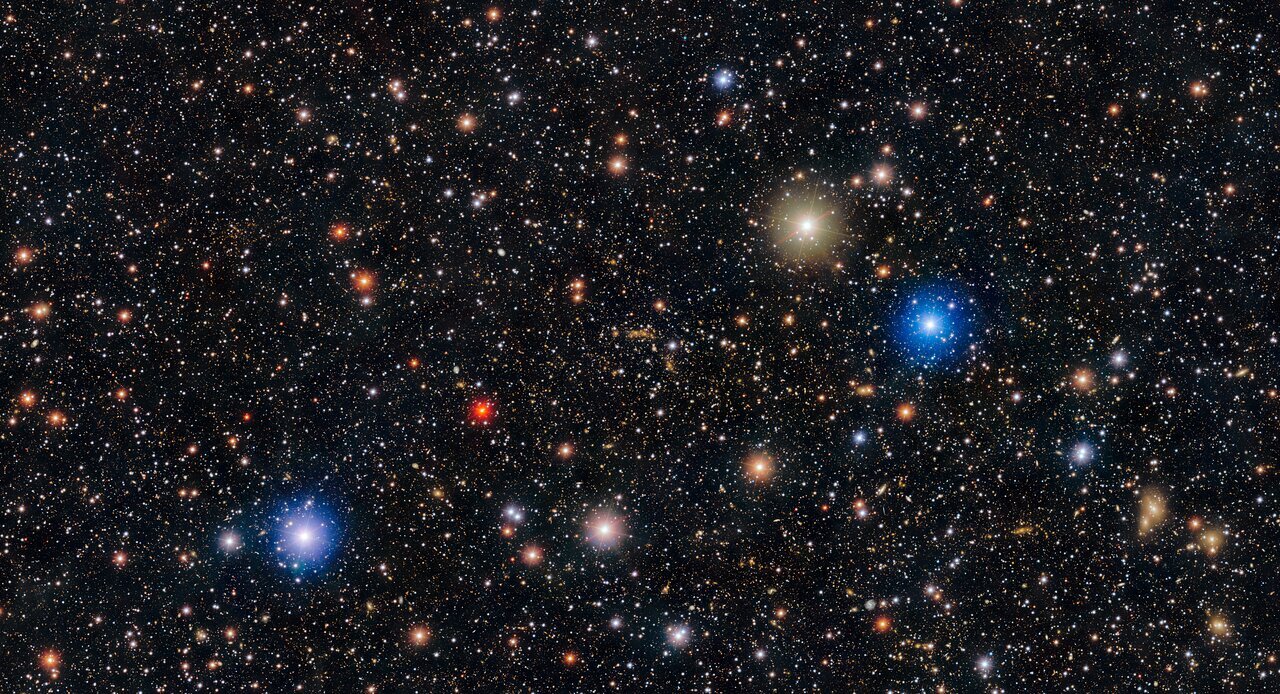
It currently brings together 35 scientific institutions and more than 400 scientists from around the world. Its achievements in data collection are also outstanding. From 2013 to 2019, it collected data on 669 million galaxies scattered throughout the Universe.
Research results
Even before the latest release, DES data was the main limiting factor for possible explanations of dark energy. But now the search field has narrowed by half. There are still many possible theories, but they are more or less close to the standard model currently accepted in cosmology. This is the fundamental result of the research.
However, one parameter still does not correspond to reality. Based on measurements of the early Universe, both the standard model and the evolving dark energy model predict how matter in the Universe accumulates in later times. Preliminary analyses revealed that the galaxy cluster differed from predictions. When DES added the latest data, this discrepancy increased, but not to the extent that the standard cosmological model was incorrect. The difference remained even after DES combined its data with data from other experiments.
Next, DES will combine this work with the latest constraints from other dark energy experiments to explore alternative models of gravity and dark energy. This analysis is also important because it paves the way for Vera Rubin Observatory to collect additional data during the ten-year Legacy Survey of Space and Time (LSST). LSST is a deep and extensive survey that catalogs approximately 20 billion galaxies across the entire southern sky.
According to phys.org

